Design & creation
Design and creation stand at the intersection of problem-solving, technical execution, and visual communication. While many perceive design as purely aesthetic decision-making, the reality encompasses a far broader spectrum: from strategic thinking methodologies that reshape business processes, to the intricate physics of 3D printing, to the ethical considerations of data visualization. Whether you’re prototyping a wearable device, managing a brand’s visual footprint across platforms, or mapping interactive narratives, the principles underlying effective design remain surprisingly consistent.
This comprehensive overview explores the fundamental dimensions of modern design and creation. We’ll examine the methodologies that guide creative problem-solving, the production realities that bridge concept and finished product, the systems that maintain visual coherence, and the technical challenges that define contemporary design practice. Understanding these interconnected domains empowers you to approach creative work with both strategic clarity and practical confidence.
Design Thinking: Beyond Aesthetics Into Strategy
The most transformative shift in contemporary design practice involves recognizing design not as decoration, but as a strategic problem-solving framework. Design thinking methodologies have migrated from traditional creative fields into business process improvement, service design, and organizational change precisely because they offer structured approaches to understanding human needs and iterating toward solutions.
At the core of this approach lies empathy-driven research. User empathy interviews reveal not just what people say they want, but the underlying frustrations, workarounds, and unmet needs that point toward genuine innovation opportunities. A financial services company, for instance, might discover through empathy interviews that customers don’t actually want “better investment options”—they want to feel confident making decisions without financial jargon intimidating them.
The design thinking process typically unfolds through distinct phases:
- Empathize: Conduct research to understand user perspectives and pain points
- Define: Synthesize findings into clear problem statements
- Ideate: Generate diverse potential solutions through collaborative brainstorming
- Prototype: Create tangible representations of ideas for testing
- Test: Gather feedback and refine solutions iteratively
The prototyping phase deserves particular attention. Skipping rapid prototyping introduces substantial risks: teams invest resources in untested assumptions, stakeholder alignment fractures around abstract concepts, and critical usability issues surface only after expensive development. A rough cardboard mock-up or clickable wireframe—created in hours rather than weeks—provides the shared reference point that transforms speculation into productive conversation.
Team collaboration during brainstorming sessions benefits from structured facilitation techniques. The “Yes, and…” principle borrowed from improvisation prevents premature idea rejection, while time-boxing individual silent ideation before group discussion ensures diverse perspectives surface rather than just the loudest voices dominating.
From Concept to Reality: The Production Journey
The path from promising prototype to manufactured product presents challenges that fundamentally reshape initial designs. This transition demands understanding Design for Manufacturability (DFM)—the practice of modifying designs to accommodate production realities without sacrificing core functionality or aesthetic intent.
Prototyping With Limited Resources
Early-stage prototyping requires resourcefulness. Designers often substitute expensive materials with accessible alternatives: foam core replacing injection-molded plastic, conductive fabric tape standing in for woven smart textiles, or 3D-printed housings simulating CNC-machined aluminum. The goal isn’t perfect fidelity but rather testing core assumptions about form, function, and user interaction before committing to tooling investments.
The Economics of Scaling Production
Transitioning to mass production involves substantial upfront investment in molds, dies, and tooling. The break-even point analysis becomes critical: if injection mold tooling costs $15,000 but reduces per-unit costs from $8 to $2, you’ll need to produce 2,500 units just to recover the tooling investment. This calculation determines whether low-volume production methods (CNC machining, vacuum forming, or small-batch 3D printing) make more financial sense than traditional mass manufacturing.
Tolerance errors represent another production pitfall. A design that looks perfect on-screen might specify a 0.5mm gap between components—achievable in CAD but problematic when real-world manufacturing tolerances introduce ±0.3mm variation. Parts that should snap together smoothly either won’t fit or rattle loosely. Experienced designers build in tolerance allowances and specify appropriate manufacturing processes for required precision levels.
Technical Design Challenges
Integrating technology into physical products introduces specialized constraints. Wearable electronics must balance functionality with comfort and durability. Conductive threads for smart fabrics suffer from rigidity compared to conventional textiles, requiring designers to strategically place technological elements within garments while maintaining natural drape and movement. Power source integration presents similar challenges—batteries add weight and bulk precisely where ergonomics demands minimal intrusion.
Consumer electronics face the perpetual tension between thermal management and aesthetic sleekness. Processors generate heat that must dissipate to prevent thermal throttling and premature failure. Passive cooling through heat-sink materials (aluminum, copper, graphite sheets) maintains slim profiles but limits performance headroom. Active cooling with fans enables higher performance but introduces noise, moving parts, and thickness. Internal component placement becomes a three-dimensional puzzle: position the processor near the device exterior for heat dissipation, but not so close that the case becomes uncomfortably warm to touch.
Visual Identity: Consistency Across Chaos
Brand identity functions as a visual language—a system of repeated elements that build recognition and communicate values through consistent application. Yet maintaining this consistency across diverse platforms, formats, and contexts presents ongoing challenges for designers and brand managers alike.
When to Rebrand (and When Not To)
The temptation to refresh a brand identity often stems from internal stakeholder fatigue rather than genuine market need. Effective rebranding decisions begin with stakeholder perception audits: systematically gathering how customers, employees, and partners actually perceive the current brand versus how leadership wishes it to be perceived. If the gap is small, evolutionary refinement preserves brand equity while addressing specific weaknesses. Revolutionary rebranding risks destroying hard-won recognition unless the existing identity actively undermines business objectives.
The “blanding” trend—where distinctive brands adopt similar minimalist sans-serif wordmarks and flat color palettes—illustrates the risk of chasing aesthetic trends over strategic differentiation. Visual consistency matters, but so does visual distinctiveness.
Multi-Platform Visual Consistency
Social media platforms impose different aspect ratios, file format requirements, and viewing contexts that strain rigid brand systems. A logo designed for letterhead might become illegible at social media profile picture dimensions. Color palettes optimized for print (Pantone or CMYK) may shift unpredictably when rendered in RGB for screens.
Flexible template systems offer the solution: establish core unchangeable elements (primary logo, brand colors, typography hierarchy) while permitting platform-specific adaptations. An Instagram grid benefits from visual repetition—recurring color palettes, consistent filters, rhythmic patterns—that create cohesive impression when viewed as a whole. Preview apps let designers plan multi-post layouts before publishing, avoiding the “checkerboard” trap where alternating content types create jarring visual fragmentation.
User-generated content introduces another challenge. When customers post about your brand, their amateur photography and casual framing might inadvertently dilute carefully crafted visual identity. Smart brands embrace this by creating shareable branded assets (templates, filters, hashtag campaigns) that guide user content toward brand-aligned aesthetics without demanding rigid compliance.
Communication Through Visual Design
Design serves not just to beautify but to communicate—to make complex information understandable, to guide attention, to enable decision-making. This responsibility carries ethical weight, particularly in data visualization and narrative design.
Data Visualization Ethics and Accuracy
A misleading chart can be more dangerous than no chart at all. The “lie factor” measures the ratio between the size of an effect in a graphic versus the size of the effect in the data. When a value doubles but the corresponding visual element quadruples in size, the visualization exaggerates reality. Common culprits include truncated Y-axes that make modest changes appear dramatic, inconsistent scaling, and 3D effects that distort proportions.
Choosing the right chart type for your data structure matters enormously:
- Bar charts: Comparing quantities across categories
- Line charts: Showing trends over time
- Scatter plots: Revealing correlations between variables
- Pie charts: Displaying parts of a whole (use sparingly—humans struggle comparing angles)
Accessibility demands designing for color blindness. Approximately 8% of men and 0.5% of women have some form of color vision deficiency. Relying solely on red-green color coding to distinguish critical information excludes these users. Effective designers use additional visual channels—patterns, shapes, labels, or position—to ensure information remains accessible regardless of color perception.
Narrative Design and Interactive Media
Interactive narratives—from video games to branching training simulations—require designers to map non-linear storylines where user choices create diverging paths. The challenge lies in maintaining coherent storytelling while honoring player agency. The “illusion of choice” occurs when apparently significant decisions lead to identical outcomes, frustrating players who discover their choices meant nothing.
Balancing open-world exploration with directed narrative presents another tension. Complete freedom can leave players directionless; excessive restriction feels like rails rather than agency. Successful designs use environmental storytelling, optional side content, and pacing techniques that guide without forcing, allowing narrative reveals to unfold organically as players explore.
Ludonarrative dissonance—when gameplay mechanics contradict story themes—breaks immersion. A game about a character seeking redemption becomes problematic when core mechanics reward indiscriminate violence. Designers avoid this by ensuring mechanical systems reinforce rather than undermine thematic intentions.
Technical Execution: Files, Formats, and Fabrication
Even brilliant creative concepts falter when technical execution stumbles. Professional designers master the unglamorous details of file preparation, format compatibility, and fabrication specifications.
Large-format print production demands meticulous vector file preparation. Converting text to outlines prevents font substitution errors when files move between systems, though this sacrifices editability. Color consistency requires understanding when to use Pantone spot colors (for brand-critical exact matches) versus CMYK process colors (for photographic images and cost-sensitive projects). Complex gradients and transparencies can render unpredictably—always request test prints for critical projects.
Bleed and margin specifications prevent embarrassing mistakes: bleed extends design elements beyond trim lines so slight cutting variations don’t create white borders, while margins ensure critical content (text, logos) stays safely away from trim edges.
In additive manufacturing, 3D print optimization requires understanding layer adhesion physics. Each layer must bond sufficiently to layers above and below to create structural integrity. Support structures enable printing overhangs that would otherwise collapse mid-print, but require careful removal post-printing. Infill density balances strength against material usage and print time—20% infill suffices for decorative objects, while functional parts under stress might need 60% or higher. Surface finishing techniques (sanding, vapor smoothing, filler primer) address the characteristic layer lines of FDM printing.
The intersection of design and creation extends far beyond any single discipline or medium. What unites these diverse practices is a commitment to intentional problem-solving—understanding constraints, respecting users, mastering technical realities, and communicating clearly. Whether you’re conducting empathy interviews, calculating mold break-even points, auditing brand consistency, or optimizing support structures for a 3D print, you’re engaged in the same fundamental work: transforming ideas into tangible, functional, meaningful reality. The specific tools and techniques evolve constantly, but the underlying principles of thoughtful, user-centered, technically informed design endure.

How to Orient 3D Models to Prevent Print Failures and Weak Spots?
In summary: Part strength is anisotropic; orient models so that critical forces travel along the length of printed layers, not across them. Structural integrity comes more from wall thickness (perimeters) than high infill percentages. Add walls before adding infill. Strategic…
Read more
How to Design Data Visualizations That Tell the Truth Without Distorting Facts?
Ethical data visualization is not about avoiding basic mistakes; it is an active process of designing for cognitive honesty and perceptual integrity. Truthful design means scaling visual elements by area, not radius, and always preferring bar charts over pie charts…
Read more
How to Plan an Instagram Grid That Looks Consistent Without Being Repetitive?
The secret to a compelling Instagram grid isn’t rigid repetition; it’s a flexible and strategic visual system that allows for creative freedom. A limited three-color palette (the 60-30-10 rule) creates recognition without monotony. Grouping posts in “content clusters” tells richer…
Read more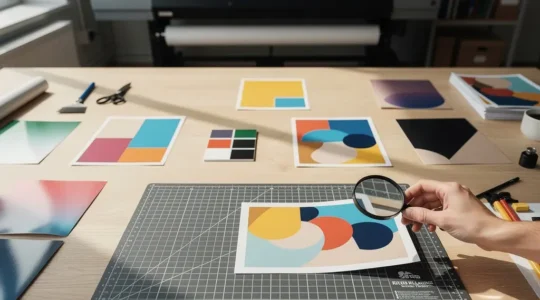
How to Engineer Vector Files for Billboard Printing Without Quality Loss
In summary: Raster images embedded in vector files are the primary cause of pixelation; all elements must be true vectors or correctly scaled, low-DPI rasters. Failing to convert text to outlines is a critical error, risking font substitution at the…
Read more
How to Design Consumer Electronics That Look Premium Without Overheating?
Industrial designers often face a fundamental conflict: a sleek, minimalist aesthetic fights against the physical necessity of heat dissipation. The solution isn’t to compromise on design, but to treat thermal management as an integral part of the design process from…
Read more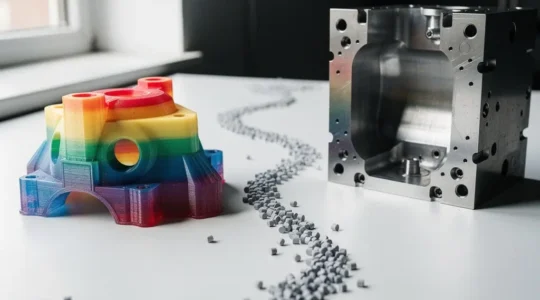
Moving from 3D Print to Injection Molding: When Is the Investment Justified?
The decision to invest in injection molding is governed less by pure volume and more by committing to a series of irreversible engineering and design principles. The financial breakeven point is a function of part complexity and material choice, often…
Read more
How to Integrate Smart Fabrics into Everyday Wear Without Sacrificing Comfort?
The failure of most smart garments isn’t a lack of features, but a failure of holistic engineering; true wearability is achieved by designing against specific stress points like circuit friction, thermal hotspots, and cognitive load. Effective design prioritizes invisible sensor…
Read more
How to Align Visuals Across Social Media Without Sacrificing Brand Identity
Maintaining visual consistency across platforms isn’t about rigid templates; it’s about building a flexible ‘Visual DNA’ that speaks each platform’s native language. True brand recognition is achieved by strategically adapting core brand assets, not by uniformly applying them. A quarterly…
Read more
Why Do 60% of Corporate Rebrands Fail to Connect with Existing Customers?
Most rebrands fail not because of bad design, but because they mistake legal ownership of a brand for the emotional ownership held by customers. Alienating loyal customers stems from changing core brand assets without first measuring their “emotional equity.” A…
Read more
Is Switching from Adobe to Affinity Worth the Learning Curve for Freelancers?
For most freelancers, switching from Adobe to Affinity is a financially sound and operationally feasible move when planned as a strategic business project, not an impulsive software swap. The financial leverage is significant, with potential savings exceeding $3,000 over five…
Read more