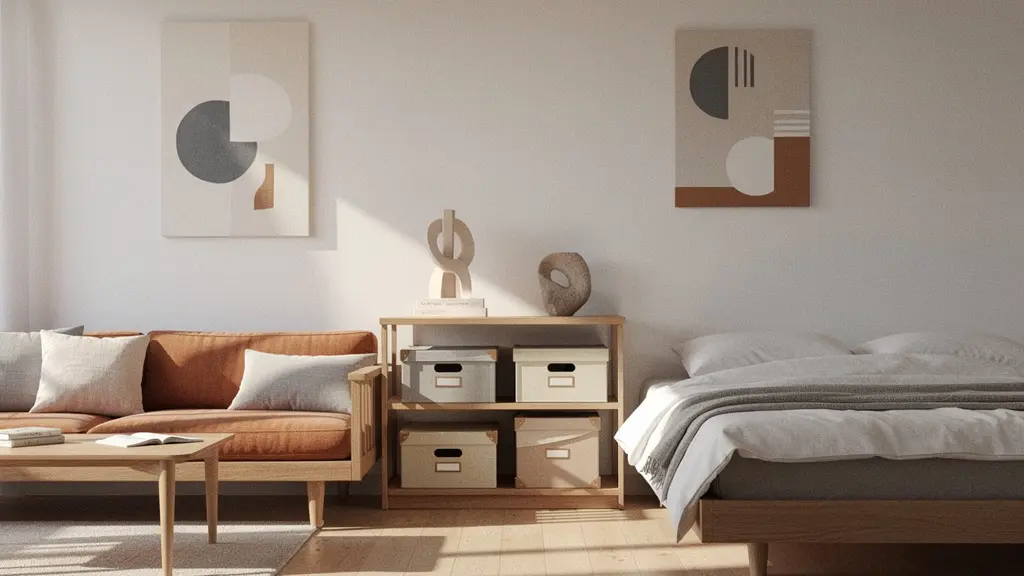
The key to a stress-free small apartment isn’t making it look bigger, but designing it to function as a psychological sanctuary that calms your nervous system.
- Visual clutter directly elevates stress hormones; strategically hiding items is more effective than constant organizing.
- Separating work and sleep zones using sensory cues (light, texture, sound) creates essential mental boundaries, even without walls.
Recommendation: Start by programming your lighting to automatically shift from cool blue to warm yellow at sunset. This single change can fundamentally improve your sleep and reduce evening anxiety.
That feeling of a space closing in, the low-grade hum of anxiety that seems to emanate from the very walls of your 400-square-foot apartment—it’s a sensation many city dwellers know intimately. The conventional wisdom is to fight back with mirrors, light paint, and endless decluttering sessions. We’re told to maximize every inch, to find clever storage solutions, and to buy furniture that folds, stacks, and disappears.
But what if these solutions are only addressing the symptom, not the cause? As an interior psychologist, I see a deeper truth: your home’s layout has a direct and profound impact on your nervous system. The problem isn’t just a lack of physical space; it’s an excess of cognitive and sensory load. The constant visual noise, the blurring of lines between work and rest, and the subtle environmental stressors all contribute to elevated cortisol levels. It’s not about making your apartment *look* bigger; it’s about making it *feel* calmer.
This guide moves beyond surface-level design hacks. We will explore the psychological principles that transform a small, stressful box into a functional sanctuary. By understanding how your brain perceives its environment, you can architect a space that actively works to reduce your daily stress, protect your focus, and promote restorative rest.
This article provides a structured approach to reclaiming your home’s psychological comfort. In the following sections, we will dissect the core stressors found in small apartments and offer scientifically-grounded, practical solutions to neutralize them, creating a space that truly supports your well-being.
Summary: How to Arrange a 400 Sq Ft Apartment to Reduce Daily Stress Levels?
- Why does visual clutter in small spaces spike anxiety levels by 40%?
- How to separate work and sleep zones in a studio without building walls?
- Open shelving or closed cabinets: Which creates a calmer visual environment?
- The lighting error that disrupts your circadian rhythm in windowless corners
- How to program your lights to fade from blue to warm white automatically at sunset?
- Heavy Curtains vs. Cellular Shades: Which window treatment actually blocks traffic noise?
- When to purge household items: The seasonal routine for maintaining a stress-free home
- How to Select Convertible Furniture for Studio Apartments That Actually Lasts 5 Years?
Why does visual clutter in small spaces spike anxiety levels by 40%?
The pile of mail on the counter, the stack of books by the bed, the open shelves displaying a chaotic mix of objects—this isn’t just untidiness. For your brain, it’s a stream of unresolved tasks and sensory data. Every item you see competes for your attention, creating a high cognitive load. This constant, low-level mental effort is exhausting and directly triggers a physiological stress response. It’s not your imagination; research has demonstrated a direct link between a cluttered home environment and elevated levels of the stress hormone cortisol, particularly in women.
This effect is magnified in a 400-square-foot space where you cannot escape the visual field of the clutter. It sends a persistent signal to your brain that your work is never done, preventing you from ever entering a state of true rest. Studies have quantified this impact, showing that living in a cluttered environment can lead to a 40% increase in anxiety symptoms. The visual chaos overstimulates your brain, making it difficult to focus, relax, and even sleep soundly. Your home, meant to be a refuge, becomes a source of chronic stress.
The solution is not about achieving sterile perfection but about reducing the number of “visual questions” your environment asks you. The first step is to immediately lower this cognitive load. Create a single, designated “sorting zone”—a basket or a box—for items that need attention. This act of consolidation contains the chaos, freeing up your mental bandwidth instantly. Then, make a habit of closing all cupboard doors, drawers, and even shower curtains. This simple action replaces complex visual information with clean, simple surfaces, giving your mind a place to rest.
How to separate work and sleep zones in a studio without building walls?
In a studio apartment, the fifteen feet between your desk and your bed can feel like no distance at all. When your laptop is always in your line of sight, your brain struggles to disconnect from “work mode,” leading to poor sleep and persistent anxiety. The key to creating separation isn’t a physical wall, but a psychological one built through sensory zoning. This involves using light, texture, sound, and ritual to signal a clear transition between different activities and mindsets.
Your “work zone” should be defined by bright, cool-toned light (around 4000K-5000K) that promotes focus and alertness. The surfaces here should be hard and functional. In contrast, your “sleep zone” should be an oasis of warm, dim light (below 2700K), soft textures like a plush rug or velvet pillows, and calming scents from a diffuser. The goal is to make the transition between zones a multisensory experience. This tells your brain, on a primal level, that the environment has changed and it’s time for a different mode of being.
To reinforce this, create a “shutdown ritual.” This is a non-negotiable, 10-minute routine that marks the end of the workday. It could involve physically putting your laptop away in a cabinet, changing into comfortable clothes, and switching the lighting from your work scene to your evening scene. This ritual acts as a powerful psychological trigger, closing the cognitive loops of the day and giving your mind permission to rest. The physical act of tidying your workspace and altering the sensory environment is far more effective than simply closing your laptop.
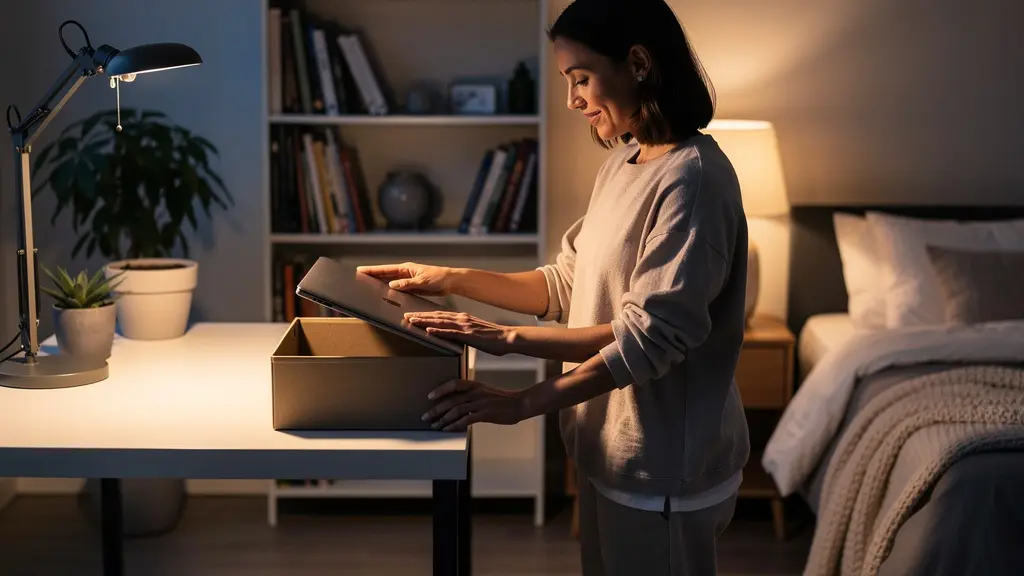
As illustrated, the distinction doesn’t require partitions. The clear shift from the bright, functional task lighting at the desk to the warm, ambient glow in the sleeping area creates two separate “rooms” within a single space. This deliberate use of environmental cues is the most powerful tool you have for reclaiming your personal time in a studio layout.
Open shelving or closed cabinets: Which creates a calmer visual environment?
The trend of open shelving is popular in design magazines, showcasing perfectly curated collections of artisanal pottery and color-coordinated books. In the reality of a 400-square-foot apartment, however, open shelves often become a primary source of visual stress. The reason lies in cognitive load. Every single item on an open shelf is a piece of visual information that your brain must process. A mismatched collection of mugs, a stack of cookbooks, and various pantry items create a chaotic, visually demanding display.
Closed cabinets, by contrast, present a single, unified surface. Behind the door, the contents may be just as varied, but from the outside, your brain processes only one thing: a clean plane. This dramatically reduces the amount of sensory input you have to manage, creating an immediate sense of calm and order. In a small space where you can’t escape the visual field, opting for closed storage is one of the most effective strategies for reducing ambient anxiety.
This doesn’t mean you must live in a featureless box. The solution is a hybrid approach. Use closed cabinets for the majority of your storage—the everyday, less-than-beautiful items. Then, reserve a small, single open shelf or a designated section of a countertop for a few carefully chosen decorative items. This approach, known as “display and conceal,” allows you to express your personality without overwhelming your senses. By being highly intentional about what is visible, you control the narrative of your space, transforming it from a storage unit into a curated gallery.
The lighting error that disrupts your circadian rhythm in windowless corners
That dark corner of your apartment—the one with no windows where your reading chair or desk is tucked away—is often “solved” with a single, harsh lamp. The critical error isn’t just the quality of light, but its color and timing. Many people use standard LED bulbs that emit a cool, blue-toned light throughout the day and into the evening. While this light is fine for daytime focus, exposing yourself to it after sunset is a direct assault on your circadian rhythm.
Blue light signals to your brain that it’s midday, suppressing the production of melatonin, the hormone that tells your body it’s time to sleep. This disruption is not a minor inconvenience; a strong scientific consensus confirms that artificial light at night is a primary driver of circadian disruption, leading to poor sleep quality, daytime fatigue, and increased stress. Using the wrong light in your windowless corner essentially creates a pocket of perpetual daylight in your home, confusing your internal clock.

The solution is to adopt tunable smart lighting that aligns with the natural cycle of the sun. The bulb itself, as seen in the detail above, is engineered to shift its color temperature. During the day, set the light in that corner to a cool, energizing white (around 5000K). As the sun begins to set, program your lighting to automatically transition to a very warm, amber glow (2200K-2700K), mimicking the color of a sunset or firelight. This simple change sends the correct hormonal signals to your brain, preparing it for rest and fundamentally improving your sleep quality.
How to program your lights to fade from blue to warm white automatically at sunset?
Implementing circadian lighting doesn’t require a complex electrical overhaul. Modern smart home technology makes it accessible at several levels of expertise. The goal is to automate the transition from cool, daytime light to warm, evening light, so it happens without you even thinking about it. This automation is what makes the habit stick and the benefits compound.
For most people, a single-brand ecosystem is the easiest entry point. Companies like Philips Hue, Wyze, or Sengled offer starter kits with a hub and a few tunable bulbs. Their native apps almost always include a pre-set scene, often called “Natural Light” or “Circadian Rhythm,” that automatically adjusts the color temperature and brightness of your bulbs throughout the day based on your geographic location and the time of sunset. This is the most straightforward, “set-it-and-forget-it” method.
For those wanting more control, the next step is to create a custom automation. A common and highly effective routine is to program a gradual 30-minute fade. You can set a trigger to start this transition three hours before your typical bedtime. The automation will slowly shift the light from a neutral white (e.g., 4000K) down to a very warm, dim glow (e.g., 2200K). This gradual change is less jarring than an abrupt switch and more closely mimics the natural process of a sunset, easing your body into a state of relaxation. Here is a simple framework for setting it up:
- Level 1 (Beginner): Use a single ecosystem like Philips Hue or Wyze with the native app’s “natural light” scene that auto-adjusts based on your location’s sunset time.
- Level 2 (Intermediate): Program a 30-minute transition starting 3 hours before bedtime. This should shift the light gradually from a daytime temperature (around 4000K-6500K) to a warm evening temperature (2700K or lower) to avoid abrupt changes.
- Level 3 (Advanced): Use a central hub like Home Assistant or SmartThings to integrate multiple brands of bulbs. This allows you to create custom transition curves that perfectly match the natural daylight patterns for your specific latitude and time of year.
By automating this process, you remove the daily decision-making and ensure your environment is always supporting your natural biological rhythms, which is a cornerstone of reducing chronic stress.
Heavy Curtains vs. Cellular Shades: Which window treatment actually blocks traffic noise?
In an urban apartment, unwanted noise from traffic, construction, or nightlife is a major, often overlooked, contributor to chronic stress. Your window is the primary entry point for this auditory assault. While both heavy curtains and cellular shades are marketed for privacy and light control, they address noise pollution in fundamentally different ways. The right choice depends on the type of sound you need to block.
Heavy, noise-reducing curtains are primarily sound-absorbent. Made from dense, tightly woven fabrics like velvet or multi-layered polyester, they act like a giant acoustic panel. Their strength lies in reducing reverberation and echo within your apartment. They are excellent at dampening high-frequency sounds, such as the screech of tires or distant sirens, making the internal environment of your room feel quieter and more muffled. However, they are less effective at blocking the low-frequency rumble of a bus or the thumping bass from a car stereo from passing through the window itself.
Cellular shades, particularly double-cell or “honeycomb” varieties, are primarily sound-blocking. Their unique structure creates pockets of trapped air that act as an insulating barrier. This barrier is effective at disrupting the transmission of sound waves from the outside to the inside. They are significantly better than curtains at reducing the overall decibel level of external noise, especially the low-frequency rumbles that curtains struggle with. For a city dweller whose main complaint is constant, invasive traffic noise, cellular shades are often the more effective solution for creating a truly quiet sanctuary.
Key Takeaways
- Your home’s layout is a psychological tool; use it to reduce cognitive load and sensory-overload, not just to save space.
- Sensory zoning with light and texture is more effective for work/life separation than physical dividers in a studio.
- Maintaining a calm environment is an ongoing process, not a one-time project. A seasonal purging routine is essential.
When to purge household items: The seasonal routine for maintaining a stress-free home
Achieving a calm, uncluttered state in a 400-square-foot apartment is a significant victory. Maintaining it, however, is the real challenge. New items inevitably enter the home, and without a system, clutter quickly reclaims its territory. The most effective strategy is not a single, massive decluttering event, but a sustainable, low-effort seasonal routine. This transforms purging from a dreaded chore into a regular, manageable habit that prevents stress from accumulating.
The principle is simple: four times a year, you conduct a focused, 30-minute review of items related to the outgoing season. This is far less daunting than trying to tackle your entire apartment at once. By aligning the purge with the changing seasons, you create a natural rhythm for assessing what is truly useful and what is merely taking up valuable physical and mental space. As one small-space dweller notes, the impact is significant:
The biggest game changer for me is making it a point to try and purge every few weeks. I have a subscription to ThredUp so they send me a new label every six weeks as a reminder to send in things! Things I haven’t worn in forever, things that don’t fit, or anything that no longer feels like ‘me’ goes in the bag and off to a new home! I’m always shocked how getting rid of a few things can make such a difference in keeping my apartment clean (and stress free!).
– Carly Hill, Apartment Organization Tips
This routine prevents the build-up that leads to overwhelming decluttering projects. It keeps the “functional footprint” of your belongings in check, ensuring that your home remains a supportive and stress-free environment year-round.
Action Plan: Your Seasonal Purging Schedule
- Spring (March-May): Focus on winter clothing, heavy blankets, and heating-related items. Store or donate what won’t be needed for the next 6+ months.
- Summer (June-August): Assess outdoor gear, spring jackets, and evaluate any items you placed in a “holding zone” from your winter purge. If you haven’t used them, it’s time to let them go.
- Fall (September-November): Review summer-specific items like beach towels, fans, and lightweight clothing. Apply the functional footprint test: does its value justify the space it occupies?
- Winter (December-February): Conduct a deep review of consumable categories like beauty products and kitchen gadgets. Consolidate duplicates and prepare a new holding zone for your spring evaluation.
How to Select Convertible Furniture for Studio Apartments That Actually Lasts 5 Years?
In a small apartment, convertible furniture like a sofa bed or a Murphy desk seems like the perfect solution. However, many of these pieces fail within a year or two, becoming a source of frustration rather than functionality. The psychological cost of unreliable furniture—the sofa that won’t fold back, the table that wobbles—adds to your daily stress. Selecting pieces that last requires you to investigate beyond the aesthetics and focus on the one thing that matters most: the mechanism.
As one furniture durability expert wisely points out, the core of the product is its moving parts. The fabric can be beautiful and the design clever, but if the hinge, piston, or folding track is low-quality, the piece is destined for failure.
The weak point of convertible furniture is the moving parts. Research the specific mechanism brand/type and check reviews for that mechanism, not just the furniture piece itself.
– Furniture durability expert, Home Reserve furniture study
When shopping, ask about the mechanism’s origin and warranty. Independent tests consistently show that components matter; for instance, European-made gas-piston mechanisms in wall beds often outlast standard spring-loaded or click-clac systems by several years under daily use. Look for brands known for their engineering, such as Hafele for hardware or Leggett & Platt for sleeper sofa mechanisms. Investing in a superior mechanism is the single best way to ensure your furniture provides stress-free functionality for years to come.
Beyond the mechanism, look for materials that signal durability. This includes solid wood or high-grade plywood frames instead of particleboard, and high-density foam cushions that won’t sag after six months. By shifting your focus from the furniture’s “features” to its “foundation,” you are making a long-term investment in your home’s stability and your own peace of mind.
To truly transform your apartment into a sanctuary, the next step is to apply these psychological principles consistently, building a cohesive system where your space actively supports your well-being every single day.