In Summary:
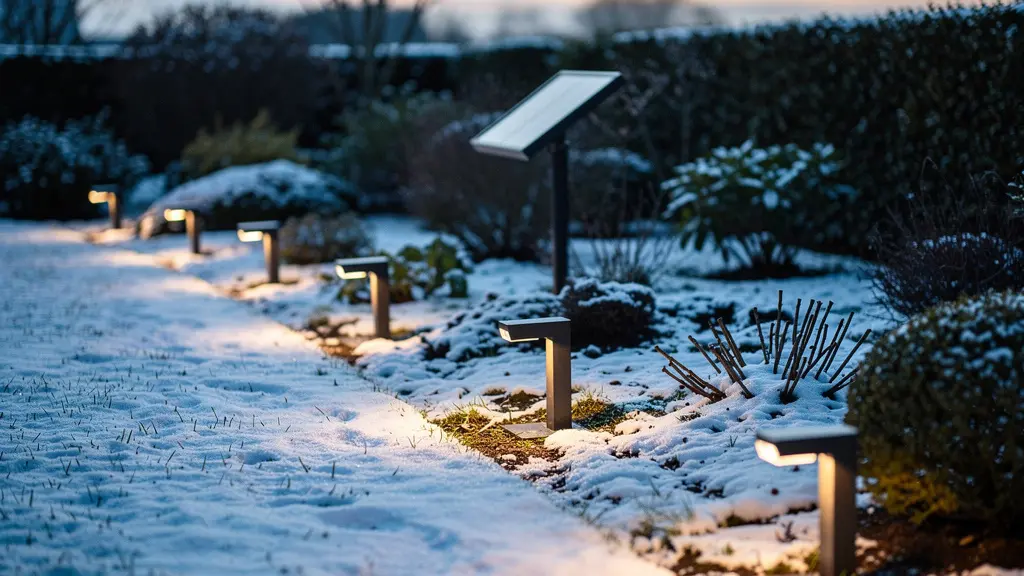
It’s 4:30 PM in Manchester, and your garden path lights have already faded to a dim amber glow. By 6:00 PM, they’re dark, leaving you stumbling over frozen stepping stones. You’ve tried buying units with larger solar panels and higher milliamp-hour ratings, yet the result remains the same: a garden that disappears into blackness just when you need visibility most. The common wisdom suggests simply buying “better” lights or adding more panels, but this ignores the fundamental physics governing portable photovoltaic systems in northern climates.
The reality is that winter solar lighting is an electrochemical engineering problem disguised as a gardening accessory. Success requires understanding voltage sag in cold electrolytes, the difference between discharge tolerance and charge safety in freezing temperatures, and the pressure differentials that crack seals during thermal cycling. This guide examines the technical specifications that actually matter when mercury drops below 5°C, from battery chemistry selection to ingress protection ratings, providing a framework for choosing fixtures that function reliably through the darkest months.
For those who prefer visual learning, the following video provides a practical demonstration of winter solar light testing and failure analysis, complementing the technical details in this guide.
The following sections break down the critical failure points of solar garden lights in cold climates. You’ll learn why battery internal resistance spikes in freezing weather, how to geometrically optimize panel angles for low winter sun, which chemistries survive sub-zero cycles, why seal integrity fails faster than electronics, and the maintenance protocols that prevent performance degradation from environmental soiling.
Table of Contents: Selecting Winter-Resilient Solar Illumination
- Why do solar lights dim by 50% when the battery gets cold?
- How to angle your solar panel to catch the low winter sun behind a fence?
- NiMH vs. Lithium-Ion: Which battery chemistry survives freezing temperatures better?
- The seal failure that corrodes cheap solar lights within one rainy season
- When to clean the panels: The maintenance schedule to remove pollen and snow
- Why does trapping heat in a plastic enclosure degrade component life by 50%?
- The security flaw in cheap smart bulbs that gives hackers access to your Wi-Fi
- How to Set Up Smart Lighting Scenes That Improve Sleep and Save Energy?
Why Do Solar Garden Lights Dim by 50% When the Battery Gets Cold?
The sudden dimming of solar lights in winter stems from electrochemical kinetics, not panel failure. As temperatures drop below 10°C, the internal resistance of rechargeable cells increases exponentially, creating a phenomenon known as voltage sag under load. This is analogous to trying to drink a frozen milkshake through a narrow straw: the energy exists, but the pathway for delivery has constricted.
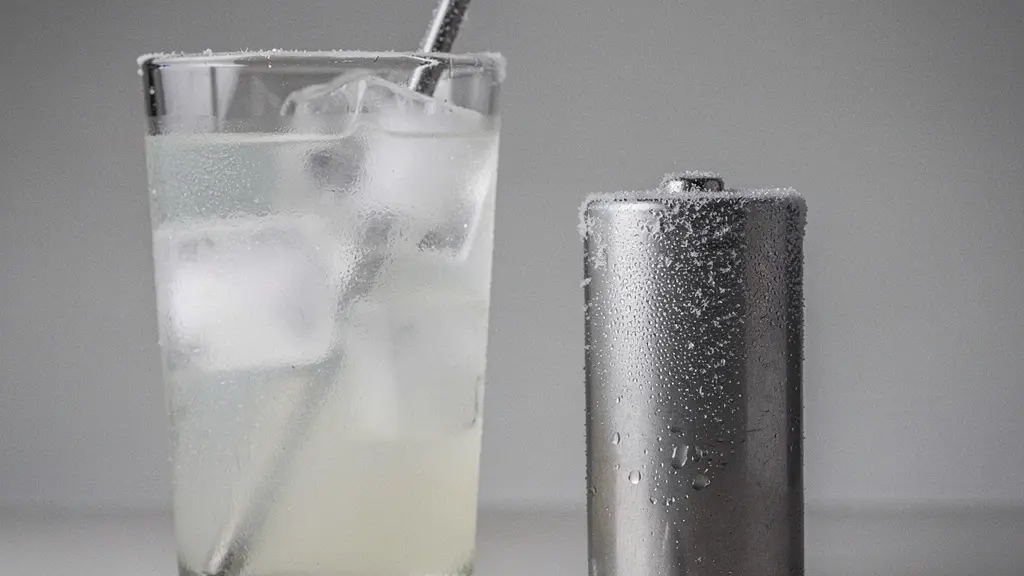
Experimental measurements confirm that cold can sharply increase internal resistance, with laboratory testing showing increases of 35–50% when cells cool from 25°C to −10°C. This resistance spike means that while the battery may indicate a full charge at rest, the moment the LED driver draws current, the voltage drops below the threshold needed to maintain full brightness. The light doesn’t die; it starves.
Cold-Weather Power Management Checklist
- Audit your battery housing placement to minimize exposure to wind chill and thermal cycling.
- Implement power triage: reserve full brightness for safety-critical zones (steps, entries) and accept dimming on decorative accents.
- Enable temperature compensation features if your charge controller supports adaptive voltage adjustment.
- Switch to motion-activated modes during deep winter to reduce continuous load and prevent voltage collapse.
- Verify that absorption charging cycles extend longer in cold weather rather than assuming summer timing.
How to Angle Your Solar Panel to Catch the Low Winter Sun Behind a Fence?
Winter sun paths present unique geometric challenges for fixed solar installations. In northern latitudes during December and January, the sun transits at angles 20–30° lower than summer peaks, creating extended shadow corridors from vertical obstacles like fences and hedges. Standard year-round mounting angles often result in panels receiving oblique irradiance for most of the shortened daylight hours.
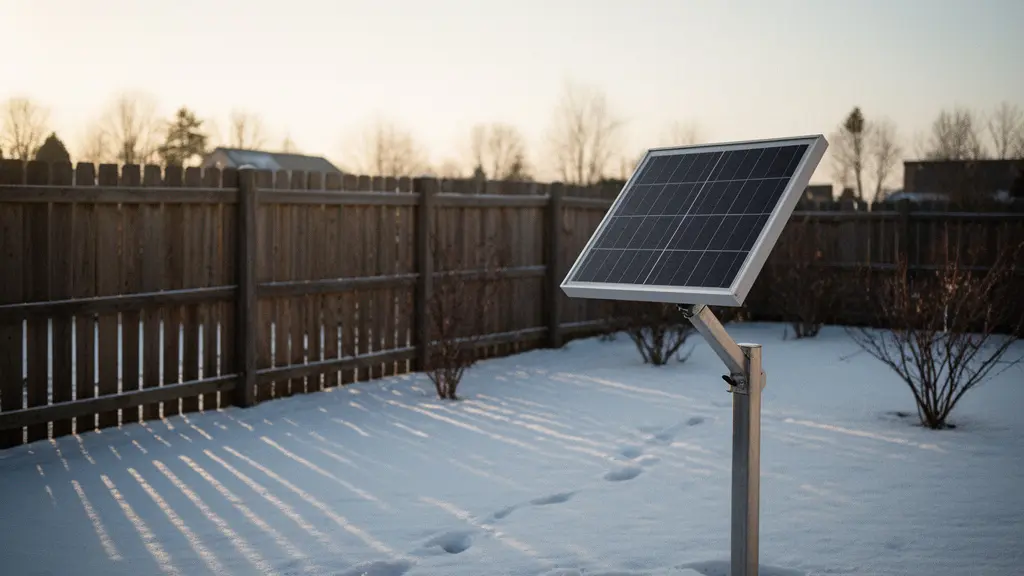
Optimization requires calculating a winter-specific tilt rather than using compromise angles. The formula Winter tilt ≈ (Latitude × 0.9) + 29° provides a baseline for capturing direct-beam radiation during solstice periods. For installations behind fences, raising the panel height or using remotely mounted panels on sunnier surfaces becomes necessary to clear shadow lines that winter sun cannot penetrate.
Snow cover introduces a dual-factor variable. A peer-reviewed field study quantifies how snow reflection can significantly boost yield, reporting a 55.3% improvement attributed to snow albedo in optimal configurations, though partial shading from snow accumulation caused a 17.0% reduction in the same study. The net 38.3% improvement potential means that properly angled, snow-clear panels can actually outperform summer expectations during high-reflectivity periods.
NiMH vs. Lithium-Ion: Which Battery Chemistry Survives Freezing Temperatures Better?
Selecting between Nickel-Metal Hydride (NiMH) and Lithium-Ion chemistries for cold climates requires distinguishing between discharge tolerance and charge safety. NiMH cells maintain functional discharge capacity well below freezing, making them forgiving of winter nights. However, they suffer from high self-discharge rates and memory effects that reduce long-term reliability. Lithium Iron Phosphate (LiFePO4) offers superior longevity— a recent comparison highlights why LiFePO4 is often chosen when longevity matters, showing typical cycle life ranges of 3,000–6,000 cycles versus 800–1,200 for standard NMC lithium chemistries.
The critical constraint with any lithium chemistry is the 0°C charge floor. Charging lithium cells below freezing causes metallic lithium plating on the anode, creating permanent capacity loss and potential short-circuit risks. Systems deployed in Canada or Scotland must include a Battery Management System (BMS) that enforces low-temperature charging protection, or the batteries must be thermally isolated from ambient air during charging periods.
Consumer NiMH performance varies significantly by manufacturing standard. A 2025 open-access study from the European Commission’s Joint Research Centre evaluates common consumer NiMH battery sizes using standardized IEC 61951-2:2017 methods, measuring capacity, charge retention, and cycle endurance—useful as a reality check when choosing replaceable-cell solar lights that rely on AA/AAA NiMH packs.
The Seal Failure That Corrodes Cheap Solar Lights Within One Rainy Season
Ingress Protection (IP) ratings represent the primary defense against the primary killer of outdoor electronics: moisture combined with ionic contamination. Cheap solar lights often advertise “waterproof” capabilities without specifying IP codes, or they rely on foam gaskets that compress permanently after the first thermal cycle. When warm daytime air inside the enclosure cools rapidly at night, it creates negative pressure that draws humid air past failing seals, condensing on cold metal contacts.
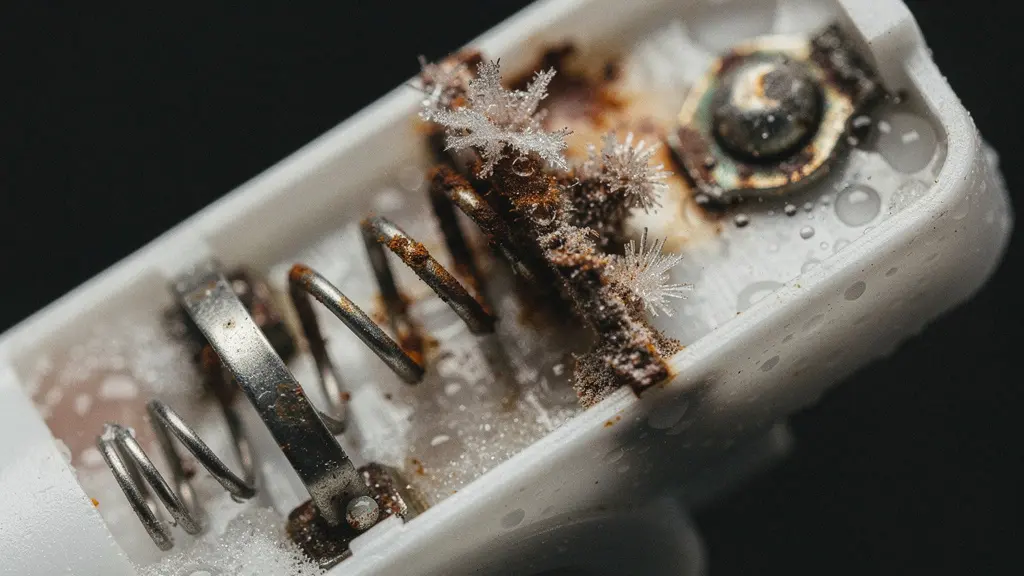
A documented case history describes how rapid temperature changes in sealed outdoor enclosures create pressure differentials that stress seals and produce leak paths. The analysis of 175,000+ vented IP67 smart-antenna units deployed in harsh road-weather conditions demonstrated that engineered breathable membranes prevent these differentials while maintaining dust and water protection.
Environmental Protection Selection Guide
- Specify IP65 or IP66 as minimum baselines for exposed outdoor locations subject to rain and dust.
- Require IP67 or IP68 ratings for ground-level installations where puddling or temporary immersion occurs.
- Verify that IP ratings apply to the specific product SKU, not just the manufacturer’s general product line.
- Inspect gasket materials: silicone maintains elasticity better than rubber in UV and freeze-thaw cycles.
- Demand venting mechanisms that equalize pressure while blocking liquid water entry.
When to Clean the Panels: The Maintenance Schedule to Remove Pollen and Snow
Photovoltaic output degrades linearly with surface soiling, but the composition of that soiling determines cleaning urgency. While rain removes loose particulates, it often bonds pollen and organic residues to glass surfaces through surface tension. A DOE/NREL field analysis shows pollen soiling can drive double-digit losses, reporting PV performance decreases of up to 15% during peak pollen season at studied sites, with rainfall failing to fully restore pre-soiling performance without planned intervention.
Snow management requires different tactics depending on consistency. Heavy, wet snow adheres to flat panels and must be cleared immediately to prevent ice formation that blocks light for days. Light, dry snow often slides off panels tilted above 40°, but may accumulate in the frame recesses of poorly designed fixtures, creating local shading that disproportionately impacts output due to the ” Christmas tree light” effect in unbypassed cells.
Cleaning protocols must avoid thermal shock. Applying cold water to hot panels or abrasive tools to frosted surfaces creates micro-cracks in the tempered glass. The optimal maintenance window occurs during cool morning hours, using soft brushes and deionized water when possible to prevent mineral spotting that creates permanent shading.
Why Does Trapping Heat in a Plastic Enclosure Degrade Component Life by 50%?
Solar light housings function as miniature greenhouses. Clear polycarbonate lenses trap infrared radiation re-emitted by black solar cells and dark battery casings, creating internal temperatures 15–20°C above ambient during summer days. This heat accumulation catastrophically impacts electrolytic capacitors in the LED driver circuits.
A practical LED reliability guide explains the temperature-lifetime relationship behind many premature outdoor-light failures, summarizing the common reliability heuristic: for every 10°C increase in operating temperature, electrolytic capacitor lifespan is roughly halved. A driver designed for 50,000 hours at 25°C may fail within 12,000 hours at 55°C—a realistic internal temperature for sealed black housings in direct July sun.
Mitigation requires passive thermal management. Breathing membrane vents allow hot air to escape while preventing liquid ingress. Reflective white or metallic internal coatings reduce radiative heat absorption. Separating the battery compartment from the panel housing using thermal breaks prevents heat soak from transferring to sensitive chemistry during charging cycles.
The Security Flaw in Cheap Smart Bulbs That Gives Hackers Access to Your Wi-Fi
The convergence of solar power and IoT connectivity introduces attack vectors unrelated to electrochemical performance. Many “smart” solar garden lights utilize the same inexpensive Wi-Fi modules found in consumer smart bulbs, inheriting their vulnerabilities. As Ionut Arghire noted in SecurityWeek regarding TP-Link smart bulb vulnerabilities:
The most severe of the identified issues is described as a “lack of authentication of the smart bulb with the Tapo app”.
– Ionut Arghire, SecurityWeek
This authentication gap allows network credential harvesting. When solar lights with Wi-Fi bridges connect to home networks to enable app-based dimming or scheduling, they create persistent entry points. NIST’s National Vulnerability Database tracks these issues formally; CVE-2023-38909 documents how smart-bulb weaknesses can be systematically exploited. In solar applications, these devices often remain unpatched for years due to “set and forget” installation mentality, providing long-term beachheads for lateral network movement.
Mitigation involves network segmentation. Isolating solar IoT devices on guest networks prevents compromise from reaching primary systems. Alternatively, selecting lights using RF protocols like Z-Wave or proprietary 433MHz remotes eliminates IP-based attack surfaces entirely, trading smartphone convenience for security hardening.
Key Takeaways
- Cold temperatures increase battery internal resistance by 35–50%, causing voltage sag that dims LEDs regardless of charge state.
- LiFePO4 batteries offer 3,000–6,000 cycles but require BMS protection against sub-zero charging; NiMH tolerates cold discharge but self-discharges faster.
- IP67 ratings and breathable pressure vents prevent moisture ingress that destroys electronics through thermal cycling.
- Winter tilt angles calculated at (Latitude × 0.9) + 29° maximize capture of low-angle irradiance and promote snow shedding.
How to Set Up Smart Lighting Scenes That Improve Sleep and Save Energy?
Extending solar lighting functionality into circadian rhythm management requires understanding melatonin suppression spectra and occupancy patterns. Blue-enriched white light (color temperatures above 5000K) suppresses melatonin production, disrupting sleep cycles if used for evening pathway illumination. Configuring solar lights with warm-white LEDs (2700–3000K) or amber options minimizes biological disruption while maintaining scotopic visibility for safety.
Energy conservation in solar contexts directly translates to battery preservation. A research-backed outdoor-controls program reports consistent 50–60% savings from occupancy-based adaptive lighting. Implementing motion-activated scenes rather than continuous dusk-to-dawn operation extends winter runtime by concentrating energy delivery into brief, high-intensity bursts when needed rather than sustained low-output drainage.
Smart scene programming should incorporate astronomical clocks that adjust for seasonal photoperiod changes. In Edinburgh or Vancouver, December civil twilight ends by 4:00 PM, while June twilight persists past 10:00 PM. Fixed-timer solar lights waste energy in summer and die prematurely in winter. Adaptive algorithms that modulate brightness based on battery state-of-charge and historical irradiance data provide the only reliable year-round performance in variable northern climates.
Evaluate your current garden lighting against the technical specifications outlined above: verify battery chemistry ratings, confirm IP67 or equivalent ingress protection, and calculate optimal winter tilt angles for your latitude. Replace fixtures that fail these criteria before the first freeze to ensure reliable illumination through the darkest months.