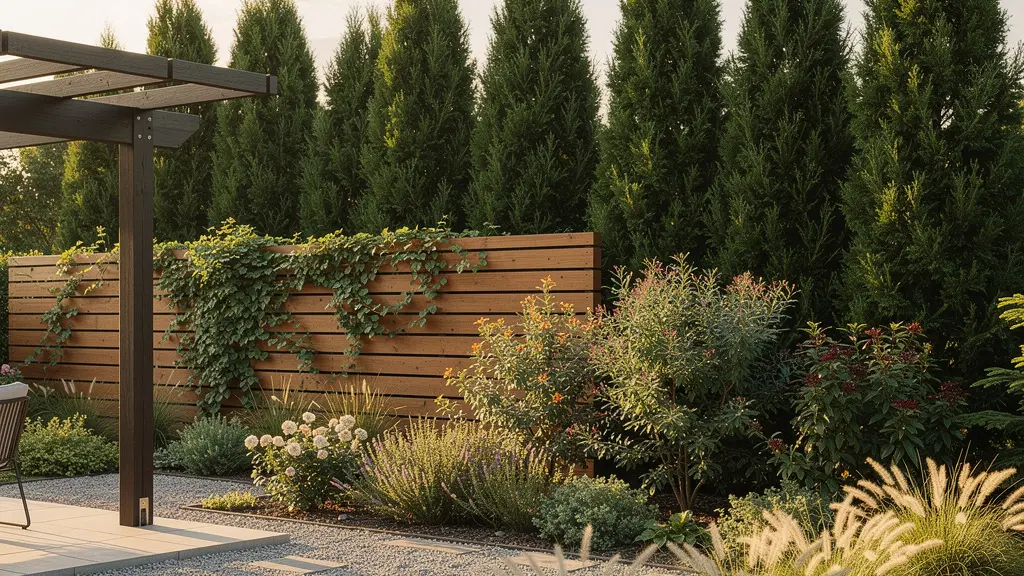
True backyard privacy requires spatial strategy beyond simple fencing, integrating zoning law navigation, resilient multi-layered planting, and dual-purpose drainage solutions.
- Monoculture hedges like Leyland Cypress fail within 15 years, while mixed-species screens and bamboo offer century-long resilience
- Legal height restrictions can be circumvented through berm construction, living screens, and architectural trellises
- Drainage problems and privacy needs can be solved simultaneously through excavated sunken sanctuaries and elevated berms
Recommendation: Audit your property’s sightlines and drainage patterns before selecting any screening material to ensure a cohesive, long-term privacy strategy.
The suburban backyard promise of private outdoor living often collides with the reality of adjacent second-story windows, sightline intrusions from driveways, and the exposed vulnerability of open-plan subdivisions. Many homeowners respond with obvious, surface-level interventions: a quick row of Leyland Cypress planted along the property line, a standard six-foot wooden fence installed without permit verification, or a casual scattering of tall ornamental grasses that rustle in autumn but leave winter yards starkly exposed. Yet these intuitive solutions frequently fail within a decade, succumbing to fungal disease, municipal zoning enforcement, or the simple biological reality of deciduous dormancy.
True privacy requires spatial intelligence—a strategic, architectural approach that treats screening not as a simple two-dimensional barrier to erect, but as a complex three-dimensional design problem integrating drainage engineering, municipal code navigation, and resilient plant ecology. Rather than asking merely which species grows fastest, we must examine which survives longest without chemical intervention, what complies with restrictive height ordinances while maximizing vertical screening potential, and how strategic earthwork modifications can simultaneously resolve backyard flooding while creating naturally sunken sanctuaries invisible to neighbors.
This guide approaches privacy landscaping through the lens of durable systems design and spatial experience. We will compare century-class bamboo against short-lived cypress monocultures, decode the zoning loopholes that legally achieve eight-foot privacy within six-foot fence limits, and explore how driveway material selection fundamentally dictates your entryway’s privacy aesthetic. By integrating water management with vertical screening and understanding how architectural elements redirect psychological perception rather than merely blocking physical views, you will develop a cohesive, long-term strategy that transforms exposed suburban lots into genuinely private, ecologically resilient sanctuaries.
To navigate these interconnected considerations systematically, we will examine specific solutions ranging from species selection and legal workarounds to drainage integration and architectural screening. The following sections address the most critical decisions facing homeowners seeking to reclaim their outdoor spaces from observation.
Table of Contents: Strategic Privacy Solutions for Suburban Landscapes
- Bamboo vs. Leyland Cypress: Which Privacy Screen Won’t Take Over Your Entire Yard?
- The Zoning Law That Forces You to Cut Down Your New Fence to 6 Feet
- How to Layer Shrubs and Trees to Block the View From a Second-Story Window?
- Pergola or Trellis: Which Structure Distracts the Eye Effectively From the Neighbor’s Wall?
- What to Plant for Privacy When the Leaves Fall: The Evergreen Backbone Strategy
- Gravel vs. Permeable Pavers: Which Driveway Option Handles Heavy Rain Best?
- Meadow or Formal Border: Which Native Style Fits a Suburban HOA Neighborhood?
- How to Design a Landscape That Solves Backyard Flooding Issues?
Bamboo vs. Leyland Cypress: Which Privacy Screen Won’t Take Over Your Entire Yard?
When selecting a primary privacy screen, the default choice for many homeowners remains the Leyland Cypress, favored for its rapid vertical ascent. However, spatial strategists recognize that growth rate represents only one variable in a complex equation of longevity, maintenance, and resilience. The Leyland’s dense, dark green wall creates immediate enclosure, yet this monoculture approach conceals structural vulnerabilities that manifest within decades.
Comparative analysis reveals critical distinctions in lifecycle performance between clumping bamboo installations and traditional cypress hedges. While both species achieve similar annual growth rates of three to five feet, their long-term trajectories diverge dramatically. The cypress operates on a finite timeline, susceptible to canker diseases, blight, and catastrophic uprooting during storm events, with a functional lifespan rarely exceeding fifteen to twenty-five years. When individual specimens fail, they create irreparable gaps requiring expensive root ball extraction that often damages adjacent trees.
Bamboo, conversely, operates on a centurial scale. Its rhizomatous root system enables rapid self-repair; above-ground damage triggers regenerative shooting the following spring, maintaining continuous screening without soil disturbance. This biological resilience translates to lower replacement costs and uninterrupted privacy. The sensory character differs significantly: bamboo produces a distinctive rustling sound and filtered light quality, creating an atmospheric enclosure rather than a solid visual barrier.
| Feature | Running Bamboo (with root barrier) | Clumping Bamboo (in planters) | Leyland Cypress |
|---|---|---|---|
| Growth Rate | 3–5 ft/year; fastest land plant | 1–3 ft/year; controlled spread | 3–5 ft/year |
| Mature Height | 20–40 ft | 10–20 ft | 40–60 ft |
| Mature Width | Contained by barrier | 3–5 ft per planter | 12–15 ft |
| Lifespan | 100+ years | 100+ years | 15–25 years |
| Disease Risk | Very low | Very low | High (canker, blight) |
| Root Barrier Needed | Yes (HDPE, $5–$10/ft) | No (planter-contained) | No |
| Wind / Storm Resilience | High — bends, rarely breaks | High | Low — prone to uprooting |
| Replacement Cost if Lost | Low — regrows from rhizomes | Moderate — replace planter | High — large root ball removal |
| Sensory Character | Rustling sound, filtered light | Rustling sound, architectural | Dense, silent, dark green wall |
| Maintenance | Annual thinning, barrier check | Watering, occasional division | Annual shearing, disease monitoring |
Case studies from specialized nurseries demonstrate the practical consequences of these differences. Operations with over two decades of field observation report consistent patterns of Leyland Cypress screens with bamboo installations following disease outbreaks or storm damage. The excavation required to remove failed cypress root systems often compromises remaining specimens, whereas bamboo’s modular growth allows seamless regeneration without disrupting the surrounding matrix.
Ultimately, the selection between these species depends on your temporal horizon. For permanent privacy architecture, bamboo offers century-class durability; for short-term solutions with accepted replacement cycles, cypress remains viable, though costly in the long view.
The Zoning Law That Forces You to Cut Down Your New Fence to 6 Feet
Municipal codes uniformly impose strict vertical limits on boundary structures, with 6 feet (backyard) / 4 feet (front yard) representing standard residential fence height limits in most US jurisdictions. These regulations, designed to preserve sightlines for safety and neighborhood aesthetics, create significant challenges for homeowners seeking to screen second-story views. Understanding the precise measurement methodology—whether from original grade or finished landscape—becomes crucial before breaking ground.
Rather than accepting these constraints as absolute limitations, strategic designers employ three primary techniques to achieve effective eight-foot screening without code violations. The berm-and-fence method involves constructing an eighteen to twenty-four inch landscaped earthen mound along the property line, then installing a code-compliant six-foot fence atop the elevation. This combination legally achieves seven-and-a-half to eight feet of total screen height, though some jurisdictions measure from the berm’s crest rather than original grade, requiring careful pre-construction verification.
Alternatively, living screens circumvent fence height restrictions entirely by utilizing columnar trees such as Sky Pencil Holly, Italian Cypress, or Spartan Juniper planted directly in front of existing six-foot barriers. Because municipalities generally regulate manufactured fence height rather than vegetation, these specimens can contribute an additional five to fifteen feet of screening above the fence line without regulatory interference. For intermediate solutions, open-lattice trellises attached to fence tops provide twelve to twenty-four inches of extension; structures maintaining less than fifty percent opacity often qualify for exemption from height limits, particularly when clothed with flowering vines like clematis or jasmine.
Always consult municipal planning departments regarding specific grade measurement protocols and HOA covenants before implementing these strategies, as enforcement variations exist between jurisdictions.
How to Layer Shrubs and Trees to Block the View From a Second-Story Window?
Second-story sightlines penetrate standard privacy screens with ease, requiring sophisticated vertical canopy layering that addresses multiple elevation planes simultaneously. Effective spatial defense operates through three distinct tiers: high canopy, mid-level mass, and low ground fill. This stratified approach not only blocks elevated views but creates ecological resilience through biodiversity, preventing the catastrophic failure patterns associated with monoculture plantings.
The uppermost layer (twenty-five to forty feet) consists of tall deciduous or evergreen specimens—Honey Locust for filtered light, Green Giant Arborvitae for dense coverage, or Eastern White Pine for rapid soft-needled growth—positioned precisely within the sightline triangle formed between your primary use area and the neighbor’s window. Rather than aligning these along the entire property line, strategic placement within this specific angular zone maximizes screening efficiency while minimizing plant material and maintenance costs.
The mid-level layer (ten to twenty feet) provides year-round screening at standing height using columnar evergreens such as Spartan Juniper, Skip Laurel, or Cryptomeria. These should be staggered in a zig-zag pattern rather than a rigid row, promoting faster fill-in and improved air circulation that reduces disease pressure. The base layer (three to eight feet) closes the gap between ground and mid-canopy using dense shrubs like boxwood or inkberry holly, or ornamental grasses including Miscanthus and Panicum, creating seamless visual continuity.
Research from the University of Maryland Extension demonstrates that mixed-species privacy screens dramatically outperform monoculture rows in long-term resilience. Single-species installations face heightened vulnerability to species-specific pathogens and climate stress, resulting in synchronous failure that creates catastrophic privacy gaps. Diverse plantings ensure that even if individual specimens decline, the overall screen maintains its integrity through varying growth habits and seasonal patterns.
Remember that effective screening targets specific sightlines rather than perimeter boundaries, concentrating resources where they provide maximum privacy impact.
Pergola or Trellis: Which Structure Distracts the Eye Effectively From the Neighbor’s Wall?
Psychological privacy often proves more achievable than physical occlusion. Rather than attempting to erase neighboring structures from view—a frequently impossible task given zoning height restrictions—sophisticated landscape architecture employs spatial distraction techniques that redirect attention toward compelling internal focal points. The strategic deployment of overhead structures creates psychological enclosure through ceiling effects, fundamentally altering how occupants perceive spatial boundaries.
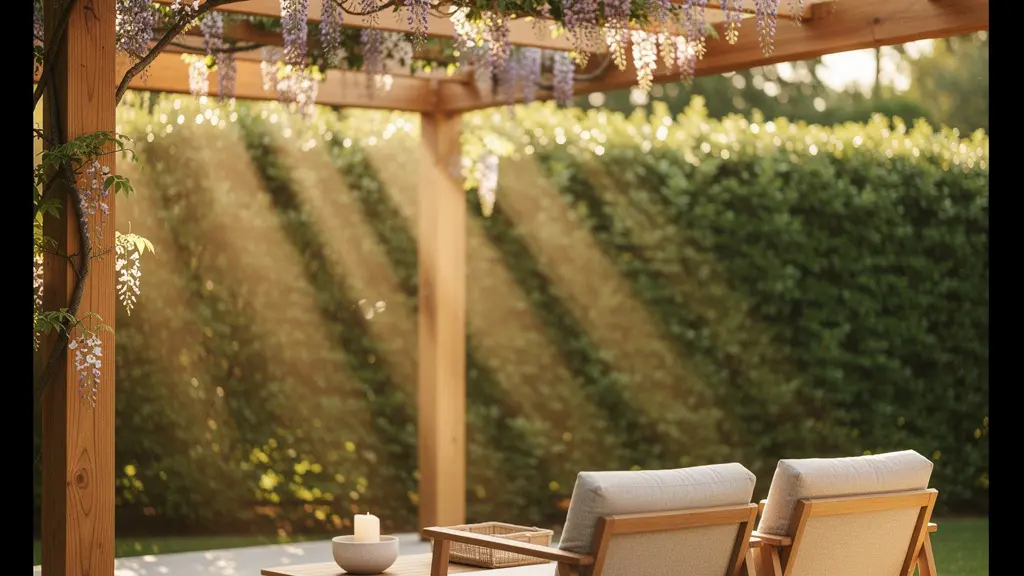
A pergola functions as an outdoor room ceiling, providing enclosure even without solid walls. When draped with climbing vines such as clematis, ivy, or wisteria, the overhead canopy creates dappled shade and partial screening from upper-story observation while establishing a strong architectural presence. The critical design principle involves positioning the pergola to frame a significant internal focal point—perhaps a water feature, fire pit, or sculptural planting—that captures visual attention and renders the neighboring wall psychologically irrelevant.
Freestanding trellises serve different tactical purposes, functioning as view-interruption devices for specific sightlines without full spatial enclosure. Positioned to intercept problematic angles, these screens require integration through base planting to avoid appearing as afterthoughts. For dynamic control, louvered or retractable canopy pergolas offer adjustable privacy, allowing real-time modulation of sun, airflow, and visual exposure according to seasonal needs and immediate circumstances.
Case studies from residential projects demonstrate this principle effectively. In one Massachusetts installation, a pergola combined with climbing plants created a natural curtain that enhanced privacy through focal point generation rather than barrier construction. The surrounding outdoor fireplace and layered greenery established such compelling visual interest that occupants naturally focused inward, effectively eliminating awareness of adjacent structures.
The goal is not to hide the neighbor’s wall, but to make your space so visually engaging that the wall becomes architecturally insignificant.
What to Plant for Privacy When the Leaves Fall: The Evergreen Backbone Strategy
Deciduous screening provides summer privacy but creates winter exposure precisely when thermal and psychological enclosure matter most. A sophisticated privacy strategy requires an evergreen backbone that maintains structural mass and visual barrier function throughout dormancy. However, effective winter screening extends beyond basic green hedges to incorporate multiple sensory dimensions including bark texture, persistent berries, and architectural silhouettes.
The foundation relies on evergreen conifers selected for color variation and texture rather than uniform dark green. Blue-foliage options such as Wichita Blue Juniper or Blue Atlas Cedar provide cooling visual tones, while gold-toned specimens like Golden Mop Cypress introduce warmth against grey winter skies. Silver-green Weeping Alaskan Cedar contributes dramatic vertical texture, creating movement even in still air. These structural evergreens maintain the primary privacy envelope when deciduous companions stand bare.
Secondary layers introduce winter interest through colored bark and persistent fruit. Red Twig Dogwood provides vivid crimson stems against snow, while River Birch offers peeling cinnamon bark and Paperbark Maple contributes warm copper exfoliation. Winterberry Holly maintains bright red berries on bare branches through mid-winter, supporting wildlife while providing color accents. Ornamental grasses such as Miscanthus retain golden seed heads that catch low winter light, adding translucency and movement to the base layer.
Beyond aesthetics, mature privacy landscaping delivers measurable property value increases. Living privacy barriers can increase property values by 7–14% compared to traditional fencing alone, representing significant return on landscape investment. Strategic uplighting of evergreen backbones transforms winter privacy screens into luminous architectural features visible from interior spaces, converting the dark season’s views into designed experiences rather than exposed vulnerabilities.
Consider the winter silhouette of every plant selected; bare branches should contribute architectural interest rather than creating skeletal gaps in your privacy perimeter.
Gravel vs. Permeable Pavers: Which Driveway Option Handles Heavy Rain Best?
The entry sequence establishes the privacy narrative before visitors reach the front door, making driveway material selection a fundamental design decision rather than a mere utilitarian choice. Both gravel and permeable pavers offer excellent drainage performance, handling heavy precipitation through distinct mechanisms that influence the overall aesthetic and privacy character of the property.
| Criteria | Gravel Driveway | Permeable Pavers |
|---|---|---|
| Drainage Performance | Excellent — water percolates directly through loose aggregate | Excellent — water drains through joint spaces into sub-base |
| Heavy Rain Handling | Good if properly graded; can wash out on slopes | Superior — engineered sub-base stores and slowly releases water |
| Sensory Privacy (Arrival Alert) | High — audible crunch of tires signals arrival, enhancing security | Low — near-silent surface; no audible arrival cue |
| Ideal Entryway Screening Style | Informal grasses, meadow plantings, rural aesthetic | Formal clipped boxwood hedges, clean architectural lines |
| Installation Cost (per sq ft) | $2–$5 | $10–$30 |
| Maintenance | Annual raking, replenishing gravel, weed control | Occasional joint sand refill, pressure washing |
| Lifespan | Indefinite with replenishment | 25–50+ years |
| Aesthetic | Rustic, cottage, farmhouse | Modern, formal, contemporary |
Gravel driveways provide excellent percolation through loose aggregate, creating an auditory privacy feature—the distinctive crunch of tires on stone serves as an arrival alert system that enhances security through acoustic signaling. This material harmonizes naturally with informal, meadow-style plantings and tall grasses that suggest rural privacy. However, gravel requires careful grading to prevent washout during extreme precipitation events on sloped sites.
Permeable pavers offer superior engineered drainage through joint spaces that feed into specialized sub-base reservoirs, slowly releasing water to prevent runoff. This solution pairs architecturally with formal clipped hedges and clean lines, creating a cohesive contemporary privacy statement. As noted in driveway and hardscape material choice analysis, the driveway surface dictates the style of entryway screening; formal pavers necessitate structured borders, while gravel accommodates naturalistic transitions.
Select driveway materials that reinforce your desired privacy aesthetic; the transition from public street to private realm should be intentional and cohesive.
Meadow or Formal Border: Which Native Style Fits a Suburban HOA Neighborhood?
Homeowners Associations often enforce aesthetic standards that appear to conflict with ecological planting approaches, yet strategic species selection allows native landscapes to satisfy formal requirements while supporting local biodiversity. The key lies in substituting native equivalents for traditional non-native screening plants, creating hedges that appear conventionally manicured while providing superior wildlife support and climate resilience.
Three primary substitutions enable HOA-compliant native privacy screens. Replace traditional boxwood with Inkberry Holly (Ilex glabra), a native evergreen with dense, compact form nearly identical to its exotic counterpart, but with superior wet soil tolerance and pollinator support. Substitute Leyland Cypress with Eastern Red Cedar (Juniperus virginiana), a columnar native evergreen that provides equivalent density and height while offering exceptional drought tolerance and disease resistance. Rather than invasive Privet, employ Arrowwood Viburnum (Viburnum dentatum), which delivers dense branching for screening alongside spring flowers and fall berries for seasonal interest.
Beyond individual species, dense living barriers deliver significant environmental benefits including noise attenuation and wind reduction, creating measurable improvements to property comfort. When presenting meadow-style plantings to skeptical associations, frame these as “eco-friendly pollinator habitat gardens” rather than “wildflower meadows.” Include neat borders of mown turf eighteen inches wide around plantings, add interpretive elements such as polished stone markers, and maintain defined edges to signal intentional design rather than neglect.
Native plantings need not appear wild; with proper selection and framing, they satisfy the most stringent formal requirements while delivering ecological performance.
Key Takeaways
- Resilient privacy screens rely on mixed-species layering rather than monoculture hedges vulnerable to disease and storm damage.
- Legal height restrictions can be navigated through strategic berms, living screens, and architectural elements that add functional height without violating codes.
- Effective privacy design integrates drainage solutions, creating sunken sanctuaries and elevated berms that simultaneously solve environmental and visual exposure issues.
How to Design a Landscape That Solves Backyard Flooding Issues?
The most sophisticated privacy strategies address multiple site constraints simultaneously, transforming drainage liabilities into spatial assets. Properties suffering from poor drainage or backyard flooding can leverage earthwork modifications to create private sunken sanctuaries while resolving water management issues. This approach converts low-lying wet areas from maintenance burdens into secluded retreat spaces through strategic grading and planting.
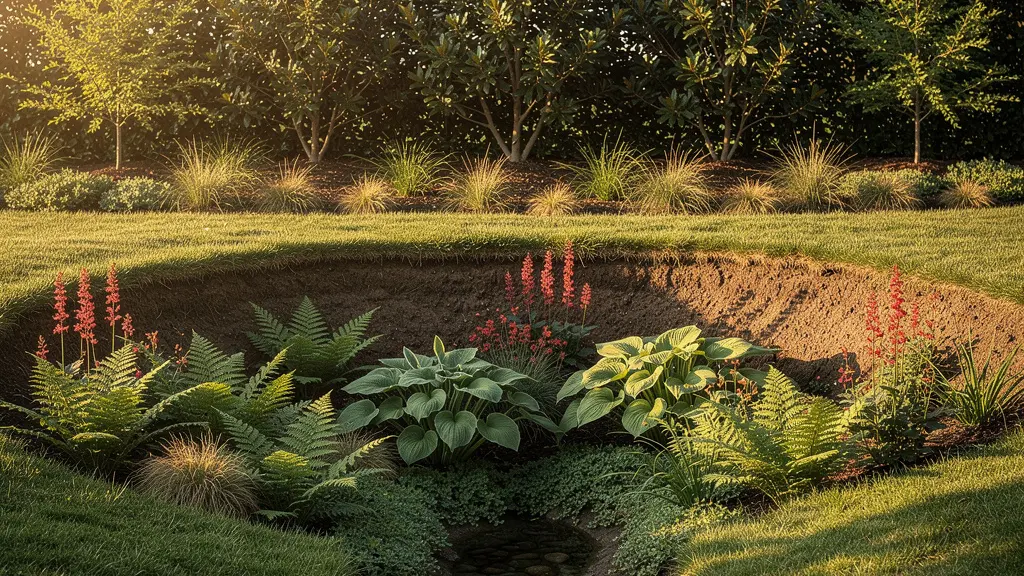
The methodology involves excavating rain gardens or bioswales in problem low spots, thereby creating depressions that sit below neighboring sightlines and offer inherent privacy without vertical screening. The soil removed during excavation constructs gently sloping berms—eighteen to twenty-four inches tall—along property lines. These elevated earthworks provide “free” height to privacy hedges planted on their crests, effectively adding two feet to screening plants without violating fence height ordinances.
The excavated low area becomes a sunken sanctuary, furnished with moisture-loving plants such as ferns, astilbe, and cardinal flower, creating usable space that remains invisible from adjacent second-story windows. This dual-purpose design approach exemplifies strategic landscape architecture, where functional problem-solving generates spatial privacy as a byproduct rather than an additional cost.
Strategic Audit: Integrating Drainage with Privacy Design
- Topographic Survey: Identify and mark all low spots where water collects for 24+ hours after rainfall
- Excavation Protocol: Dig rain garden basins to a depth of 18 inches below grade, creating physical privacy depressions
- Berm Engineering: Construct sloped earthworks using 100% of excavated soil, achieving 18–24 inches of elevation gain
- Elevated Screening: Install privacy hedge species along the berm crest, effectively adding 2 feet to mature plant height
- Sunken Room Installation: Furnish the excavated zone with permeable paving and hydrophilic plantings for usable wet-weather privacy
Begin your privacy transformation by conducting a comprehensive site analysis that maps both sightlines and drainage patterns, allowing you to implement a cohesive strategy that resolves multiple site constraints through unified design.