
The emotional toll of acting is not “just in your head”; it’s a neurological reality that requires deliberate psychological tools to manage for a sustainable career.
- Your brain releases real stress hormones like cortisol during a performance, a process of “neurological hijacking” that can blur the lines between character and self.
- Conscious, physical rituals are not symbolic gestures but powerful commands that signal to your brain it’s time to return to your baseline identity.
Recommendation: Instead of trying to “forget” a character, create a structured “coming home” ritual that actively disengages the emotional and physical states you embodied.
The curtain falls, the director yells “cut,” but the character’s sorrow, rage, or despair lingers. For any dedicated actor, this experience is deeply familiar. It’s the residue of a powerful performance, a haunting echo in the quiet of your own life. Many will advise you to simply “leave the character at work,” a well-meaning but profoundly unhelpful platitude. This advice ignores a fundamental truth: your body doesn’t know you’re pretending. The art of performance is an act of controlled psychological and neurological hijacking.
While the industry often celebrates total immersion, it frequently fails to provide the tools to safely return from it. The conversation often revolves around the craft of becoming, but rarely the craft of unbecoming. This is a dangerous oversight, as research shows that performers are twice as likely as the general public to face challenges with anxiety and depression. The issue isn’t a lack of mental fortitude; it’s a lack of a structured, psychological off-boarding process.
But what if the key wasn’t building a thicker wall between you and your work, but creating a better door? The solution lies not in suppressing the emotional bleed, but in understanding its neurological roots and designing conscious rituals to guide your mind and body back to “you.” This isn’t about magical thinking; it’s about practical neuroscience applied to the art of acting.
This guide will provide a professional framework for that process. We will explore the science behind why your body reacts so powerfully, how to design effective de-roling rituals, understand the safety differences in acting approaches, and recognize the warning signs that a character is taking up too much space in your life. It’s time to make psychological safety an indispensable part of your craft.
Summary: A Framework for Psychological Safety in Acting
- Why does your body release real stress hormones even when you are “just acting”?
- How to design a physical ritual that signals to your brain the character is gone?
- Method Acting vs. Technical Acting: Which approach is safer for trauma survivors?
- The warning sign that your character’s depression is affecting your real life
- When to refuse a role: Why doing back-to-back tragedy plays leads to burnout
- Why does externalizing pain into metaphors reduce emotional intensity?
- Why does the brain treat fictional experiences as real social training simulations?
- How to Write Poetry to Process Grief: A Framework for Beginners
Why Does Your Body Release Real Stress Hormones Even When You Are “Just Acting”?
The most common misconception actors face is that the emotions of a character are purely an act of imagination. In reality, your brain cannot fully differentiate between a real threat and a perceived one. When you embody a character in distress, your sympathetic nervous system kicks in. As explained by Dr. Michelle Sherman of the University of Minnesota Medical School, “When you really get into character, your blood pressure goes up, your heart rate increases and your mind and body can’t differentiate between reality and acting.” This isn’t a failure of control; it’s a feature of your biology.
This phenomenon can be described as neurological hijacking. To generate authentic emotion, you call upon your memories, experiences, and empathy. Your brain, in turn, releases a very real cocktail of hormones, including adrenaline and cortisol, the primary stress hormone. These are the same chemicals that would flood your system during a genuine crisis. In fact, neuroscience research reveals how deeply acting affects brain function, showing that different neural pathways are engaged when an actor fully embodies a role.
The tragedy of actors like Heath Ledger, who became deeply immersed in the role of the Joker, serves as a stark reminder of this danger. His commitment was legendary, but it seemingly blurred the line between his own identity and the character’s nihilism, leading to a state where separation became difficult. This is the extreme result of sustained neurological hijacking without a proper “off-switch.” Understanding this biological process is the first step toward respecting its power and learning how to manage it, not just for one role, but for a lifetime in the arts.
How to Design a Physical Ritual That Signals to Your Brain the Character Is Gone?
Since your body experiences the character’s reality, you must give it an equally real signal that the performance is over. A de-roling ritual is a conscious, physical sequence of actions that tells your nervous system to stand down. It’s a deliberate transition from the character’s world back into your own. This isn’t just about changing clothes; it’s about using sensory anchoring to ground yourself in the present reality. The goal is to create a clear, repeatable boundary that your brain learns to recognize.

As the image above illustrates, the physical act of removing a costume piece can be a powerful anchor. It is a tangible act of separation. Your ritual should engage multiple senses to be most effective. A great example of this is the “Proust Effect” in de-roling, where scent is used as a potent trigger. Because our olfactory senses are directly linked to the brain’s memory and emotional centers (the hippocampus and amygdala), you can assign a specific perfume or oil to a character. When you wash it off, you are physically and neurologically signaling the end of that emotional state. Here are some foundational techniques to build your own ritual:
- Shed the Skin: The most critical step. Mindfully remove a key costume piece, prop, or even makeup. As you do, verbally state, “I am no longer [Character’s Name]. I am [Your Name].”
- Sensory Reset: Actively engage your five senses in your own reality. Listen to your favorite non-character-related music, touch a familiar object like a personal keepsake, smell a comforting scent (like your own perfume or a calming essential oil), and taste a specific tea or snack you reserve for post-performance.
- Physical Release: Literally shake it off. Shake your hands, your arms, your legs, and your whole body to release the physical tension and posture of the character. Follow this with deep, diaphragmatic breathing to calm the nervous system.
Method Acting vs. Technical Acting: Which Approach Is Safer for Trauma Survivors?
The question of which acting technique is “better” is endless, but when viewed through the lens of psychological safety, the differences become critical, especially for actors who are trauma survivors. Method acting, which encourages drawing on personal and often painful memories to fuel a performance, can be a high-risk practice. It intentionally blurs the line between self and character, which can lead to re-traumatization if not managed with extreme care and professional support. Technical acting, by contrast, focuses on building a character from the outside in, using physical and vocal choices to create the illusion of emotion without necessarily dredging up personal history.
A more protective framework can be found in Drama Therapy, which prioritizes the actor’s well-being above all. It introduces the crucial concept of aesthetic distance—the ability to be both invested in the character’s emotional journey and simultaneously aware of your own separateness as the artist. This “dual consciousness” is a powerful protective mechanism. The following table, adapted from research into therapeutic theatre, highlights the key differences in focus and safety.
| Aspect | Traditional Acting | Drama Therapy Approach |
|---|---|---|
| Focus | Performance and authenticity | Wellbeing and therapeutic goals |
| De-roling Practice | Not commonly taught | Essential component |
| Emotional Distance | Often encourages deep immersion | Maintains aesthetic distance |
| Safety Protocols | Varies by program | Built-in safety mechanisms |
For a trauma survivor, an approach that has de-roling and safety built into its DNA is inherently safer. As researcher Gabrielle L. Arias notes in a critical review for Lesley University, de-roling is a vital tool for managing what can be called ‘post-dramatic stress.’ As she states in her review, which you can read here:
De-roling may assist actors who experience ‘post-dramatic stress’ (Seton, 2006) because it is a grounding technique that asks actors to shed their characters and come back into themselves.
– Gabrielle L. Arias, In the Wings: Actors & Mental Health A Critical Review of the Literature
This does not mean method acting is “bad,” but it does mean it requires a robust support system and a high level of self-awareness that may not be advisable for everyone at every stage of their life and career. Prioritizing techniques that champion aesthetic distance can be a profound act of self-care.
The Warning Sign That Your Character’s Depression Is Affecting Your Real Life
It starts subtly. You find yourself feeling a little more cynical, a little more withdrawn. You’re sleeping more, or less. Your friends say you seem distant. You brush it off as fatigue from a demanding role, but it’s crucial to recognize these as potential warning signs of “character bleed.” This is the term used when the thoughts, feelings, and even physical mannerisms of a character begin to seep into your personal life, long after you’ve left the set or stage.
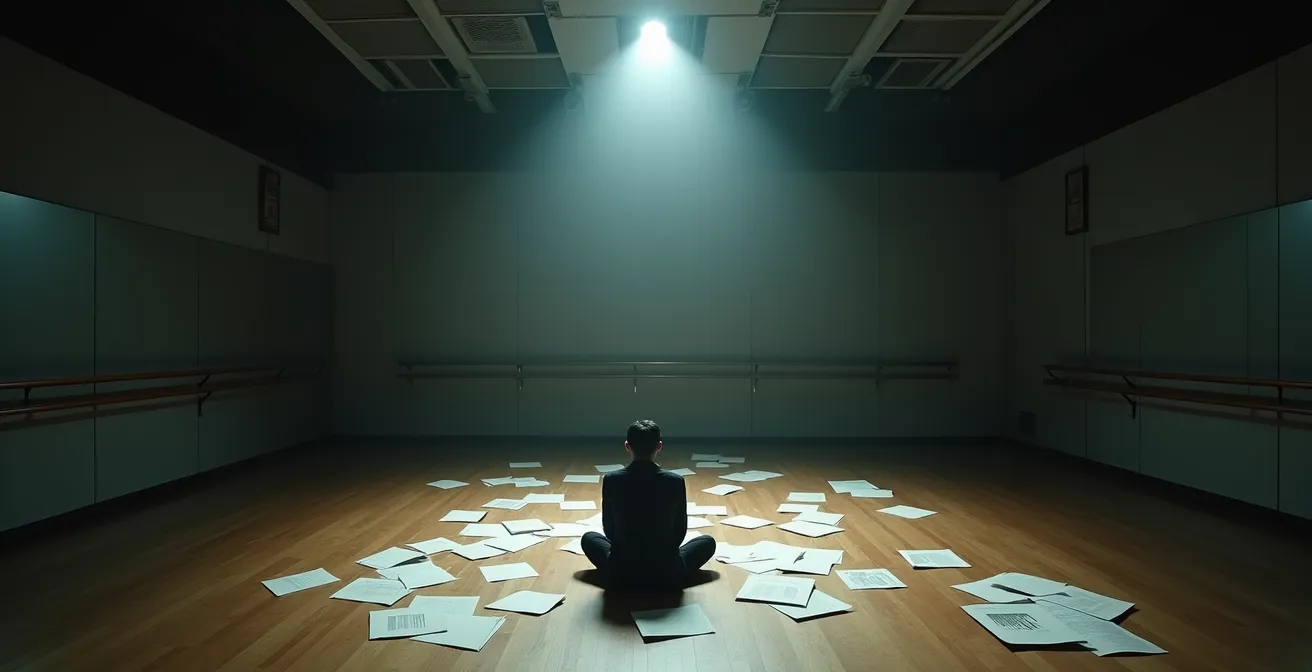
This bleed is especially dangerous when portraying characters with depression, trauma, or other mental health struggles. Because you have effectively trained your brain and body to produce the physiological state of depression for hours a day, your system can get “stuck” in that mode. The primary warning sign is a change in your baseline. If your “normal” self starts to look and feel more like the character you’re playing, you are experiencing character bleed. This is not a sign of great acting; it’s a sign that your de-roling process is insufficient or absent.
Case Study: Understanding “Character Bleed”
As intimacy and wellness coordinators point out, the more an actor inhabits a role, the more that character’s emotional patterns can become present in the actor’s own psyche. An actor playing a deeply grieving widow for a six-month theatre run might find themselves experiencing unexplained sadness, social withdrawal, or a loss of interest in hobbies in their own life. This experience is referred to as ‘Bleed,’ where the character starts to bleed into the psyche of the actor. It is the professional actor’s equivalent of “taking your work home” in the most psychologically invasive way possible.
Ignoring these signs can have severe consequences. A general lack of mental well-being can escalate, and it’s important to remember that statistics reveal the serious nature of mental health crises, with over 12% of adult emergency room visits in the U.S. being related to mental health. The key is to catch the bleed early by conducting regular self-check-ins and having a trusted friend or therapist who can help you notice when your behavior deviates from your norm.
When to Refuse a Role: Why Doing Back-to-Back Tragedy Plays Leads to Burnout
There is a romanticized notion of the “suffering artist,” but there is nothing romantic about burnout. As a professional, you are your own primary asset, and protecting that asset is a strategic business decision. One of the quickest paths to burnout is taking on emotionally harrowing roles back-to-back without adequate recovery time. Each intense role depletes your emotional and psychological reserves. Without a period of “fallow” time to recharge and reconnect with yourself, you start the next project with a deficit, making you more susceptible to character bleed and mental exhaustion.
Saying “no” to a role is one of the most powerful and difficult acts of self-preservation an actor can perform. It’s not a sign of weakness; it’s a sign of a professional who understands the long game. The pressure to always be working is immense, but the cost of burnout is far higher. Beyond the emotional toll, there is a significant financial one. In the broader economy, serious mental illness causes $193.2 billion in lost earnings each year. For an actor, burnout can mean months or even years of being unable to work, a far greater loss than turning down a single project.
Knowing you have a support system in place can make these decisions easier. Resources like the Entertainment Community Fund are designed specifically for this purpose, providing a safety net that understands the unique pressures of the industry. The story of voice artist Charity James, who faced multiple crises, highlights their importance. She turned to the Fund when she had nowhere else to go. As she shared, “I didn’t have any other resources at that time, and I didn’t have any way of helping myself at that point.” A social worker from the Fund provided direct, tangible help, demonstrating that professional support is not an abstract idea but a concrete lifeline.
Your Mental Health Safety Net: A Checklist for Actor Support
- Identify Points of Contact: Save the contact information for support organizations. Key among them is the Entertainment Community Fund, which has regional offices and online access.
- Collect Your Resources: Inventory the services available to you. This includes free counseling sessions, actor-specific support groups, mental health workshops, and emergency financial assistance programs.
- Check for Coherence: Does your personal support system (friends, family, agent) understand and respect your need for psychological safety and downtime between roles? Have you communicated your boundaries?
- Assess Accessibility & Emotion: Is your support readily available? Do you feel comfortable reaching out? The Fund’s regional numbers—Eastern (917.281.5919), Central (312.372.0989), Western (323.330.2455)—are designed for direct access.
- Create an Integration Plan: Don’t wait for a crisis. Proactively schedule a check-in with a therapist or a support group during and after an intense project. Make it part of your professional workflow.
Why Does Externalizing Pain Into Metaphors Reduce Emotional Intensity?
When you are deep within a character’s grief or trauma, the emotion can feel all-consuming and formless. Giving that pain a name and a shape through metaphor is a powerful act of cognitive reframing. Your brain processes concrete images and abstract emotions differently. By translating an internal feeling (“I feel a crushing sadness”) into an external metaphor (“This sadness is a heavy cloak I’m wearing”), you create a crucial psychological separation.
This process works on several levels. First, it engages your prefrontal cortex—the logical, analytical part of your brain—rather than leaving you stuck in the amygdala, the primal emotion center. The act of searching for a metaphor is an analytical task that forces a degree of objectivity. You are no longer just *feeling* the sadness; you are *observing* it, describing its qualities, and packaging it into a new concept. This act of observation creates distance.
Second, this externalization makes the emotion manageable. A formless, all-encompassing dread is impossible to fight. But a “heavy cloak” is an object. You can study it, you can describe it, and, most importantly, you can imagine taking it off. A “storm inside your chest” is a weather system that will eventually pass. These metaphors transform an overwhelming identity (“I am sad”) into a temporary state or external object (“I am experiencing sadness”). This shift is not just a word game; it is a fundamental change in your relationship with the emotion, reducing its power and perceived permanence.
Why Does the Brain Treat Fictional Experiences as Real Social Training Simulations?
Your brain is fundamentally a prediction and simulation machine. Its primary job is to keep you safe by preparing you for future social interactions. When you watch a film, read a novel, or perform a role, your brain doesn’t see it as useless fiction. It sees it as valuable data. This is largely thanks to a fascinating class of brain cells known as mirror neurons. These neurons fire both when you perform an action and when you observe someone else performing that same action. They are the neurological basis of empathy.
When you embody a character, your mirror neuron system goes into overdrive. You are not just intellectually understanding the character’s decisions; you are running a full-body simulation of their experience. Your brain processes the character’s conflicts, moral dilemmas, and emotional responses as if they were your own trial runs for life. This is why you can emerge from a role feeling as though you’ve genuinely learned something profound or lived a piece of another life—because, neurologically speaking, you have.
This “social training simulation” function is incredibly useful for human development, but it’s also why de-roling is so vital. If you run a simulation of a traumatic event over and over for weeks in a play, your brain logs that experience as a real and repeated danger. It has “trained” for that reality. Without a clear signal that the simulation is over, your nervous system can remain on high alert, anticipating a threat that exists only in the script. The de-roling process is the command that tells your brain, “Simulation complete. Return to baseline reality.”
Key Takeaways
- Acting is a biological act; your body releases real stress hormones, making psychological aftercare a necessity, not a luxury.
- A de-roling ritual must be a conscious, physical, and sensory process to effectively signal to your brain that the performance is over.
- Character bleed is a real psychological phenomenon; recognizing changes in your personal baseline behavior is the most critical warning sign.
How to Write Poetry to Process Grief: A Framework for Beginners
After stepping away from a heavy role, the residual emotions—the character’s grief, anger, or despair—can remain. One of the most effective ways to process this “emotional residue” is through creative externalization, such as writing. Poetry, in particular, provides a contained, structured space to give voice to these feelings without being overwhelmed by them. It allows you to transform the abstract pain into a tangible object that you can observe and, ultimately, release.
This is not about writing a masterpiece; it is about the process. The goal is to get the feelings out of your body and onto the page. Here is a simple framework to guide you through this therapeutic practice, adapted from proven creative processing techniques.
- The Farewell Letter: Begin by writing a simple letter to the character. Thank them for the journey and the lessons learned. Acknowledge the parts of them that you found challenging and the parts you will miss. This creates a formal moment of separation.
- From Your Perspective: Now, shift to your own voice. Write freely about your experience portraying the role. What emotions did it stir up in you? What was the hardest part of letting go each night? Don’t censor yourself; this is for your eyes only.
- Find the Metaphor: From your free-writing, identify the core feeling. Is it a weight? A color? A sound? A storm? Use this as the central image for a short poem. Describe this metaphor using sensory details. What does it look, sound, and feel like?
- The Act of Release: Conclude your poem or writing session with a clear statement of release. A simple line like, “I leave you here on this page,” or “I release this weight and return to myself.” The final step can be a ceremonial act of closure, such as folding the paper and putting it away in a special box or even safely burning it.
This framework provides a beginning, a middle, and an end to the emotional processing, guiding you from immersion to a place of centered, personal peace.
Protecting your mental health is not an impediment to great art; it is the very foundation upon which a long, healthy, and brilliant career is built. By integrating these practices into your craft, you honor both the character you portray and the artist who gives them life. Take the next step and schedule a consultation with a therapist or an acting coach who specializes in performer mental health to build your personalized de-roling strategy today.