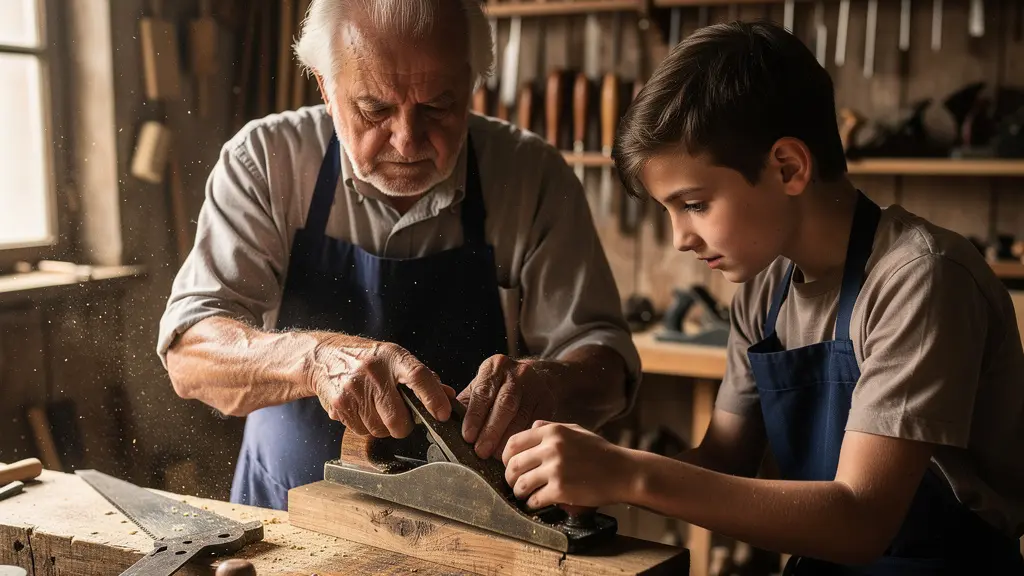
Passing on your craft isn’t just about teaching; it’s a high-stakes legacy transfer that requires strategic systems, not just good intentions.
- The most critical skills—muscle memory and intuition—cannot be written down and demand structured, non-verbal teaching methods.
- Without airtight, specific contract clauses, you risk your apprentice becoming a direct competitor using your own trade secrets.
Recommendation: Shift your mindset from master artisan to legacy strategist. Your craft’s survival depends on the strength of the financial, legal, and educational framework you build around your apprentice.
The silence in a master’s workshop can be profound. It’s a space filled with the ghosts of a thousand creations, the scent of wood, metal, or clay, and the weight of a lifetime of accumulated knowledge. But for too many master craftsmen and women, another, more urgent silence looms: the absence of a successor. Your hands hold a universe of skill, but with each passing year, the risk grows that this universe will simply vanish. Your legacy is on the line.
The common advice feels hollow and inadequate. “Find someone passionate,” they say. “Just show them the ropes.” This approach treats a complex issue of cultural preservation as a simple hiring problem. It naively assumes that passion is a substitute for patience, and that watching is the same as learning. This is the path to frustration, failed apprenticeships, and, ultimately, the extinction of your craft.
But what if the solution isn’t about finding a unicorn candidate, but about building a robust system? What if transmitting your life’s work requires you to become a strategist, not just a teacher? The real challenge lies not in the craft itself, but in decoding and transferring the “intangible”—the feel, the timing, the rhythm that lives in your muscles and nerves. This is not merely a job posting; it’s a mission to save a piece of human history embodied in you.
This guide provides a strategic roadmap. It moves beyond platitudes to offer concrete systems for funding the journey, identifying true dedication, protecting your intellectual property, and sequencing training in a way that respects both your production schedule and your apprentice’s development. It is the framework for ensuring your craft doesn’t die with you.
To navigate this critical mission, we’ve structured this guide to address the most pressing strategic challenges you’ll face. The following sections provide a clear path from understanding the nature of your knowledge to ensuring its successful and sustainable transfer to the next generation.
Summary: A Strategic Guide to Craftsmanship Legacy
- Why manuals aren’t enough: The difficulty of transferring “muscle memory” to a student
- Government grants or Crowdfunding: Which model sustains a 2-year training period best?
- The interview question that reveals if a student has the patience for a 10-year mastery path
- The contract mistake that lets an apprentice steal your trade secrets and open a rival shop
- How to sequence the training from observation to practice without slowing down production?
- When to engage volunteers for restoration: The 4 distinct phases of a project
- Why do experts struggle to realize when they are using confusing jargon?
- How to Generate Sustainable Revenue for Heritage Sites with Under 10,000 Visitors?
Why manuals aren’t enough: The difficulty of transferring “muscle memory” to a student
The most valuable parts of your craft are likely impossible to write down. This is the realm of tacit knowledge, a deep, intuitive understanding that lives in your body. It’s the precise pressure on a chisel, the feel of perfectly tempered metal, or the sound of a shuttle flying through a loom. The Japanese concept of ‘waza’ perfectly describes this embodied skill, a form of knowledge that resists verbal description and can only be transferred through direct practice and observation. This is why instruction manuals and video tutorials, while useful for basic steps, will always fail to transmit the true essence of a master’s ability.
Expecting an apprentice to learn from a book is like asking them to learn to swim by reading about water. The transmission of this knowledge is a physical, sensory process. In Japan’s traditional ‘deshi-iri’ apprenticeship system, students spend years absorbing the craft through osmosis—cleaning, preparing materials, and watching the master relentlessly. They must “steal” the techniques, internalizing the rhythm and flow of the workshop long before they touch a valuable piece. This method, while extreme, acknowledges a fundamental truth: muscle memory is built through repetition, observation, and disciplined practice, not through intellectual study.
To bridge this gap in a modern context, you must create a system for making the intangible tangible. This involves:
- Shared Sensory Vocabulary: Develop metaphorical language to describe non-visual sensations. Is the clay “as stubborn as cold butter” or “as yielding as soft dough”? This helps the apprentice connect words to feelings.
- Slow-Motion Analysis: Use video to record your hands at work, then review it in slow motion with your apprentice. This deconstructs micro-movements that are invisible at normal speed but are critical to the technique.
- Scaffolding on Scrap: Break down a complex process into ten micro-skills. The apprentice must master each one sequentially on worthless scrap material before moving to the next. This isolates skills and removes the fear of costly mistakes.
- Advanced Documentation: Consider technologies like 3D scanning or motion capture to create a digital record of your movements, capturing the precise angles and rhythms of your technique for future analysis.
This focus on embodied knowledge is the first strategic shift. You are not just teaching a series of steps; you are cultivating a new body of knowledge in another person. It is a slow, deliberate, and deeply personal process that requires a dedicated framework.
Government grants or Crowdfunding: Which model sustains a 2-year training period best?
Taking on an apprentice isn’t just a time commitment; it’s a significant financial one. For a micro-business or sole trader, the cost of a trainee’s salary and the master’s lost production time can be crippling. The challenge is finding a funding model that provides stability over a multi-year training period. The two most common paths, government grants and crowdfunding, offer starkly different advantages and disadvantages.
Government funding schemes seem like an obvious first choice, but the reality can be complex. These programs often come with a high administrative burden, rigid timelines, and criteria not designed for the unique needs of heritage crafts. In the UK, a recent analysis revealed that only 25% of the UK’s 259 heritage crafts have approved apprenticeship standards, leaving the majority without a clear path to official support. For a small workshop, navigating the bureaucracy can be more work than the funding is worth.
Crowdfunding, on the other hand, offers flexibility and a direct connection with a supportive community. A compelling story can raise significant funds and build a base of patrons invested in your craft’s survival. However, it requires marketing savvy and a continuous effort to keep backers engaged. The pressure to deliver on promises and provide regular updates adds a different kind of administrative load.
The following table breaks down the key differences to help you make a strategic choice.
| Factor | Government Grants | Crowdfunding |
|---|---|---|
| Funding Amount | £27,000 max (UK standard) | Variable (£5,000-£50,000+) |
| Administrative Burden | High – formal reviews, compliance | Medium – regular updates to backers |
| Timeline Flexibility | Low – fixed program duration | High – can adjust based on progress |
| Community Building | Limited institutional support | Strong patron engagement throughout |
| Success Rate | Low for micro-businesses | Higher with compelling narrative |
A third, often more viable option, is a hybrid model. The “Apprenticeship+” project by Heritage Crafts is a prime example. It supplements government funding for off-the-job training with private donations that cover the apprentice’s salary and compensate the master for lost earnings. This blended approach mitigates the weaknesses of each individual model, creating a sustainable financial engine for the full duration of the training.
The interview question that reveals if a student has the patience for a 10-year mastery path
Passion is easy to fake. Patience, resilience, and the ability to endure frustration are not. In the search for a successor, many masters make the mistake of looking for enthusiasm when they should be looking for grit. The path to mastery is a decade-long marathon paved with repetitive tasks, failed attempts, and harsh critiques. Your interview process must be a crucible designed to test for these traits, not a pleasant chat about their “love of craft.”
Forget questions like “Why do you want to do this?” The answers are predictable and rehearsed. Instead, you need to design questions and tasks that strip away the romantic veneer and reveal the candidate’s true character. Your goal is to see how they react under pressure and when faced with failure. A single, well-designed question can tell you more than an hour of conversation.
One of the most revealing questions is: “Imagine you’ve spent 40 hours on a piece. I look at it and tell you it’s fundamentally flawed and you must start over from scratch. What is your internal thought process, and what is your verbal response to me?” A promising candidate won’t be defensive. Their internal process will be one of disappointment followed by analytical curiosity: *What did I miss? How can I avoid this next time?* Their verbal response will be a simple, “Okay. Can you show me where I went wrong so I don’t make the same mistake?” This reveals humility, a focus on learning over ego, and an acceptance of the master-apprentice hierarchy.
Beyond this single question, your interview should be a series of “patience tests”:
- Probe Past Failures: Ask about the most spectacular failure they’ve had making something with their hands. What went wrong, and what was their immediate next action? Look for ownership and problem-solving, not blame.
- Test Intrinsic Motivation: Ask them to describe a difficult personal project they worked on for months with no guarantee of success or recognition. What kept them going when they wanted to quit? This separates those motivated by internal standards from those who need external validation.
- Implement a “Frustration Task”: This is a practical test. Give them a seemingly pointless, repetitive task—like polishing a surface to a perfect mirror finish for an hour, or sorting hundreds of tiny, similar components. Observe their focus, their posture, and their demeanor. Do they rush? Do they lose focus? Or do they settle into the rhythm and find a state of flow?
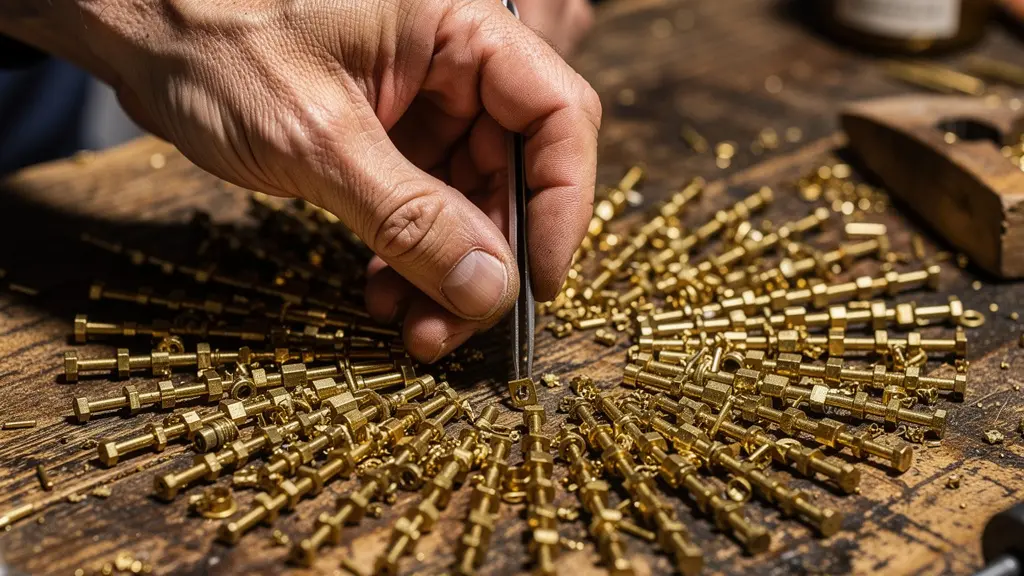
This practical test, more than any words, shows you who has the temperament for the long, often unglamorous, road to mastery. It’s a filter for the patient soul who understands that greatness is built on a foundation of a million, perfectly executed, mundane steps.
The contract mistake that lets an apprentice steal your trade secrets and open a rival shop
In the romantic vision of apprenticeship, the bond between master and student is built on trust and a shared love for the craft. In the real world, a handshake agreement is a recipe for disaster. Your unique processes, material recipes, and specialized techniques are your most valuable assets. Without a robust legal framework, you are not training a successor; you are training a future competitor who can legally take your life’s work and open a rival shop across the street.
The historical guild systems understood this. They enforced strict, multi-year indentures that legally bound an apprentice to a master, protecting trade secrets as a matter of course. Modern apprenticeships often lack these built-in protections, forcing masters to become proactive in creating their own contractual safeguards. While systems like France’s Compagnons du Devoir provide some regulatory oversight, most artisans are on their own. Relying on a standard employment contract is a critical mistake; it fails to address the unique nature of proprietary craft knowledge.
Your apprenticeship agreement must be a bespoke document designed to protect your legacy. It’s not about being mistrustful; it’s about being a professional and setting clear expectations for a long-term business relationship. The most common mistake is failing to define what constitutes a “trade secret” in the context of an un-patentable craft. You must explicitly list specific processes, tool modifications, and material formulas as proprietary intellectual property.
A strong contract is your first line of defense. It transforms the informal transfer of knowledge into a structured, legally-defensible partnership. Below is a checklist of critical clauses that should be in every master’s apprenticeship agreement, drafted with the help of a legal professional.
Your Legal Shield: An Audit Checklist for Your Apprenticeship Contract
- Technique Non-Disclosure (TNDA): Does your contract go beyond a generic NDA? It must explicitly define un-patentable processes, material recipes, and specific methods as proprietary trade secrets that belong to the business.
- Graduated Non-Compete: Is your non-compete clause reasonable and forward-thinking? Consider a 2-year ban on direct competition that converts to a mandatory licensing agreement in year 3, planning for future collaboration instead of conflict.
- “Golden Handcuffs” Vesting: How do you incentivize long-term loyalty? Structure bonuses, profit-sharing, or even equity stakes that only vest after 5-7 years, making partnership more attractive than leaving.
- Right of First Refusal: Does the contract give you a future option? Include a clause requiring the apprentice to offer you a partnership stake or first right of refusal on any related business they start within a set timeframe after their departure.
These clauses are not about trapping an apprentice, but about creating a clear path toward a potential partnership. They protect your legacy while offering the apprentice a transparent roadmap of their future within your craft’s ecosystem.
How to sequence the training from observation to practice without slowing down production?
The paradox of apprenticeship is that the process of training someone is most disruptive when you are busiest. The fear of slowing down production, wasting valuable materials, and missing deadlines is a major barrier for many masters. The solution is not to avoid training, but to design a parallel workflow where the apprentice’s learning journey actively supports, rather than hinders, your own work. This requires a strategic, phased approach to training.
The goal is to move the apprentice from a passive observer to an active participant in a structured way. This sequence must be designed to build skills incrementally while simultaneously offloading less-critical tasks from the master. The National Trust’s Heritage Crafts Apprenticeship programme is a large-scale example of this, where apprentices work on real restoration projects alongside masters. The apprentices gain invaluable hands-on experience, such as building a replica of the Sutton Hoo ship, without disrupting the critical-path conservation work handled by the experts.

For a small workshop, this principle of parallel work is even more vital. The master works on the high-value, intricate pieces, while the apprentice works on preparatory tasks or practices on separate, lower-stakes components. This visual separation of workspaces, as shown above, is key to maintaining efficiency. The master is freed from time-consuming setup and finishing tasks, which can actually increase overall productivity.
A well-structured training sequence can be broken down into four distinct phases, each designed to build upon the last while delivering increasing value to the workshop.
This phased approach systematically builds skills and confidence while ensuring the master’s workflow is supported, not slowed. An analysis from Historic Environment Scotland supports this structured methodology.
| Phase | Duration | Apprentice Tasks | Master’s Role | Production Impact |
|---|---|---|---|---|
| Observation & Documentation | 0-3 months | Document processes, organize tools, quality control checks | Continue normal work | Positive – improved documentation |
| Preparatory Work | 3-6 months | Material preparation, tool maintenance, workspace setup | Focus on skilled tasks | Positive – master freed from prep |
| Scaffolded Practice | 6-12 months | Practice on scrap materials, simple product line | Periodic supervision | Neutral – parallel workflow |
| Assisted Production | 12-24 months | Work on actual products under supervision | Quality oversight and finishing | Positive – increased output |
By implementing this phased sequence, the apprenticeship transforms from a production bottleneck into a productivity multiplier. The apprentice is not “in the way”; they are an integral part of a more efficient and resilient workshop ecosystem.
When to engage volunteers for restoration: The 4 distinct phases of a project
While a dedicated apprentice is the core of your legacy strategy, a team of well-managed volunteers can be a powerful supporting force, especially in larger restoration projects. However, their involvement must be rigorously structured to prevent well-intentioned help from causing irreversible damage. The key is to understand which tasks are safe for volunteers and which must be reserved exclusively for the master and apprentice. The massive investment in heritage skills, such as the £6.2 million awarded for 52 new heritage craft apprenticeships by the Hamish Ogston Foundation, underscores the value of professional skill and the need to protect it.
Engaging volunteers is not an all-or-nothing proposition. A restoration project can be broken down into four distinct phases, with clear boundaries for volunteer participation. This phased approach maximizes their contribution while safeguarding the integrity of the object and the core learning experience of the apprentice.
The cardinal rule is simple: volunteers should only ever perform non-invasive and reversible tasks. Any action that permanently alters the object or requires deep craft knowledge is strictly off-limits. This protects the heritage asset and ensures that the most valuable, skill-building work is reserved for the apprentice, whose entire purpose is to learn these core techniques. Mismanaging this can lead to volunteers feeling excluded or, worse, causing damage that the apprentice must then learn to fix, wasting valuable training time.
A safe and effective engagement model follows these four phases:
- Phase 1: Assessment & Documentation. This is an ideal role for volunteers with skills in photography, research, or cataloging. They can be deployed to document the object’s current condition, research its history, and build a comprehensive record before any physical work begins. This is non-invasive and creates immense value.
- Phase 2: Stabilization & Cleaning. Under strict supervision, volunteers can perform low-risk, reversible tasks. This might include surface cleaning with pre-approved materials and methods, or carefully dismantling non-structural components. The key here is supervision and the use of tested, reversible techniques.
- Phase 3: Core Craftsmanship (NO VOLUNTEERS). This phase is the exclusive domain of the master and apprentice. All irreversible, skill-based work—such as carving, joining, forging, or weaving—happens here. This is the heart of the knowledge transfer and must be protected from outside interference.
- Phase 4: Finishing & Reassembly. Once the core craft work is complete, volunteers can be re-engaged for low-risk support tasks. This could include polishing finished surfaces, applying protective wax coats (with clear instructions), or helping with the careful movement and reassembly of large, stabilized components.
By segmenting the project in this way, you create meaningful roles for a wider community without compromising the quality of the restoration or the integrity of the apprenticeship.
Why do experts struggle to realize when they are using confusing jargon?
One of the greatest ironies of teaching is that the more expert you become, the harder it can be to communicate with a beginner. This phenomenon, known as the “curse of knowledge,” causes experts to unconsciously assume that others share their background and understanding. You’ve spent a lifetime building a specialized vocabulary, and to you, terms like “tenon,” “warp,” or “quenching” are as simple as “hammer.” To an apprentice, they might as well be a foreign language.
This struggle is not a sign of a bad teacher, but a natural cognitive bias. The real issue goes deeper than just vocabulary. As discussed earlier, much of a master’s knowledge is the ‘waza’—the embodied, non-verbal understanding that UNESCO calls intangible cultural heritage. Because you “just know” how something should feel or sound, you struggle to find the words to describe it, and often fall back on technical jargon as a shorthand. You don’t realize it’s confusing because the term and the physical sensation are inextricably linked in your mind.
Overcoming this curse requires a conscious, systematic effort to build a shared language with your apprentice. It means turning your workshop into a laboratory for clear communication. Instead of getting frustrated when an apprentice doesn’t understand, you must see it as a feedback loop telling you that your explanation is flawed. The responsibility for clarity lies with the master, not the student.
Here are several techniques to actively identify and translate your own expert jargon:
- The “Jargon Jar” System: This is a simple but powerful tool. The apprentice deposits a note in a jar every time you use a term they don’t understand. The jar is reviewed weekly. This is a blame-free way to build a shared glossary and makes the apprentice an active partner in the learning process.
- “Explain It To a 5-Year-Old”: Before teaching a complex process, force yourself to explain it using only simple, common words. This exercise breaks your reliance on jargon and forces you to find clarifying analogies.
- Record and Review: Record your teaching sessions (audio is sufficient). Later, listen back and mark every time you used a specialized term without defining it. This self-analysis is often a shocking revelation.
- Frame Jargon as Identity: Don’t avoid all jargon. Instead, frame it as learning the “secret language” of the craft. Explicitly teaching the vocabulary fosters a sense of professional belonging and transforms a barrier into an initiation rite.
By actively working to deconstruct your own language, you not only become a better teacher but also gain a deeper understanding of your own craft. It forces you to move from intuitive action to conscious explanation, which is the very heart of effective teaching.
Key Takeaways
- Legacy is a System, Not a Hope: The survival of your craft depends on building robust legal, financial, and educational systems, not just on finding a “passionate” person.
- Protect Your Knowledge Legally: A standard employment contract is insufficient. You need a bespoke agreement with specific TNDA and non-compete clauses to protect your life’s work.
- Teach the Intangible: The most critical skills are “embodied knowledge.” Your training must focus on non-verbal methods, scaffolding, and creating a shared sensory language to transfer what cannot be written.
How to Generate Sustainable Revenue for Heritage Sites with Under 10,000 Visitors?
The ultimate goal of an apprenticeship is not just to transfer skills, but to create a sustainable future for the craft itself. A skilled apprentice is the first step, but a viable business model is what ensures the legacy endures for generations. For many small craft workshops, which often function as micro-heritage sites, this means diversifying revenue streams beyond simply selling finished products. The same strategic mindset applied to training must be applied to commerce.
Even with government support, such as the £60 million announced in January 2025 to boost creative industries in the UK, self-sufficiency should be the goal. Relying on grants is not a long-term business plan. The key is to monetize the very thing that makes your workshop unique: the process, the story, and the master-apprentice dynamic itself. You are not just a producer of goods; you are the guardian of a living tradition, and that is a story people are willing to pay for.
This is where the apprentice becomes a core part of the revenue engine, not a drain on it. Their journey is a compelling narrative that can be packaged and sold in various forms. For instance, the targeted bursary model used by Heritage Crafts—allocating funds to specific demographics like veterans or those in endangered crafts—demonstrates how the training process itself can attract specific funding and create a powerful story of impact and preservation.
Here are several concrete strategies to build a sustainable revenue engine around your craft and your apprentice:
- “Master-in-Action” Premium Tours: Don’t just let people look. Charge a premium for small, curated workshop tours where visitors can observe you and your apprentice at work, with dedicated time for Q&A. This turns your daily production into a ticketed event.
- Certificate of Provenance & Process: For each high-value item created, include a beautifully designed booklet. This certificate should detail the history of the craft, the materials used, and a short bio of the apprentice who contributed to the piece. This documented provenance justifies a higher price point.
- “Artisan in Residence” Experiences: Partner with boutique travel agencies or hotels to offer multi-day, immersive experiences. High-paying guests learn a basic skill, observe the master, and share a meal. The substantial fees from these packages can subsidize the apprentice’s salary for months.
- Digital Product Bundles: Not everyone can visit your workshop, but they can still support you. Create and sell digital bundles for a global audience, including high-resolution photo packs of your work, video tutorials of basic techniques, and curated lists of your recommended tools and suppliers (potentially with affiliate links).
By implementing these strategies, the workshop transforms from a simple production facility into a multi-faceted cultural enterprise. The apprentice’s training is no longer a cost center, but a central part of a compelling brand story that attracts new and diverse streams of revenue.
You have the knowledge, the skill, and the passion. Now you have the strategic framework. The work of saving your craft is not easy, but it is one of the most meaningful endeavors a person can undertake. The next step is to move from contemplation to action. Begin today by auditing your own knowledge, outlining your ideal apprentice profile, and drafting the first version of your legacy plan. Your craft’s future is waiting to be built.