In Summary:
- The primary constraint in urban food production is not square footage but dimensional thinking—exploiting vertical space and temporal succession simultaneously.
- Biointensive methods yield 2–4 times more calories per square meter than conventional spacing by utilizing deep soil preparation and hexagonal planting patterns.
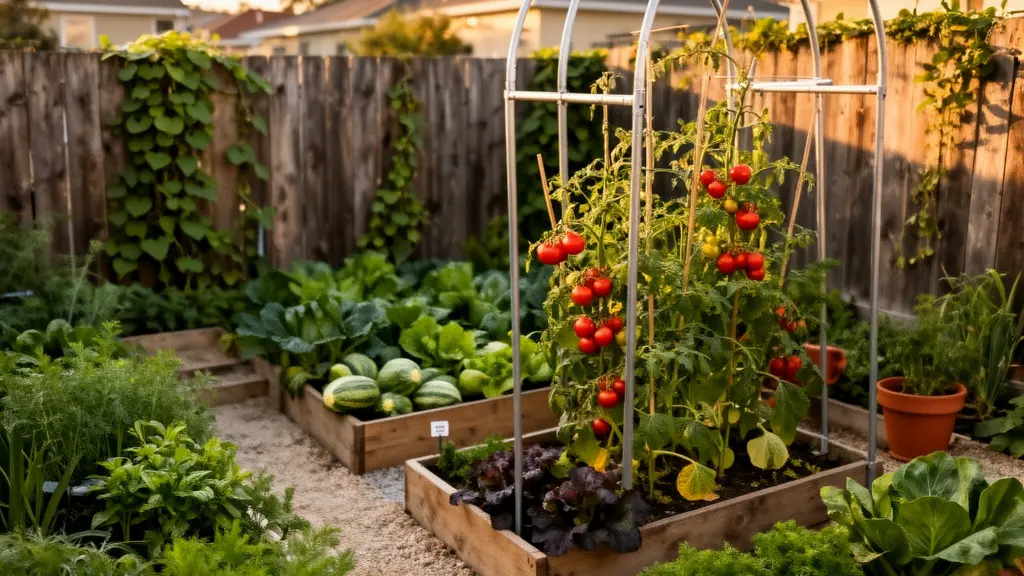
- Structural support systems like cattle panel arches transform vertical space into load-bearing infrastructure for heavy crops.
- Zero-gap succession planting eliminates bare soil time, effectively doubling your growing season within the same footprint.
- Strategic crop selection prioritizes high-value vertical crops (tomatoes) over space-intensive bulk crops (potatoes) for maximum grocery savings.
Urban homesteaders face a frustrating paradox: the desire for food self-sufficiency collides with the reality of 400-square-foot backyards surrounded by concrete. The conventional response—raised bed kits, bagged potting soil, and neat rows of lettuce—promises simplicity but delivers insufficient caloric density. These approaches treat soil as a static substrate and space as a two-dimensional plane, ignoring the vertical axis and the temporal dimension of the growing calendar.
But what if the limitation is not the size of your yard, but the architecture of your approach? High-yield urban agriculture requires treating your garden as a three-dimensional, time-layered ecosystem rather than a flat surface. By integrating vertical load-bearing trellises, biointensive planting geometry, and seamless succession timing, you can harvest 300+ pounds of produce from spaces as small as 1,700 square feet.
This article dismantles the “space myth” and introduces a system of temporal stacking and structural biomass support. You will learn how to engineer trellises that handle 50-pound squash vines, why hexagonal spacing outperforms square grids, how to execute same-day crop transitions, and which crops deliver genuine grocery savings versus those that waste valuable real estate.
Before diving into the methodology, consider how these principles interconnect. Each section builds upon the last, creating a closed-loop system where soil restoration, vertical architecture, and precision timing converge to maximize your caloric architecture.
Table of Contents: Maximizing Food Yield in Compact Urban Spaces
- How to Build a Trellis That Supports Heavy Squash Vertically Without Collapsing?
- Square Foot Gardening vs. Biointensive Rows: Which Yields More Calories per Meter?
- The Airflow Mistake in Crowded Beds That Invites Powdery Mildew Instantly
- How to Pull Out Spring Lettuce and Plant Summer Beans on the Same Day?
- Tomatoes or Potatoes: Which Crop Saves You More Money at the Grocery Store?
- Mushroom Compost or Animal Manure: Which Adds Structure to Clay Soil Faster?
- How to Find a Local Farmer or Producer to Minimize the Carbon Footprint of Transport?
- How to Restore Life to Dead Soil Using Permaculture Principles?
How to Build a Trellis That Supports Heavy Squash Vertically Without Collapsing?
Vertical growing fails when structures collapse under the weight of mature fruit. Standard tomato cages bend and fail when confronted with 20-pound butternut squash or dense clusters of cantaloupe. The solution lies in repurposing agricultural-grade cattle panels—heavy-gauge galvanized steel grids rated to contain livestock weighing 700–1,100 kg—into architectural arches that transform your garden’s vertical plane into productive infrastructure.
To construct a load-bearing arch, acquire a 16-foot by 50-inch cattle panel and four steel T-posts. Drive the T-posts at least 18 inches deep on either side of your bed, spacing them precisely five feet apart to prevent bowing under load. With a partner, bend the panel into an arch and secure both ends to the posts using heavy-duty zip ties or metal wire. This creates a tunnel that supports not just the vine, but the fruit itself.
For heavy winter squash and cantaloupe, you must provide additional support as fruits develop. Fasten individual fruits to the panel using twine slings that distribute weight across the grid structure, preventing stem breakage. Alternatively, select lighter vining varieties such as Tromboncino or butternut that drape naturally without requiring individual slings. Crops like pole beans and Malabar spinach thrive on these structures with no extra support needed. A step-by-step guide to building these cattle panel arches provides detailed diagrams for proper construction.
When properly anchored, these arches create microclimates beneath them, shading heat-sensitive crops while maximizing your production per square meter. The key is treating vertical space as load-bearing architecture, not just decorative support.
Square Foot Gardening vs. Biointensive Rows: Which Yields More Calories per Meter?
Not all intensive methods deliver equal caloric returns. Square Foot Gardening (SFG) offers simplicity for beginners with its rigid one-foot grids, but its six-inch depth and artificial soil mixes create root limitations that cap production. Biointensive methods, by contrast, prioritize deep root architecture and geometric precision to maximize photosynthetic efficiency.
The critical difference lies in soil preparation and spacing. SFG relies on raised beds filled with peat moss, vermiculite, and compost—purchased inputs that dry quickly and require frequent watering. Biointensive gardening employs double-dug native soil to 24 inches, creating capillary water movement that reduces irrigation needs by up to 88 percent while accommodating deep-rooted calorie crops like parsnips and potatoes.
Spacing geometry further separates the two approaches. While SFG uses rigid grids, biointensive methods utilize triangular hexagonal offsets that fit 15 percent more plants per area. This dense canopy shades soil, suppresses weeds, and creates a living mulch effect. Documented biointensive gardening research confirms these methods produce 2–4 times more food per square foot while using 50–75 percent less land than conventional approaches.
| Feature | Square Foot Gardening (Bartholomew) | Biointensive (Jeavons) |
|---|---|---|
| Bed depth | 6 inches (raised, artificial mix) | 24 inches (double-dug native soil) |
| Spacing pattern | Rigid 1-foot grid | Triangular / hexagonal offset (+15% plants per area) |
| Soil approach | Peat moss, vermiculite & compost mix (purchased inputs) | On-site compost, closed-loop fertility |
| Primary goal | Simplicity & beginner-friendliness | Maximum sustainable yield per unit of land |
| Yield potential | High for beginners; limited by shallow root zone | 2–4x conventional yields; deep root architecture |
| Water efficiency | Raised beds dry faster; more frequent watering needed | Up to 88% less water than conventional methods |
| Caloric density potential (root crops) | Limited by 6-inch depth | High: potatoes yield ~70,000 cal per 100 sq ft |
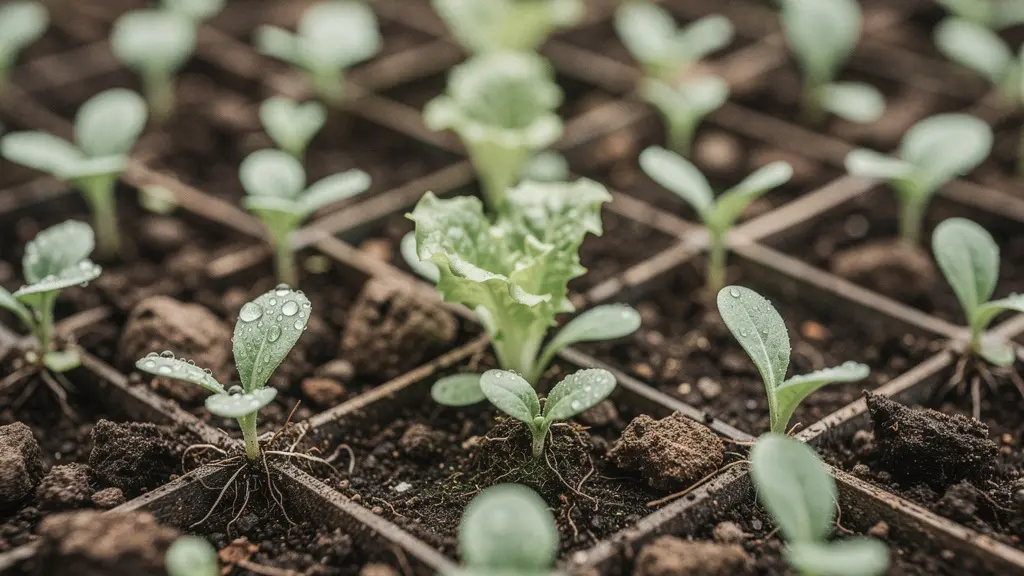
The hexagonal pattern visible above demonstrates how offset planting creates natural corridors for air movement while maximizing leaf exposure to sunlight. For urban homesteaders prioritizing food security, biointensive rows deliver superior caloric density per meter.
Ultimately, your choice depends on priorities: SFG offers immediate accessibility, while biointensive methods provide the succession velocity needed for true caloric self-sufficiency.
The Airflow Mistake in Crowded Beds That Invites Powdery Mildew Instantly
High-density planting creates a microclimate that either protects or destroys your crop. The critical error occurs when gardeners maximize plant count without engineering airflow pathways, trapping humidity in stagnant pockets where powdery mildew proliferates within 48 hours of spore contact.
Preventing fungal disease requires active management of “negative space”—the deliberate creation of voids within the canopy. Remove lower leaves and interior branches on tomatoes and squash until you can see light windows through the foliage. This disruption eliminates humidity pockets while maintaining enough leaf cover to prevent soil desiccation.
Structural elements surrounding your beds significantly impact airflow. Replace solid fences with lattice panels or train espaliered fruit against them to convert stagnant “urban canyon” air into a passive chimney-effect breeze. Orient your tallest crops—corn, trellised beans, or sunflower borders—along the prevailing wind direction so air channels naturally between rows rather than creating turbulence.
Living mulches offer dual functionality. Plant low-growing aromatic herbs such as thyme, oregano, and rosemary at the base of tall crops. These suppress rain-splashing spores while keeping the under-canopy ventilated through their structural openness. Strategic plant spacing proves particularly crucial during winter or shoulder seasons when weak sunlight and cool temperatures favor fungal growth.
John Jeavons’ research farm demonstrates that careful density management reduces pest crop loss to approximately 5 percent despite extremely dense planting. The key is creating a mini-climate where the canopy shades soil for moisture retention, but strategic pruning and polyculture design maintain sufficient airflow to prevent disease.
Remember that airflow management is proactive, not reactive. Once powdery mildew appears, removal of affected tissue is your only remedy; prevention through architectural spacing is your true defense.
How to Pull Out Spring Lettuce and Plant Summer Beans on the Same Day?
Traditional gardening leaves soil bare between crops, wasting precious growing days. The technique of relay planting—sowing the next crop before harvesting the current one—eliminates this downtime, effectively doubling your succession velocity within the same footprint.
The execution requires precise timing. Two weeks before your lettuce reaches maturity, sow bean seeds directly between the lettuce heads. The existing canopy shades the germinating beans, keeping soil cool and preventing moisture loss during the critical germination phase. When you harvest the lettuce, cut at the soil line but leave the roots intact—decaying lettuce roots provide organic channels and a modest nutrient bridge for the incoming bean seedlings.
Your Relay Planting Action Plan: Seamless Season Transitions
- Interplant: Sow bean seeds between lettuce heads 14 days before harvest, using the existing canopy as living shade cloth.
- Root retention: Cut lettuce at soil level, leaving roots to decompose and feed the soil food web without disturbing fungal networks.
- Plug-and-play fertility: Drop a trowelful of pre-mixed compost into each planting hole to refresh nutrients locally without tilling.
- Immediate mulching: Apply mulch around bean seedlings within 24 hours to prevent erosion and weed colonization in the zero-bare-soil transition.
- Trellis recycling: Utilize the same vertical infrastructure for beans that previously supported peas, maximizing your structural investment.
Avoid the temptation to till the entire bed. Instead, use a “plug and play” approach: remove only the lettuce heads and drop fresh compost into each vacant spot before planting beans. This preserves soil structure and microbiology while providing immediate nutrient availability.
Gardening experts note about crop timing that succession planting can double or even triple a garden’s production in limited space. This same technique works for transitioning cool-season peas to warm-season pole beans on existing trellises, maintaining continuous vertical production throughout the season.
The goal is continuous coverage: soil should never see direct sunlight, and roots should always occupy the rhizosphere. This temporal stacking transforms a single growing season into multiple production waves.
Tomatoes or Potatoes: Which Crop Saves You More Money at the Grocery Store?
Urban space constraints demand ruthless economic prioritization. While both tomatoes and potatoes offer caloric value, their return on investment differs dramatically when accounting for space efficiency, store pricing, and harvest duration.
Organic heirloom tomatoes command $3–5 per pound at retail, with cherry varieties reaching $5 per pint. A single indeterminate tomato plant, trained vertically on stakes or cages, yields 10–20 pounds over a continuous 2–4 month harvest period. This vertical growth habit maximizes production per square foot while providing a flavor differential that makes store-bought alternatives unacceptable.
Potatoes, conversely, occupy horizontal space for 3–4 months before delivering a single harvest event. At roughly $1 per pound for organic varieties, and yielding 3–5 pounds per seed potato, the economics favor purchasing potatoes while dedicating precious garden space to higher-value crops. Potatoes also require hilling and digging that disturb soil microbiology, whereas tomatoes maintain soil structure when mulched properly.
| Criterion | Tomatoes (indeterminate) | Potatoes |
|---|---|---|
| Store price (organic) | $3–5/lb (heirloom cherry up to $5/pint) | ~$1/lb (commodity bags) |
| Seed/start cost | $2–3 per seed packet (hundreds of seeds) | $1/lb for seed potatoes |
| Yield per plant | 10–20+ lbs per indeterminate plant over months | 3–5 lbs per seed potato (single harvest) |
| Space usage | Vertical: grows upward on stakes/cages all season | Horizontal: occupies ground space for 3–4 months |
| Harvest duration | Continuous picking over 2–4 months | Single harvest event |
| Taste difference vs. store-bought | Dramatic — widely considered the #1 reason to garden | Minimal for common varieties |
| Recommended for small gardens? | Yes — high value per square foot | Generally no — cheap to buy, space-intensive |
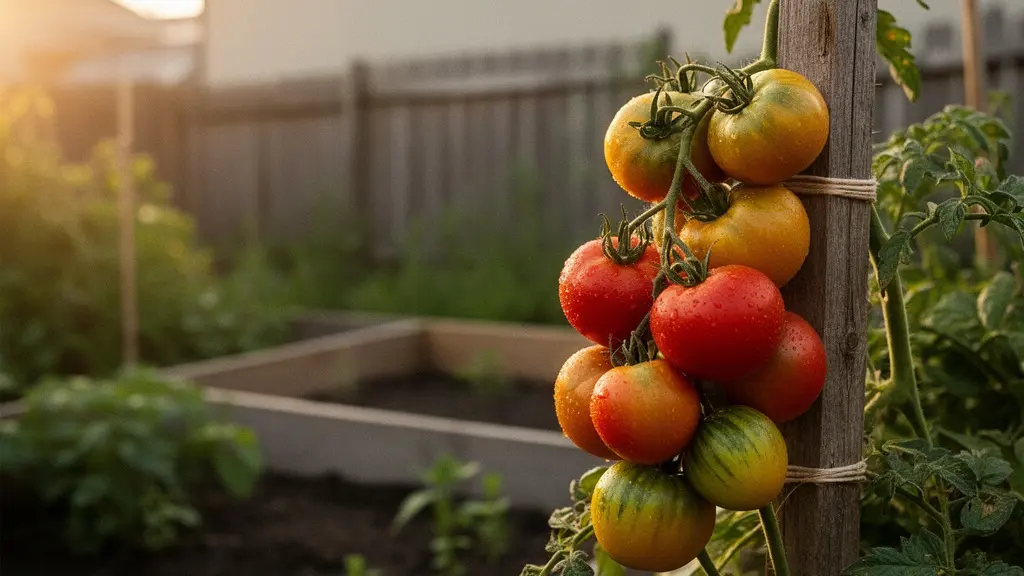
The data reveals a clear strategy: prioritize vertical, continuous-harvest crops with high store premiums. According to a study by the National Gardening Association, an average garden plot provides 300 pounds of fresh produce worth $600 from a $70 investment, yielding $530 in net savings. Maximizing this return requires dedicating limited space to crops like tomatoes that offer both economic and sensory premiums.
Outsource commodity crops to local farmers while your garden specializes in high-value, high-turnover fresh produce that loses quality in transit.
Mushroom Compost or Animal Manure: Which Adds Structure to Clay Soil Faster?
Urban soils often arrive as lifeless clay or construction-compacted fill dirt. Restoring tilth requires organic matter that creates immediate aggregate stability rather than merely adding nutrients. The choice between spent mushroom compost (SMC) and animal manure determines how quickly you achieve workable soil.
SMC excels at rapid structural improvement. The residual fungal hyphae in spent substrate physically bind clay particles into crumb-like aggregates within a single season. This fibrous, light material improves tilth immediately when layered 2–3 inches deep, unlike manure which often requires 6–12 months of composting to avoid salt damage and weed seed contamination.
Animal manure presents significant risks in urban contexts. Feedlot-sourced manure frequently carries extremely high salt content that can seal clay soil tighter rather than loosening it. While manure offers long-term fertility, its bacterial decomposition process works chemically rather than physically, resulting in slower aggregate formation. Additionally, uncomposted manure introduces weed seeds and potential pathogens that compete with your vegetables.
SMC offers additional advantages for immediate planting. Its pasteurized nature eliminates weed seeds, and its pH of 6.5–7.5 suits most vegetables without drastic adjustment. The material works particularly well as a top-dressing or in lasagna layering systems for urban beds filled with heavy construction debris.
Biointensive composting and deep cultivation methods build soil 60 times faster than natural processes when combining SMC with double-digging techniques. For urban homesteaders facing dead clay, SMC provides the structural foundation necessary for immediate planting while long-term composting systems mature.
Prioritize fungal-dominated composts for structure, transitioning to bacterial-dominated manures only after achieving basic tilth and verifying salt content through testing.
How to Find a Local Farmer or Producer to Minimize the Carbon Footprint of Transport?
True urban homesteading recognizes strategic outsourcing. Your small backyard cannot efficiently produce calorie-dense storage crops like potatoes, winter squash, or dry beans—these require extensive horizontal space while offering low grocery premiums. Instead, develop a “gap-filling” partnership with local producers.
Identify your “gap crops”—those space-hogging staples you cannot grow efficiently—and source them specifically from local farmers. Subscribe to a Community Supported Agriculture (CSA) share as “crop failure insurance,” ensuring your kitchen remains seasonal even when weather or pests devastate your home harvest. This maintains dietary continuity without requiring excessive storage space.
Hyper-local food-sharing platforms and neighborhood apps enable surplus exchange—trading your excess herbs for a neighbor’s eggs or fruit. Visit farmers markets at closing time for discounted bulk produce and negotiate direct relationships with growers who offer volume pricing on staples. These connections often provide access to seconds-quality produce perfect for preserving.
Blogger Kristina Seleshanko documented this hybrid approach: her relatively small gardens (12×14 foot and 33×3 foot plots) combined with strategic local sourcing cost only $278 in startup expenses yet produced harvests valued at $1,770.89—a net savings of $1,492.89. Her strategy demonstrates the efficiency of specialization: grow high-value, perishable crops at home while relying on local farmers for storage-heavy bulk items.
This “division of labor” between your garden and regional agriculture minimizes carbon footprint while maximizing the utility of every square foot under your cultivation.
Key Takeaways
- Treat vertical space as load-bearing architecture using cattle panel arches to support heavy crops without structural failure.
- Prioritize biointensive hexagonal spacing and deep soil preparation to achieve 2–4 times higher yields than conventional methods.
- Execute zero-gap succession planting by interplanting crops two weeks before harvest to eliminate bare soil downtime.
- Focus limited garden space on high-value vertical crops (tomatoes, greens) while outsourcing space-intensive staples to local farmers.
How to Restore Life to Dead Soil Using Permaculture Principles?
Dead soil—compact, gray, and odorless—results from chemical sterilization and mechanical compaction. Restoring it requires shifting from input-dependent gardening to closed-loop systems that accelerate natural soil formation. The goal is creating a self-sustaining rhizosphere that improves annually without external amendments.
Tom Bartels demonstrates this transformation in the high desert of southwest Colorado. Despite a short 130-day growing season at 6,500 feet elevation, he grows approximately 1,000 pounds of fruit and vegetables in just 1,700 square feet of beds using biointensive methods. His approach centers on building closed-loop fertility through on-site composting, chop-and-drop mulching, and open-pollinated seed saving—techniques that transform severely depleted soils into productive growing media within three seasons.
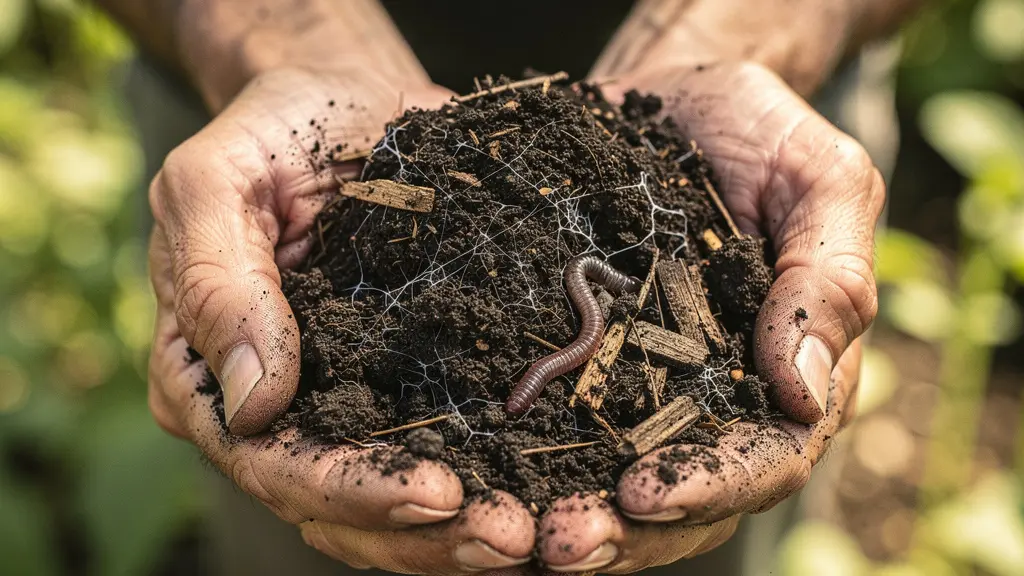
The image above illustrates the goal: living soil containing visible mycelium networks and earthworm activity. Achieving this requires consistent organic matter addition and minimal disturbance. According to Ecology Action’s 40+ years of research data, a single person can be fed a complete vegan diet on 4,000 square feet using biointensive methods, versus approximately 15,000 square feet required by conventional US farming.
Start with aggressive composting—building soil 60 times faster than natural processes—and transition to perennial mulches that feed soil fungi. Avoid tilling, which destroys fungal hyphae and releases sequestered carbon. Instead, layer organic materials on the surface, allowing earthworms to incorporate them naturally.
Transforming dead soil into living ecosystem represents the final step in urban food sovereignty. Begin today by analyzing your current soil structure and implementing double-digging in one bed to experience the difference deep preparation makes.