
The longevity of convertible furniture is determined by its ability to withstand mechanical stress, not its features or style.
- Most failures originate from cheap plastic joints and poorly engineered mechanisms that can’t handle daily folding (cyclic loading).
- In-store testing must go beyond comfort; it requires a physical stress test of the frame, joints, and locking systems.
Recommendation: Adopt a quality inspector’s mindset. Prioritize the integrity of the primary function (e.g., the bed) over all secondary uses, and learn to identify material and mechanical weak points before you buy.
That convertible sofa seemed like the perfect solution for your studio apartment. It was a couch, a bed, and maybe it even had storage. But a year later, the hinges groan, the mechanism clunks, and one side sags. You’re not alone. The market is flooded with multi-function furniture that promises everything but delivers only frustration. For apartment dwellers tired of disposable products, the cycle of buying and replacing is both expensive and wasteful. The common advice—”measure your space,” “check reviews”—barely scratches the surface of the real problem.
The issue isn’t a lack of stylish options; it’s a fundamental misunderstanding of material science and mechanical engineering. Most consumers evaluate convertible furniture based on its functions in a static state. But its true test is dynamic: the repeated stress of transformation. This is where cheap materials and design shortcuts reveal themselves, often within months. The secret to finding a piece that lasts isn’t about finding the one with the most features. It’s about becoming a temporary quality inspector in the showroom.
But what if the key to durability wasn’t in the brand name or price tag, but in your ability to spot specific failure points before purchase? This guide abandons generic decorating tips. Instead, it provides an inspector’s critical, material-focused methodology. We will dissect the anatomy of failure, from the molecular breakdown of plastic under stress to the critical importance of fabric weave and grain direction. You’ll learn not just what to look for, but *why* certain components fail.
This article will equip you with a forensic approach to furniture selection. We will explore the science behind joint failure, provide a rigorous in-store testing protocol, compare fabric durabilities with hard data, and expose the common design traps. By understanding the mechanics of longevity, you can finally invest in a convertible piece that serves you reliably for five years and beyond.
Summary: A Forensic Guide to Buying Durable Convertible Furniture
- Why do plastic joints in sofa beds fail within 200 cycles of use?
- How to test a convertible table in the store to ensure you won’t hate using it daily?
- Polyester blend or Cotton: Which fabric withstands the friction of daily folding and unfolding?
- The design mistake of buying furniture that tries to do 5 things but does none of them well
- When to lubricate hinges and tracks: The yearly maintenance routine for convertible gear
- Why printing a vertical rod makes it 5x weaker than printing it horizontally?
- When to clean the panels: The maintenance schedule to remove pollen and snow
- How to Renovate a Home for Aging Parents Without Making It Look Like a Hospital?
Why do plastic joints in sofa beds fail within 200 cycles of use?
The catastrophic failure of a sofa bed often begins with a tiny crack in a plastic joint. This isn’t random; it’s a predictable outcome of a process called material fatigue. Every time you convert the furniture, you apply a load to its components. When this happens repeatedly, even small stresses create micro-fractures that grow until the part breaks. For a sofa bed used daily, 200 cycles can be reached in just over six months. The choice of plastic is critical here. Low-grade polymers are used to cut costs, but they lack the resilience to handle this cyclic loading.
High-quality plastics like polypropylene (PP) are engineered to resist this. In fact, research on polypropylene’s fatigue resistance shows it can perform comparably to some metals under cyclic stress. The problem is that cheaper, more brittle plastics are visually indistinguishable to the average consumer. Manufacturers rely on this, using inferior materials in hidden, high-stress areas like pivot joints and locking mechanisms. These components are the mechanical heart of the furniture, and their premature failure renders the entire piece useless.
Proper engineering can mitigate these risks even with plastics. A study on the structural integrity of furniture by Song et al. (2024) used finite element simulations to optimize material thickness, reducing weak points. Well-designed pieces will use thicker, reinforced plastic or, ideally, metal inserts at key pivot points. When inspecting a piece, look for flimsy, thin plastic components in the mechanism. If a joint looks like it belongs on a toy rather than a piece of load-bearing furniture, it is a primary candidate for early failure.
How to test a convertible table in the store to ensure you won’t hate using it daily?
A showroom test must be more than a gentle push. You are simulating months of daily use in a few minutes. The goal is to identify resistance, instability, and noise—all signs of poor engineering that will only worsen over time. A mechanism that is stiff or clunky in the store will become a source of daily frustration at home. Your inspection should be systematic and rigorous, focusing on the dynamic performance of the piece. Don’t be shy; you are stress-testing a significant investment.
Start with the mechanism itself. A quality system, often using gas pistons or balanced springs, should operate smoothly and with minimal effort. Any grinding, squeaking, or jerking is a major red flag, indicating friction and potential premature wear. Next, focus on structural integrity. When the furniture is in its fully extended form, like a dining table or bed, it must be completely stable. Any wobble or flex under moderate pressure indicates weak joints or an inadequate frame. This is especially crucial for tables where an uneven surface can be a deal-breaker.
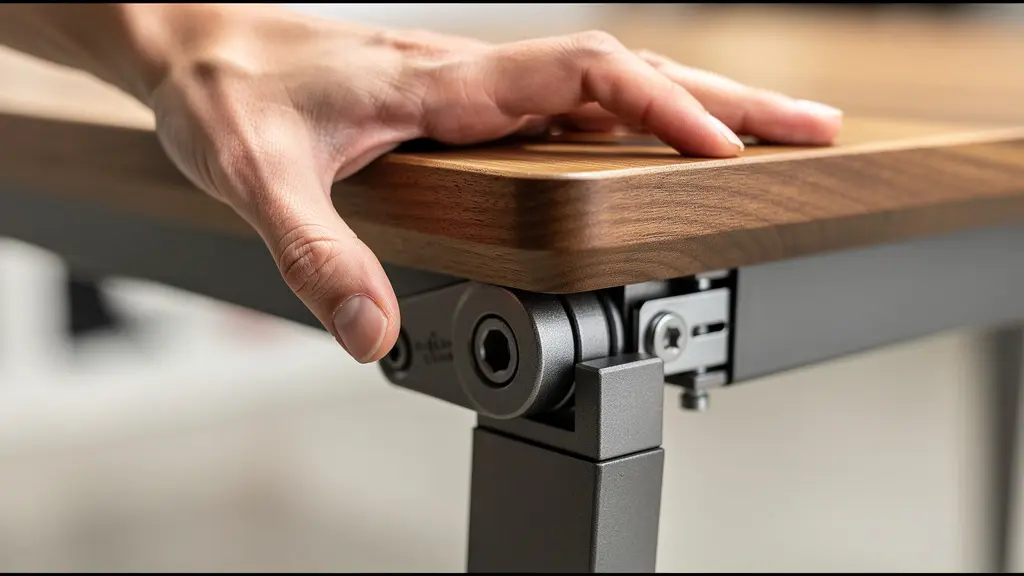
As the image above demonstrates, a key part of the stability check is the corner load test. Applying firm pressure to each corner reveals how the frame and legs distribute weight. This simple action exposes weaknesses that a casual once-over will miss. A solid piece won’t dip, lift, or creak. To make your in-store inspection truly effective, follow a strict protocol.
Your In-Store Inspection Checklist: The 5-Minute Stress Test
- The 10-Rep Test: Operate the primary conversion mechanism 10 times in a row. Note any increase in resistance, new noises, or components becoming misaligned.
- The Corner Load Test: In its most extended state (as a bed or full table), apply firm, downward pressure (approx. 20kg/45lbs) to each corner. Check for any wobble, lift, or flexing.
- The One-Handed Challenge: Attempt to perform the simplest conversion steps (e.g., pulling out a drawer, lifting a flap) with only one hand. Difficulty here indicates poor ergonomics and design.
- Mechanism Smoothness Check: Ensure any gas-piston or spring-assisted systems operate without jerking or sudden drops. The movement should be controlled throughout.
- Lock Security Verification: All locking mechanisms, cams, or hooks must engage with a firm, audible click. Try to gently force them from the locked position; there should be no play.
Polyester blend or Cotton: Which fabric withstands the friction of daily folding and unfolding?
The fabric on convertible furniture endures a unique form of abuse: high-friction rubbing at every fold and hinge point. While a standard sofa sees wear from sitting, a sofa bed’s fabric is constantly abraded by its own mechanism. This is why material choice goes beyond aesthetics; it’s a matter of structural durability. Cotton, while breathable, often has lower resistance to pilling and abrasion compared to synthetic alternatives specifically engineered for high-traffic use.
The industry standard for measuring this durability is the Martindale test. This test measures how many “rubs” a fabric can withstand before showing noticeable wear. As a quality inspector, this number is far more important than the fabric’s composition alone. A higher Martindale count directly translates to a longer lifespan, especially at critical friction points.
For a daily-use sofa bed, don’t accept anything under 30,000 rubs on the Martindale scale – this ensures at least 5 years of regular folding and unfolding without visible wear.
– European Upholstery Standards Committee, in Textile Testing Standards for Furniture Applications
This 30,000-rub benchmark is your non-negotiable minimum. While premium fabrics can exceed 100,000, this baseline ensures the upholstery won’t be the first point of failure. Polyester blends and solution-dyed acrylics generally offer the best performance in this regard, combining high durability with good resistance to pilling and fading. The following table breaks down the typical performance of common fabric types.
| Fabric Type | Martindale Rub Count | Pilling Resistance (1-5) | Best Use Case |
|---|---|---|---|
| Tight-weave Cotton Canvas | 25,000-35,000 | 3 | Budget-conscious, breathable option |
| Polyester Microfiber | 30,000-45,000 | 4 | High-traffic daily use |
| Cotton-Poly Blend (65/35) | 35,000-40,000 | 4 | Best overall balance |
| Solution-dyed Acrylic | 40,000+ | 5 | Premium durability |
The design mistake of buying furniture that tries to do 5 things but does none of them well
In the quest for space-saving solutions, the “5-in-1” piece is an alluring trap. A coffee table that becomes a dining table, that becomes a desk, with hidden storage and integrated footrests, sounds like a triumph of efficiency. In reality, it’s often a masterclass in functional compromise. Each additional function adds mechanical complexity, introducing more potential points of failure. More importantly, the quality of the primary function—what you will use 90% of the time—is almost always diluted.
A sofa bed must first be a comfortable bed for nightly sleep and a decent sofa for daily sitting. If the mechanism required to add a third, fourth, or fifth function compromises the mattress support or seating comfort, the design has failed. The best convertible pieces are often the simplest, excelling at two, or at most three, complementary functions. This minimalist approach allows engineers to focus on creating a robust and reliable core mechanism without the trade-offs required by hyper-functional designs.
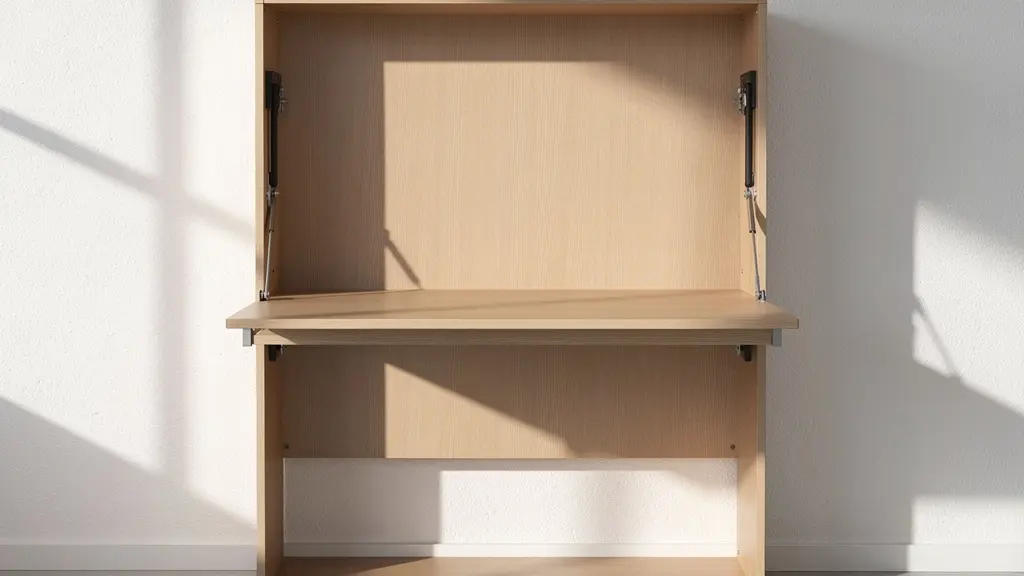
The Murphy bed with an integrated desk, as shown above, is a perfect example of successful dual-functionality. It does two things well, without compromising either. The bed is a proper bed, and the desk is a functional workspace. There are exceptions, of course. The famous expandable furniture in a tiny New York apartment successfully transforms a living room into a 10-person dining room. However, these are typically high-end, precision-engineered systems, not mass-market products. For most consumers, the key is to prioritize and limit functionality.
- Identify ONE non-negotiable primary function (e.g., ‘comfortable nightly sleep’).
- Select ONE secondary function that complements the primary (e.g., ‘daytime seating’).
- Reject any piece attempting more than 3 total functions, as this is a strong indicator of compromise.
- Test the primary function’s effectiveness at 100% before even considering the secondary features.
- Ensure secondary functions don’t compromise the primary function’s quality by more than 10%.
When to lubricate hinges and tracks: The yearly maintenance routine for convertible gear
Purchasing a durable piece of convertible furniture is only half the battle. Like any mechanical system, it requires routine maintenance to ensure a long, trouble-free life. Neglecting it is a surefire way to accelerate wear and tear, leading to the grinding, squeaking, and eventual seizure of moving parts. A simple yearly check-up can prevent the vast majority of age-related failures. The most critical tasks are cleaning debris from tracks and lubricating pivot points.
The number one enemy of a smooth mechanism is not wear, but contamination. Dust mixed with lubricant creates a grinding paste that accelerates component failure.
– Maintenance Engineering Journal, in Industrial Equipment Maintenance Best Practices
This “grinding paste” is the primary villain in your furniture’s life story. It’s why cleaning is just as important as lubricating. Before applying any new lubricant, you must first thoroughly clean all tracks, hinges, and gears with a vacuum, compressed air, or a dry brush. Only then should you apply the appropriate lubricant. For sliding tracks, a dry PTFE or pure silicone spray is ideal as it doesn’t attract dust. For high-load metal-on-metal pivot points, a small amount of white lithium grease may be more effective.
A structured, long-term maintenance plan removes the guesswork. It ensures you’re inspecting the right things at the right time, catching small issues before they become catastrophic failures. Following a schedule like the one below, based on insights from convertible furniture maintenance guides, will dramatically extend the life of your investment.
| Year | Maintenance Task | Products Needed | Time Required |
|---|---|---|---|
| Year 1 | Visual inspection + tighten all user-accessible bolts | Allen key set | 30 minutes |
| Year 2 | Clean tracks + apply silicone lubricant | Pure silicone spray | 45 minutes |
| Year 3 | Inspect fabric at hinge points for wear | Fabric protector spray | 20 minutes |
| Year 4 | Check integrity of welds and joints | None (visual only) | 20 minutes |
| Year 5 | Full clean and re-lubrication of entire mechanism | PTFE spray, white lithium grease | 60 minutes |
Why printing a vertical rod makes it 5x weaker than printing it horizontally?
This question from the world of 3D printing reveals a universal principle of material science that is critically important for furniture: anisotropy. It means that a material’s strength is not the same in all directions. In 3D printing, an object is built layer by layer. If you print a rod standing up (vertically), the layers are stacked like a pile of coins. Pulling on that rod puts stress directly on the weak bonds between the layers, causing it to snap easily. If you print it lying down (horizontally), the force is distributed along the continuous strands of plastic, making it far stronger.
This exact same principle applies to wood, the most common structural material in furniture. Wood has a grain—long fibers running in one direction. A wooden table leg is strong because it is oriented so the grain runs vertically, parallel to the load it must bear. The forces are transmitted down through the strong, continuous wood fibers. If you were to craft a leg with the grain running horizontally, it would be catastrophically weak and snap under the slightest pressure. The layers of wood fiber would simply shear apart, just like the layers in the 3D-printed rod.
As an inspector, you must check the grain direction on all load-bearing components. This is non-negotiable for longevity. Manufacturers of cheap furniture may ignore this to save material, cutting parts from a larger board without regard for orientation. This is a hidden flaw that will lead to certain failure. A quick visual check can save you from a costly mistake.
- Examine table leg end-grain: The lines of the grain should be visible running up and down the length of the leg.
- Check horizontal supports: The grain should run lengthwise along the support beam, not across its shorter width.
- Inspect plywood edges: You should see the cross-laminated layers, which give plywood its multi-directional strength.
- Avoid particleboard/MDF for structural parts: These materials are isotropic (equally weak in all directions) and should never be used for legs, frames, or primary supports.
When to clean the panels: The maintenance schedule to remove pollen and snow
While the title is specific, the underlying principle is universal: contamination is the silent killer of mechanical furniture. Whether it’s outdoor pollen or indoor dust and skin oils, debris that works its way into hinges, tracks, and springs creates a vicious cycle. It absorbs lubricant, attracts more dirt, and forms the “grinding paste” that abrades moving parts with every use. A consistent cleaning schedule is therefore not about aesthetics, but about preserving mechanical function.
For indoor convertible furniture, the main culprits are household dust, pet dander, and oils from skin contact on fabric panels. These contaminants are often invisible until they reach a critical mass within the mechanism. The goal of your maintenance is to remove them before that happens. A vacuum cleaner with a brush attachment is your most valuable tool, allowing you to get deep into the tracks and joints where debris accumulates. This should be done at least twice a year.
The type of cleaning agent is also crucial and depends on the panel material. Using the wrong product can damage the finish or leave a residue that attracts more dust. Always follow the “less is more” approach, starting with the mildest possible solution.
- Spring Cleaning (e.g., April): Use a vacuum with a brush attachment to remove all winter dust from tracks, hinges, and springs. This is the most critical step.
- Panel Surfaces: For matte laminate, use a microfiber cloth with heavily diluted dish soap (a 1:10 ratio with water is sufficient). For high-gloss or wood veneer, use a specialized cleaner, always wiping in the direction of the grain.
- Fall Maintenance (e.g., October): Deep clean any fabric panels with an appropriate upholstery cleaner to remove body oils and dirt accumulated over the summer.
- Protective Coatings: After cleaning, consider applying a material-appropriate protective spray to make future cleaning easier.
Key Takeaways
- Longevity is a function of mechanical integrity; prioritize robust mechanisms over extra features.
- Plastic joints and incorrect wood grain orientation are the two most common hidden points of failure in budget furniture.
- A structured in-store stress test and a commitment to a yearly maintenance schedule are non-negotiable for a 5+ year lifespan.
How to Renovate a Home for Aging Parents Without Making It Look Like a Hospital?
The challenge of designing for aging parents—creating a space that is accessible and effortless without feeling clinical—offers a surprisingly relevant lesson for selecting any piece of high-use furniture. The core principles are ergonomics and reliability. A mechanism that is difficult to operate, requires significant strength, or feels unstable is not just an inconvenience; it is a sign of poor engineering that will affect users of all ages and is a predictor of mechanical failure.
Think about it from an inspector’s viewpoint: if a convertible mechanism is not smooth and easy enough for an older person to use, it means there is excessive friction, poor balance, or weak points in the system. These are the very same issues that lead to breakdowns under daily use by a younger apartment dweller. Therefore, using “accessibility” as a benchmark for quality is a powerful strategy. A truly well-designed piece should feel almost weightless and effortless to transform. It shouldn’t look like a piece of hospital equipment; it should simply work flawlessly.
This need is amplified by a consistent trend in real estate. As apartments are now on average 100 square feet smaller than two decades ago, the reliance on smart, convertible solutions is no longer a niche choice but a mainstream necessity. High-end systems like the Ori Cloud Bed, a robotic bed that descends from the ceiling, are excellent examples. They are marketed for luxury micro-apartments but are designed with the ultimate accessibility in mind: a simple button press. While you may not opt for a robotic bed, the principle holds: seek out designs that prioritize effortless operation. This is your best guarantee of both daily convenience and long-term durability.
Now that you are equipped with an inspector’s checklist, the next step is to apply this critical mindset every time you evaluate a piece of furniture, ensuring your next purchase is an investment in longevity, not a subscription to disappointment.
Frequently Asked Questions about Convertible Furniture Maintenance
What does it mean when my convertible furniture SQUEAKS?
Squeaking indicates dry pivot points that need lubrication. Isolate the specific joint causing the noise by operating the mechanism slowly. Apply a dry PTFE spray directly to that pivot point. Avoid oil-based lubricants which can attract dust.
Why is my mechanism GRINDING when I operate it?
Grinding suggests that dirt, grit, or debris has become trapped in the tracks, creating the “grinding paste” effect. Do not just add more lubricant. First, clean the tracks thoroughly with a vacuum, compressed air, and a soft brush before applying a fresh, clean coat of silicone or PTFE spray.
What causes a CLUNKING sound in my furniture?
Clunking typically means a fastener has loosened or a locking mechanism is misaligned and not engaging properly. Stop using the furniture and perform a visual inspection. Check and tighten all accessible bolts and screws, and verify that all locks are correctly seating in their intended positions.