In summary:
- Protect the canvas surface with a layer of acid-free glassine paper before any other wrapping to prevent permanent marks.
- Understand that a carrier’s “declared value” is not insurance; secure a separate, all-risk fine art insurance policy for real protection.
- Use the correct Harmonized System (HS) code (9701.10 for original paintings) on your commercial invoice to prevent costly customs delays.
- Build your pricing to include all logistical overhead, including crating, insurance, and potential duties, to ensure profitability.
The moment a collector commits to purchasing one of your large-scale works is a career high. The feeling is quickly followed by a logistical dread: how do you get this massive, fragile, and valuable piece across the globe in one piece? The internet is full of well-meaning but generic advice, usually boiling down to “use a lot of bubble wrap and find a sturdy box.” This approach turns shipping into a gamble, relying on hope rather than a sound process.
But for professional artists, hope is not a strategy. What if the real risk isn’t a dented corner, but a permanent, grid-like pattern etched into your varnish from that very bubble wrap? Or a six-figure insurance claim denied due to an “insufficient packaging” clause you never knew existed? Or your masterpiece languishing in a customs warehouse for weeks because of a single error on a form? This is the reality that separates amateur shippers from logistics professionals.
Shipping large art internationally isn’t just about packaging; it’s a calculated business process of risk mitigation. It requires thinking less like a packer and more like a logistics manager, protecting both your artwork and your profit margin from the hidden pitfalls of crating, insurance, and international trade regulations. This guide moves beyond superficial tips to provide a professional framework for every step of the process.
This comprehensive guide breaks down the essential logistical stages, from constructing a robust crate to navigating the complexities of customs and accurately pricing your work to cover these critical expenses. Discover the professional methodology to ensure your art arrives safely and your business remains profitable.
Summary: A Professional Framework for International Art Shipping
- How to build a wooden crate for under $100 that withstands airport handling?
- FedEx vs. Specialized Art Shippers: When is the extra cost absolutely necessary?
- The packaging error that causes bubble wrap to leave permanent marks on acrylics
- Why standard carrier insurance denies 90% of art damage claims?
- How to fill out a commercial invoice to avoid your art getting stuck in customs for weeks?
- How to calculate artist fees so you don’t end up working for free?
- When is an oil painting truly dry: Why waiting 6 months is non-negotiable?
- How to Write a Visual Arts Grant Proposal That Actually Gets Funded?
How to build a wooden crate for under $100 that withstands airport handling?
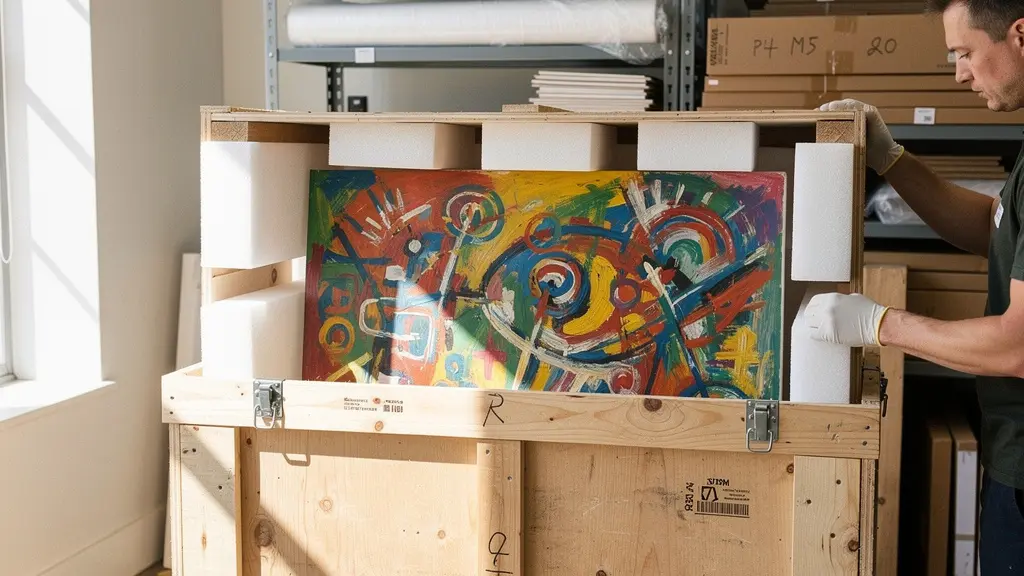
The purpose of a wooden crate is not merely to be a hard shell, but to create a suspension system that isolates the artwork from shock and vibration. While building a basic plywood box for under $100 is feasible, its effectiveness hinges entirely on the internal packing, which is where most DIY efforts fail. Professional crates utilize specialized foam bracing to “float” the painting within the crate, ensuring no external force is directly transferred to the canvas or frame.
To create a professional-grade interior, start by wrapping the artwork correctly (more on that in a moment). The wrapped piece should then be encased in rigid foam insulation board. This “foam sandwich” is then placed inside the wooden crate with a gap of at least two to three inches on all sides. This gap is the crucial buffer zone. It should be filled with precisely cut blocks of Ethafoam or other high-density foam that hold the artwork firmly in place, preventing any movement.
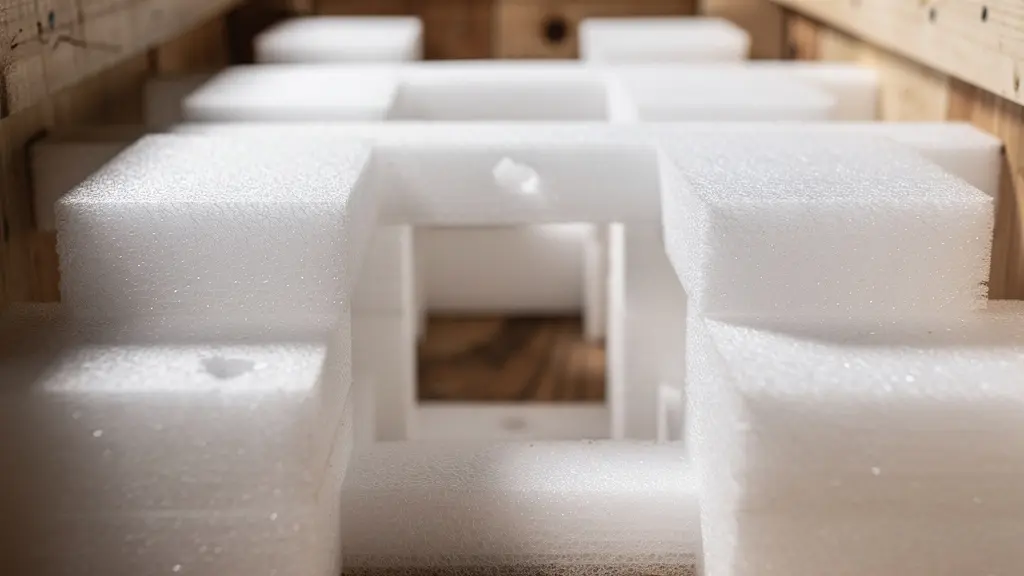
The cost difference between DIY and professional solutions reflects this engineering. While you can build a simple crate yourself, professional services offer options from basic, limited-use crates to museum-quality, reusable ones. According to an analysis by Artwork Archive, a pre-built crate for a small 12×12 inch work can start at $75, while a full museum-quality crate for the same piece can exceed $500. For a large canvas, this cost escalates significantly. The decision to build your own depends on your handiness with tools and the artwork’s value; for high-value pieces, professional crating is a prudent investment in risk mitigation.
FedEx vs. Specialized Art Shippers: When is the extra cost absolutely necessary?
Choosing a shipper is not a simple cost comparison; it’s a decision based on the value and vulnerability of your artwork. Standard carriers like FedEx, UPS, or DHL are logistics giants optimized for moving millions of standardized packages at high speed. Specialized art shippers, in contrast, are boutique services focused on the unique demands of high-value, fragile, and irregularly shaped items. The extra cost is absolutely necessary when the risks associated with standard shipping outweigh the savings.
These risks include a lack of climate control (a painting can go from a freezing cargo hold to a hot tarmac), handling by non-specialized staff, and severe limitations on insurance liability. Specialized “white glove” shippers offer end-to-end management, including climate-controlled transport, professional installation services, and, most importantly, comprehensive, all-risk insurance policies designed for fine art. A current market analysis reveals that shipping a 30″x40″ canvas domestically with a standard carrier might cost $200-$350, whereas a specialized service for the same piece could range from $400 to over $2,000 for international, climate-controlled transport.
The decision matrix is clear: for lower-value works or domestic shipments where you’ve personally built a robust crate, a standard carrier might be a calculated risk. For any high-value artwork (e.g., over $5,000), international shipments, or pieces with delicate surfaces, the extra cost of a specialized shipper is not a luxury—it’s an essential part of your professional responsibility to the artwork and the collector.
| Shipping Type | Cost Range | Features | Best For |
|---|---|---|---|
| USPS Priority Mail | $50-200 | Basic tracking, limited insurance | Paintings under 30″ valued below $1,000 |
| FedEx Standard | $200-350 | Tracking, up to $1000 declared value | Mid-size domestic shipments, 2-5 day delivery |
| Specialized Art Shippers | $400-2000+ | Climate control, white glove service, full insurance | High-value pieces, international shipping |
| Gallery Transfers | 20-30% less than consumer rates | Volume discounts, professional handling | Gallery-to-gallery shipments |
The packaging error that causes bubble wrap to leave permanent marks on acrylics
The most common and heartbreaking packaging mistake is allowing bubble wrap to come into direct contact with the surface of an acrylic painting. Even if the paint feels dry to the touch, the acrylic polymer and any varnish on top may not be fully cured. The pressure of the bubbles against the surface, combined with temperature fluctuations during transit, can cause the plastic to adhere to the varnish or leave permanent, circular impressions. This is due to a process called plasticizer migration, where chemicals from the bubble wrap can leach into and soften the paint surface.
This type of damage, known in the conservation world as “ferrotyping,” is often irreversible without professional intervention. It is a classic example of an “inherent vice”—a problem caused by the nature of the materials themselves. The solution is simple but non-negotiable: never let plastic wrapping touch the face of your painting.
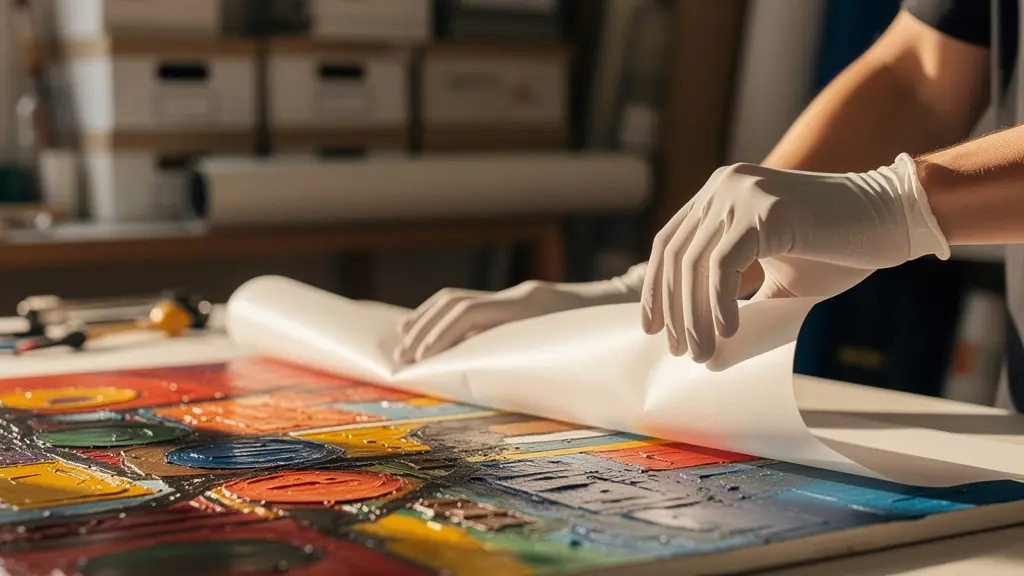
The correct procedure is to first create an archival barrier. The primary choice for this is acid-free glassine paper. This smooth, non-porous paper acts as a neutral shield between the artwork and any subsequent packing materials. After carefully wrapping the painting in glassine (taping it on the back, never on the front), you can then proceed with further layers, such as plastic sheeting for moisture protection or soft foam wraps, before placing it into its foam-board housing or crate. This first, critical step is the single most important action you can take to prevent surface damage.
Why standard carrier insurance denies 90% of art damage claims?
Standard carrier insurance frequently denies art damage claims because their policies are designed for mass-market goods, not unique, high-value items. They rely on two key mechanisms: the critical distinction between “declared value” and “insurance,” and the use of ambiguous exclusion clauses like “insufficient packaging.” Declared value is not an insurance policy; it simply sets the carrier’s maximum liability if—and only if—they are found to be 100% at fault for the loss or damage, a finding they will actively dispute.
Real, all-risk fine art insurance, purchased from a third-party provider, covers a much broader range of scenarios, including accidental damage where no single party is at fault. Carriers use the “insufficient packaging” clause as a catch-all reason for denial. They can argue your packaging was inadequate even if you followed industry best practices, especially if you lack extensive documentation, including photos and videos of the packing process. The burden of proof is on you, the shipper, to demonstrate that your packaging was beyond reproach.
Furthermore, the cost of this limited liability is often misleading. While professional art insurance data shows that insuring a $5,000 artwork can cost from $26 to nearly $200 for comprehensive coverage, the “declared value” fee from a standard carrier provides a false sense of security for a similar price. Without a formal appraisal, a pre-shipment condition report, and a detailed record of your packing process, you have almost no chance of winning a claim dispute. For any serious international shipment, relying on carrier insurance is a financial gamble you are statistically likely to lose.
How to fill out a commercial invoice to avoid your art getting stuck in customs for weeks?
A commercial invoice is the single most important document for international shipping. It’s the primary document customs officers use to determine what your item is, what it’s worth, and what duties and taxes are applicable. Vague, incomplete, or incorrect invoices are the number one reason artworks get delayed, inspected, or slapped with incorrect fees. To avoid this, your invoice must be precise, professional, and fully transparent.
The most critical element is the Harmonized System (HS) Code. This is a standardized international code used to classify traded products. For original paintings, drawings, and pastels executed entirely by hand, the code is 9701.10. Using this specific code signals to customs that the item is a work of art, which is duty-free in many countries, including the US, UK, and EU. Using a generic code for “homewares” or “decorations” can trigger unnecessary taxes. Your description must also be precise: “Original acrylic painting on canvas by [Your Name], ‘[Artwork Title]'” is far better than “wall art.” Finally, the declared value must be accurate; for a sale, it is the sale price. Declaring a zero or artificially low value is a major red flag that invites scrutiny.
Action Plan: Essential Customs Documentation Checklist
- Use the specific HS Code 9701.10 for original paintings to avoid incorrect duties.
- Write a precise description: “Original acrylic painting on canvas by [Artist Name], ‘[Artwork Title]'”.
- Declare the appropriate value: the sale price for commercial sales, or the cost of materials for exhibitions or gifts.
- Never declare a zero value; use a nominal value (e.g., $20) for gifts if required, but check country-specific rules.
- Include a signed artist declaration on your letterhead, stating the work’s originality and country of creation.
- Attach a Certificate of Origin if the artwork is over 50 years old to comply with antiquity regulations.
- Include any necessary CITES permits if your work incorporates materials from endangered species (e.g., certain woods, shells, or ivory).
Understanding the destination country’s rules is also key. While original art is often duty-free, Value Added Tax (VAT) or Goods and Services Tax (GST) usually still applies.
| Country | Duty on Original Art | VAT/GST Rate | De Minimis Threshold (below which taxes are waived) |
|---|---|---|---|
| USA | 0% | No national VAT | $800 |
| EU | 0% | 5-27% (varies by country) | €150 |
| UK | 0% | 5% (reduced import rate) | £135 (for VAT) |
| Canada | 0% | GST/HST applies | CAD $20 |
| Australia | 0% | 10% GST | AUD $1,000 |
How to calculate artist fees so you don’t end up working for free?
After navigating the complexities of crating, shipping, and customs, the final pitfall is financial: underpricing your work and failing to account for the significant logistical overhead. Many artists calculate their price based on materials, time, and a desired profit, then treat shipping as a separate, pass-through cost. This is a mistake. The time, risk, and administrative burden of managing an international shipment are valuable services you are providing to the collector, and they must be factored into your pricing structure.
A professional approach involves creating a detailed pricing formula that itemizes these costs. This ensures transparency for the collector and profitability for you. Instead of just adding a shipping charge at the end, consider building an “International Logistics Management” fee (often 10-15% of the artwork price) into your quote. This covers your time spent coordinating with shippers, preparing extensive documentation, and managing the process. While data on international freight shows a minimum charge of $100 is common, the true “landed cost” is much higher.
A complete international pricing formula should include the following components:
- Base Artwork Price: Your standard calculation of materials, time, studio overhead, and profit.
- International Logistics Management: A 10-15% surcharge for your project management time and expertise.
- Packaging Materials Cost: The actual cost of the crate, foam, glassine, and other materials ($75-$500+).
- Third-Party Insurance Cost: The premium for an all-risk fine art policy (typically 0.5-2% of the artwork’s value).
- Documentation & Brokerage Fees: Any costs associated with hiring a customs broker or preparing special permits ($50-$500).
- Currency Conversion Buffer: A 3-5% buffer to protect against fluctuations in exchange rates.
- Payment Processing Fees: Fees for international wire transfers or credit card payments (3-4%).
You can present this to the collector as two options: “Ex Works” (the collector arranges and pays for all shipping) or “DDP – Delivered Duty Paid” (your price is all-inclusive). The DDP option is more professional and positions you as a full-service artist-entrepreneur.
When is an oil painting truly dry: Why waiting 6 months is non-negotiable?
While this guide is focused on shipping acrylics, a catastrophic and common error arises when artists apply acrylic shipping practices to oil paintings. The drying processes are fundamentally different. An acrylic painting dries by evaporation in a matter of hours or days. An oil painting, however, dries through oxidation—a slow chemical reaction with the air that can take months or even years to fully complete. Shipping an oil painting that is not fully cured is one of the biggest risks in art logistics.
For acrylics, the main concern is the curing of the final varnish layer. Even if the paint itself is dry, a fresh varnish can remain soft for weeks. Before packaging an acrylic painting, you must verify it is cured. The “Thumbnail Test” is a reliable method:
- Wait a minimum of one to two weeks after the final varnish application.
- Choose an inconspicuous area, like the wrapped edge of the canvas.
- Gently press your thumbnail into the surface with firm pressure.
- If an indentation remains, the surface is not fully cured and is not ready for packaging.
- If no mark appears, the painting is ready for the glassine barrier and subsequent wrapping.
For oil paintings, this timeline is drastically different. A thin layer of oil paint might feel “touch-dry” in a week, but the paint underneath is still volatile. Wrapping it can trap off-gassing solvents and, worse, the pressure from packaging can flatten impasto or stick to the surface. The widely accepted industry standard is to wait a minimum of six months for an oil painting of average thickness to cure enough for safe shipping. For very thick impasto, this can extend to a year or more. Rushing this process is a non-negotiable risk that can lead to irreparable damage, and it highlights why understanding the specific properties of your materials is a cornerstone of professional art handling.
Key Takeaways
- A non-stick archival barrier, like glassine paper, between the artwork’s surface and any plastic wrap is the most critical step to prevent permanent damage.
- A carrier’s “declared value” is not a substitute for real insurance. Always purchase a separate, all-risk fine art insurance policy for adequate financial protection.
- Accuracy on customs paperwork, especially the use of the correct HS Code (9701.10), is your direct responsibility and the key to avoiding costly delays and incorrect fees.
How to Write a Visual Arts Grant Proposal That Actually Gets Funded?
The significant costs associated with professional international shipping can be a major barrier for artists. This is where strategic grant writing becomes a powerful tool. Instead of viewing shipping as a personal business expense, you can frame it as a project cost within a grant proposal for an international exhibition, residency, or art fair. Grant panels are increasingly aware of these logistical costs and are receptive to well-researched budgets that include them.
First, it’s essential to understand when you, the artist, are typically responsible for shipping costs. This context is crucial for justifying your funding request. In many scenarios, the financial burden falls squarely on your shoulders, making external funding necessary.
| Exhibition Type | Artist Pays | Venue Pays | Notes |
|---|---|---|---|
| Commercial Gallery | Shipping TO gallery | Return shipping | Standard practice |
| Juried Exhibition | Both directions | – | Artist covers all costs |
| Museum Exhibition | – | Both directions | Museum typically covers all shipping |
| Art Fair (through gallery) | Sometimes TO fair | Return shipping | Varies by agreement |
When you identify a scenario where you are responsible for costs, your grant proposal budget should not just list “Shipping.” It must be a detailed, professional line-item budget that demonstrates you have thoroughly researched the true landed cost. This shows the grant panel that you are a serious professional who understands the business side of your practice. A strong budget will translate all the knowledge from this guide into specific, justifiable figures.
Your budget narrative should include strategic line items such as:
- Professional Custom Crating: Quote based on artwork dimensions ($500-$2000 per artwork).
- Climate-Controlled Art Transport: Specify this need and its premium (20-50% over standard freight).
- Customs Brokerage Fees: An essential fee for ensuring smooth international clearance ($150-$500 per shipment).
- All-Risk Transit Insurance: Based on the artwork’s value (0.5-2% of value).
- Installation/Deinstallation by Art Handlers: If required by the venue ($500-$1500).
By treating logistics as a core, fundable component of your artistic projects, you transform a daunting expense into a strategic opportunity. Stop treating shipping as an afterthought. Start implementing this professional logistical framework today to protect your art, your finances, and your international reputation.
Frequently Asked Questions About Shipping Large Art Internationally
What’s the difference between declared value and actual insurance?
Declared value only sets the carrier’s maximum liability if they are proven to be 100% at fault for the damage or loss, a finding they will actively dispute. It is not an insurance policy. Real, all-risk fine art insurance, purchased from a third-party, covers a much wider array of potential problems, including accidental damage where no single party is deemed at fault.
What documentation is needed for an ironclad insurance claim?
To have a strong chance of a successful claim, you need a comprehensive documentation package. This includes: a formal appraisal or proof of value, a time-stamped pre-shipment condition report with high-resolution photos from all angles, a video recording of the entire packing process, and all original shipping receipts and customs forms.
Why do carriers deny claims for ‘insufficient packaging’?
“Insufficient packaging” is a deliberately vague clause that serves as the primary tool for carriers to deny claims. Because there is no single, legally-binding standard for what constitutes “sufficient,” the carrier can almost always argue that more could have been done. This is why third-party insurance and exhaustive documentation of your professional packing methods are the only reliable forms of protection.