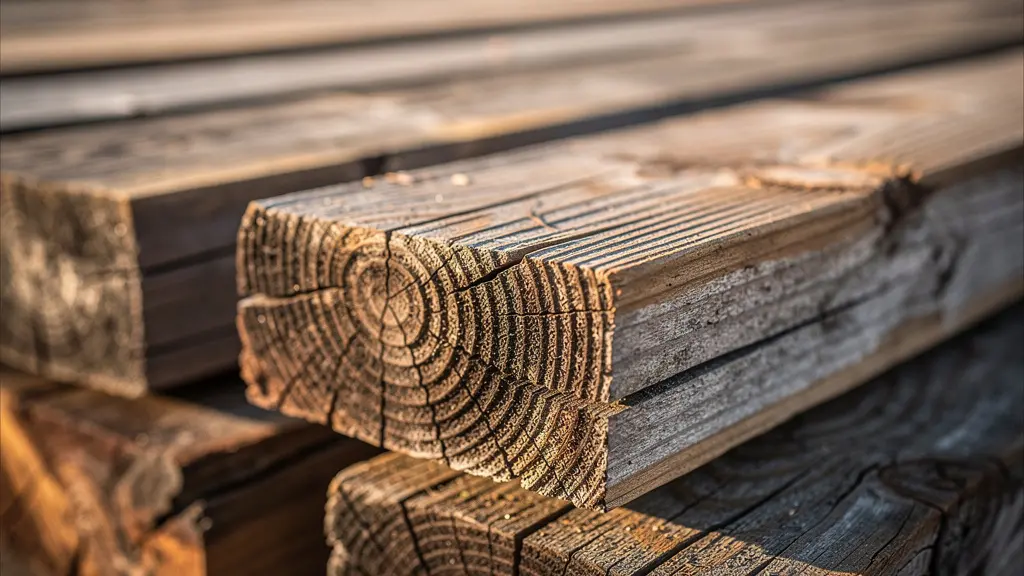
Sourcing for heritage projects isn’t a treasure hunt; it’s a calculated process of risk mitigation where material science meets modern compliance.
- Authenticity requires forensic validation, as chemically aged new wood often masquerades as genuine reclaimed timber.
- Structural integrity is paramount; the romantic appeal of original salvage must be weighed against the predictable performance of engineered reproductions.
- Using historically inappropriate materials, like modern cement on soft 19th-century brick, can cause catastrophic failure within a single decade.
Recommendation: Prioritize material forensics and structural validation over simple aesthetics. The truest authenticity lies in respecting the original material’s physical properties, not just its appearance.
For architects and builders tasked with a 19th-century restoration, the mission is a delicate balancing act. The client envisions a faithful return to historical grandeur, while building codes demand 21st-century performance and safety. The common advice—to scour architectural salvage yards—barely scratches the surface of this complex challenge. It frames the process as a simple shopping trip, a quest for “character” and “rustic charm.” This approach is not only insufficient; it’s fraught with financial and structural peril.
The reality is that sourcing authentic materials is less like shopping and more like a forensic investigation. The market is saturated with convincing fakes, from chemically aged new wood to mismatched brick batches. The true task for a heritage professional is not merely to acquire old materials, but to become a specialist in material validation, logistical planning, and, most importantly, risk management. The wrong choice doesn’t just compromise the aesthetic; it can lead to budget overruns, project delays, and even structural failure.
But what if the key to successful heritage restoration wasn’t just finding old things, but deeply understanding how they work? This guide moves beyond the platitudes to provide a strategic framework for sourcing. We will not be hunting for treasure; we will be mitigating risk. We will explore the forensic techniques to identify fraudulent timber, analyze the critical structural trade-offs between original salvage and custom reproduction, and uncover the hidden material incompatibilities that can doom a project from the inside out. This is the specialist’s approach to ensuring a restoration is not only beautiful, but enduring.
text
This article provides a detailed roadmap for navigating the complexities of sourcing authentic materials. The following summary outlines the key stages of this specialist process, from material validation to risk management.
Summary: A Specialist’s Guide to Sourcing for 19th-Century Restoration
- How to spot fake “reclaimed” timber that is actually chemically aged new wood?
- Original salvage or Custom reproduction: Which is more structurally sound for load-bearing beams?
- The logistical reality of waiting 6 months for hand-fired bricks
- The cement mistake that destroys soft historic bricks within a decade
- Why you need a 20% contingency fund just for material price fluctuations?
- The structural maintenance mistake that ruins stone facades within 10 years
- How to find a local farmer or producer to minimize the carbon footprint of transport?
- How to Insulate Your Home with Hemp or Wool for Better Thermal Regulation?
How to Spot Fake “Reclaimed” Timber That Is Actually Chemically Aged New Wood?
The first rule of material forensics in a heritage project is to assume nothing. The premium price and high demand for reclaimed wood have created a market for sophisticated forgeries. Distinguishing genuine, century-old timber from rapidly-aged new wood is a critical skill that protects both your budget and the project’s integrity. While some sellers are transparent, others may use chemical treatments, mechanical distressing, and stains to mimic the patina of age. A specialist must rely on empirical evidence, not just a seller’s story.
A field-level authenticity check involves a multi-sensory approach. Genuine old-growth reclaimed wood, having air-dried for a century, is significantly denser and heavier than new timber. It often carries a distinct, earthy scent reminiscent of an old attic, starkly different from the sharp, chemical odor of aging agents. Since 1993, organizations like The ReUse People have deconstructed over 4,000 houses, and their experience shows that trained eyes are the best defense. The key is to look for a coherent story told by the wood’s “flaws,” which are, in fact, its certificate of authenticity.
To move from guesswork to a reliable assessment, a systematic field guide is necessary:
- Examine saw marks: Authentic 19th-century timber will show signs of early milling technology. Look for the straight, parallel lines of a water-powered sash saw or the more irregular, slightly curved marks of a pit-saw. Modern circular saws leave arc-shaped marks that are a clear red flag.
- Perform the end grain test: This is the most definitive test. Count the growth rings on the end of the board. True old-growth timber, harvested from virgin forests, has a density of 20 or more growth rings per inch. Modern, fast-growing commercial wood will typically have only 4 to 8.
- Map the character flaws: Authentic nail holes, mortise pockets, and insect marks should tell a logical structural story. For example, nail holes should appear in regular patterns where floor joists or cladding would have been attached. Randomly placed distress marks are a sign of artificial aging.
This forensic approach transforms you from a buyer into an authenticator, ensuring that the material you specify is a true piece of history.
Original Salvage or Custom Reproduction: Which Is More Structurally Sound for Load-Bearing Beams?
This question lies at the heart of the authenticity-versus-performance dilemma. The allure of a massive, hand-hewn beam salvaged from a 19th-century barn is undeniable. It brings an unparalleled story and aesthetic. However, when that beam is destined for a load-bearing application, romance must give way to rigorous structural engineering. An original salvaged beam is an unknown quantity; its history of stress, moisture, and insect damage is often invisible. A custom reproduction, while lacking the historical provenance, offers predictable, engineered performance.
The choice is not a simple “either/or” but a risk assessment based on the specific application. A salvaged beam may possess a “case-hardened” exterior from centuries of slow air-drying, making it incredibly dense. Yet, it could harbor internal rot or checks that compromise its load capacity. Each salvaged structural element requires individual assessment and certification by a structural engineer, adding cost and time. A reproduction, crafted from new timber or engineered wood products, arrives with manufacturer specifications and a guaranteed load capacity, simplifying compliance with modern building codes.
The following table breaks down the critical comparison points, helping to guide a decision based on project priorities rather than emotion. This data, drawn from analyses of material properties, highlights the fundamental trade-offs. For instance, studies on heritage restoration projects show that while reproductions have higher initial costs, their predictable nature can prevent costly over-engineering or on-site failures.
| Criteria | Original Salvage | Custom Reproduction |
|---|---|---|
| Structural Integrity | Case-hardened outer layer (centuries of air-drying) | Uniform strength throughout |
| Load Capacity | Variable; requires individual testing | Predictable; engineered to specifications |
| Material Quality | Old-growth timber (20+ rings/inch) | New-growth (4-8 rings/inch) |
| Cost | 25-50% less than new premium timber | Higher initial cost but predictable |
| Certification | Requires structural engineer assessment | Comes with manufacturer specifications |
Ultimately, for critical structural roles, a high-quality reproduction often provides the necessary margin of safety, while original beams can be used in decorative applications where their authenticity can shine without structural risk.
The Logistical Reality of Waiting 6 Months for Hand-Fired Bricks
In an era of just-in-time delivery, the concept of waiting half a year for a basic building material can seem absurd. Yet, for a 19th-century restoration demanding period-correct masonry, this is a common reality. Authentic hand-fired or wood-fired bricks are not mass-produced commodities. They are crafted by a handful of specialist producers using traditional methods, often to match a specific size, color, and texture from a historical sample. This artisanal process is immune to the pressures of a modern construction schedule.
The six-month lead time is not a sign of inefficiency; it is a testament to the craft. It encompasses sourcing the right clay, molding and drying the bricks naturally, and firing them in small batches in a traditional kiln, a process that can take weeks. Attempting to rush this can lead to catastrophic inconsistencies in color and strength. Therefore, the challenge for the architect or builder is not to shorten the wait, but to integrate this long lead time into the project’s master schedule from day one. It requires a fundamental shift from reactive ordering to proactive logistical management.
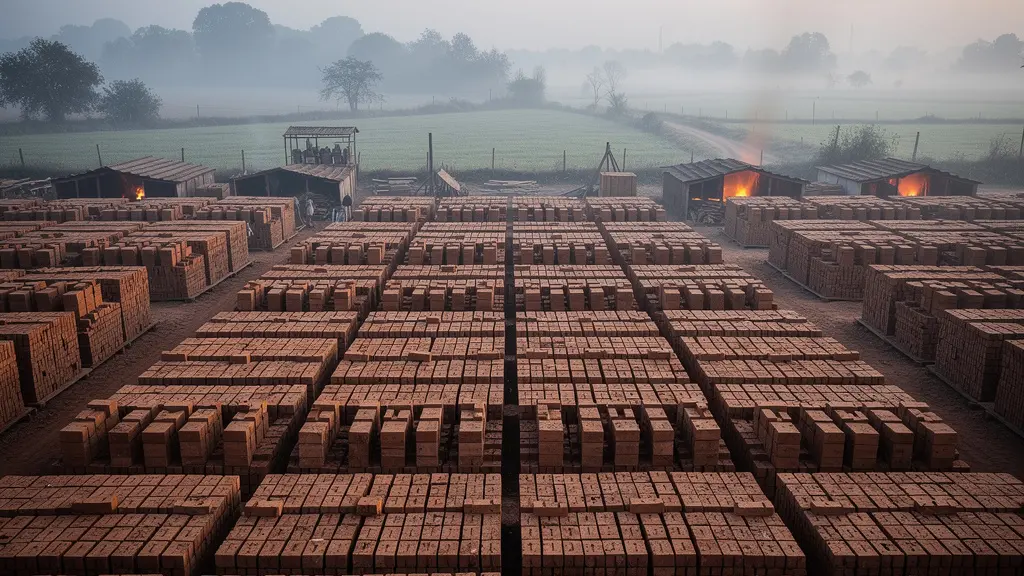
As the illustration shows, this process is defined by manual labor and natural cycles, not automation. Managing this reality involves a specific set of strategies:
- Build material buffers into the schedule: Plan the project sequence so that interior work (plumbing, electrical, plaster) can proceed while waiting for the exterior brick delivery. The building can be wrapped and weatherproofed, turning the wait time into productive work time.
- Create contractual safeguards: When ordering custom bricks, the contract must be meticulously detailed. Specify an acceptable range of color variation (e.g., provide a physical control sample) and include a breakage allowance of 5-10% to account for shipping and handling losses.
- Conduct a storage cost analysis: If a batch of matching bricks becomes available early, weigh the cost of pre-purchasing and storing them against the risk of future price increases or the producer going out of business.
- Document provenance during the wait: Use the lead time to formally document the material’s story—the clay source, the firing method, the maker’s marks. This documentation adds verifiable value to the finished project.
Viewing the lead time as a manageable project phase, rather than a delay, is the hallmark of a specialist.
The Cement Mistake That Destroys Soft Historic Bricks Within a Decade
Of all the potential errors in a 19th-century restoration, this is one of the most common and destructive. Driven by modern building habits, a well-meaning mason may use a standard Portland cement-based mortar to repoint or repair historic brickwork. The result is a ticking time bomb. Portland cement is extremely hard, dense, and impermeable. Historic bricks, particularly those from the 19th century, are relatively soft, porous, and were always intended to be laid with a soft, breathable lime-based mortar.
When these two materials are combined, a destructive battle begins. The historic wall system was designed for moisture to travel through and evaporate from the sacrificial mortar joints. When those joints are filled with impermeable cement, moisture becomes trapped in the bricks themselves. During freeze-thaw cycles, this trapped water expands, and since the mortar is now harder than the brick, the brick face spalls and crumbles. The Portland cement effectively turns the wall’s moisture management system against itself, destroying the very material it was meant to protect. Documented cases from Italian heritage projects show that using the correct Natural Hydraulic Lime (NHL) mortar can extend a facade’s life by 200-300% compared to using cement.
Hiring the right mason is therefore less about finding someone who can lay bricks and more about finding a specialist who understands historic material science. Vetting them is a critical risk-management step.
Your Vetting Checklist for a Historic Masonry Specialist
- Ask about their process for selecting Natural Hydraulic Lime (NHL) grades: They should explain why they’d choose NHL 2, 3.5, or 5 based on the specific softness and exposure of the historic brick.
- Request a portfolio of previous lime mortar projects with a verifiable 5+ year history. Look for photos showing how the mortar has aged gracefully without damaging the surrounding brick.
- Verify their understanding of the “sacrificial mortar” principle. Ask them to explain how they manage moisture movement through the wall assembly.
- Inquire about their sand sourcing methods for color matching. A true specialist will match color using different sands, avoiding modern pigments which can fade unpredictably.
Choosing a soft, lime-based mortar isn’t a stylistic choice; it’s a fundamental requirement for the long-term survival of the building.
Why You Need a 20% Contingency Fund Just for Material Price Fluctuations?
While sourcing reclaimed materials can offer significant initial savings—studies show that projects can realize 25-50% cost savings on reclaimed lumber compared to new premium timber—this figure can be dangerously misleading. The upfront purchase price is only one part of the total cost equation. The market for high-quality, authentic reclaimed materials is volatile, illiquid, and unpredictable. A 20% contingency fund is not “fat” in the budget; it is a necessary risk management tool to absorb the inevitable shocks of sourcing unique items.
Unlike commodity materials with stable pricing, the cost of a specific batch of 19th-century heart pine flooring or matching bluestone pavers can double overnight based on a single high-profile auction or the discovery of a new, wealthy buyer. The contingency fund is designed to cover several specific, predictable-in-their-unpredictability scenarios. It allows you to say “yes” to a perfect, but unexpectedly expensive, discovery mid-project. It covers the premium for rush shipping when a long-awaited item finally becomes available. Most importantly, it accounts for usable yield loss—the fact that a significant portion of a purchased batch of old flooring or timber may be unusable due to rot, splits, or damage.
A professional budget allocates this contingency fund strategically, rather than treating it as a single slush fund. The following breakdown illustrates a typical allocation for a materials-focused contingency:
| Risk Category | % of Fund | Typical Scenarios |
|---|---|---|
| Market Price Volatility | 8-10% | Sudden demand spikes, seasonal variations |
| Shipping/Crating Costs | 5-6% | Fragile items, special handling requirements |
| Discovery Premium | 4-5% | Perfect match found mid-project |
| Usable Yield Loss | 30-40% extra purchase | Splits, rot, unusable sections in flooring |
By building in this buffer, you transform material sourcing from a source of budget anxiety into a strategic advantage, empowering the project to acquire the best possible materials when they become available.
The Structural Maintenance Mistake That Ruins Stone Facades Within 10 Years
The principle of using soft, sacrificial mortar is not limited to brickwork; it is equally, if not more, critical for historic stone facades. Nineteenth-century structures built with limestone, sandstone, or brownstone are highly susceptible to the same destructive forces as brick when repaired with modern Portland cement. Case studies from restoration specialists like Fischer Restoration have documented catastrophic failures in limestone facades in as little as 10 years after being repointed with hard cement mortar. The mechanism is identical: the impermeable cement traps moisture within the softer stone, leading to spalling, cracking, and delamination during freeze-thaw cycles.
The cement essentially acts as a wedge, leveraging the historic stone apart from within. This mistake is often made during routine maintenance, turning a small repointing job into the primary cause of a future, full-scale restoration crisis. The remedy, as with brick, is a strict adherence to using breathable, lime-based mortars that are softer than the stone itself. This ensures the mortar joint remains the sacrificial element of the wall system, protecting the irreplaceable historic stone.
When damage has already occurred, true restoration craftsmanship favors repair over replacement. Techniques like the “Dutchman” repair involve meticulously carving out the damaged section of stone and inlaying a new, precisely-fitted piece of matching stone. This highly skilled work preserves the maximum amount of original material and is far superior to patching with a cementitious compound, which will inevitably fail and cause further damage.
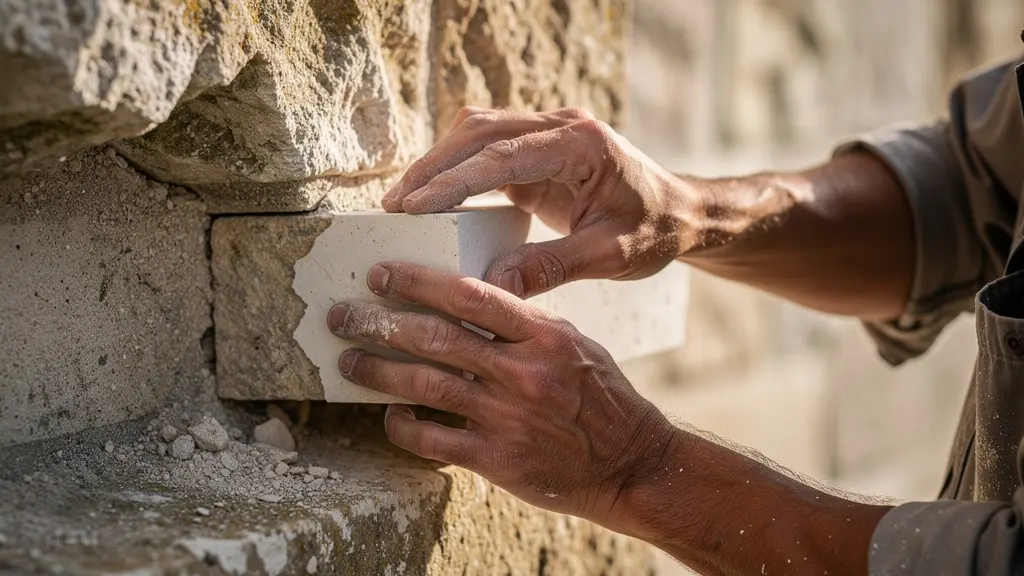
Embracing these traditional techniques, from mortar choice to repair methods, is the only sustainable path to preserving historic stone facades for future generations.
How to Find a Local Farmer or Producer to Minimize the Carbon Footprint of Transport?
While the focus of this guide is on authenticity and structural performance, a resourceful sourcing strategy can also yield significant environmental benefits. Minimizing the carbon footprint of a restoration project often comes down to reducing “material miles”—the distance materials are transported from source to site. This requires moving beyond established salvage dealers and developing a hyper-local sourcing network. The most authentic and low-impact materials are often sitting in plain sight, viewed as a liability by their current owners.
The key is to think like a deconstruction specialist, not a buyer. A farmer with a collapsing 19th-century barn may not see a valuable stock of old-growth timber; they see a dangerous and expensive problem. By offering a solution (safe dismantling and site cleanup), you can often acquire priceless materials for little more than the cost of labor. This proactive, relationship-based approach requires creativity and local knowledge.
Building this hyper-local network involves a specific set of tactics that go far beyond a simple web search:
- Build relationships with demolition companies: Approach local demolition contractors and educate them on the value of materials in the historic buildings they are tasked to tear down. Offer to act as a consultant or a buyer for materials they would otherwise pay to send to a landfill.
- Use hyper-local search terms: Instead of searching for “reclaimed wood,” use highly specific, location-based terms like “heritage barn removal + [county name]” or “salvage rights for old mill + [township name].”
- Offer barter services: For smaller property owners, the offer of free, insured, and professional dismantling in exchange for the materials is often more attractive than a cash payment. Frame it as a problem-solving service.
- Contact local historical societies: These organizations are often the first to know about historic properties slated for demolition or major alteration. They can be an invaluable source of leads for materials that need a new home.
This approach not only reduces the carbon footprint but also uncovers materials with an unimpeachable and fully documented local provenance, adding another layer of value to the project.
Key takeaways
- Authenticity is a science, not a guess: Rely on forensic evidence like saw marks and end grain density to validate timber, not on a seller’s story.
- The wrong mortar is a system killer: Using modern Portland cement on historic soft brick or stone is not a repair; it’s a guaranteed future failure due to trapped moisture. Always use a softer, lime-based mortar.
- Budgeting for heritage materials requires a structured contingency: A 20% fund isn’t just for overages; it’s a strategic tool to manage market volatility, shipping costs, and unusable yield loss.
How to Insulate Your Home with Hemp or Wool for Better Thermal Regulation?
When upgrading the thermal performance of a 19th-century building, modern insulation solutions can be another form of the “cement mistake.” Standard fiberglass batts or closed-cell spray foams are often vapor barriers. When installed in the solid-wall construction typical of the era, they can trap moisture, leading to rot in timber framing and a failure of the building’s original, self-regulating moisture management system. The building needs to “breathe,” and the insulation must be part of that system, not a barrier to it.
Natural, vapor-permeable insulation like hemp or sheep’s wool is often the ideal solution for historic structures. These materials have the ability to absorb and release moisture (a property known as hygroscopicity), which helps to buffer indoor humidity and prevent condensation from forming on or within the wall structure. Case studies on historic renovations show that this property is essential for maintaining the health of the original lath and plaster walls. Furthermore, hemp and wool batts offer superior sound-dampening qualities, a significant benefit in improving the livability of older homes.
Correct installation is critical to realizing these benefits without damaging the historic fabric of the building:
- Install batts without compression: Hemp and wool batts should be cut slightly oversized and friction-fit between studs. Compressing them reduces their thermal value. Care must be taken not to damage fragile original lath.
- Use loose-fill for irregular cavities: The uneven nature of 19th-century framing creates many non-standard cavities. Blown-in, loose-fill versions of hemp or wool are perfect for filling these gaps completely without creating voids.
- Pair with a breathable interior finish: To complete the breathable wall assembly, the insulation should be paired with a vapor-permeable interior finish, such as a traditional lime plaster or a modern “smart” vapor control layer, rather than a standard polyethylene vapor barrier.
By adopting a mindset of forensic analysis and diligent risk management, you can elevate your restoration projects from simple renovations to enduring testaments of architectural history. The next step is to integrate this material-first approach into your earliest project planning stages.