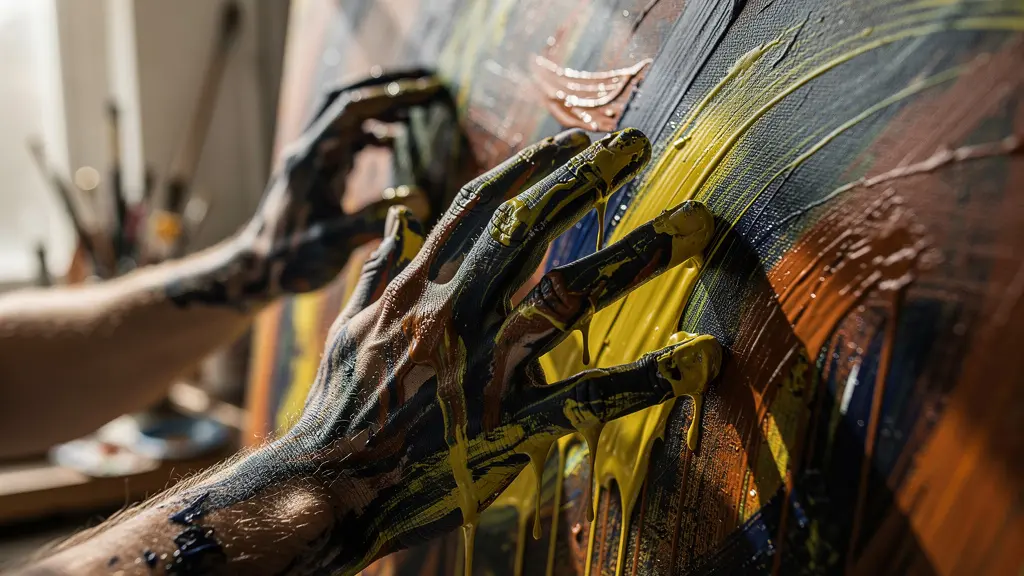
Expressing deep emotion through abstract art isn’t about finding the ‘right’ color for sadness; it’s about engaging in a physical dialogue that bypasses the critical mind entirely.
- Perfectionism is the primary block; the goal is cathartic release, not a flawless product.
- Your body is the best tool; using hands or aggressive knife strokes provides a more direct kinesthetic release than controlled brushwork.
Recommendation: Start by choosing one feeling, select colors based on its physical ‘energy’ (not its cliché), and give yourself permission to make a ‘mess.’ The painting is a record of the conversation, not a portrait of the emotion.
There’s a silent language we all speak, a current of feeling that runs deeper than words. Joy, grief, rage, peace—these states can be so immense that language feels inadequate, a tiny net trying to capture an ocean. Many of us turn to creative outlets, hoping to give these feelings a form. We pick up a brush, face a blank canvas, and the pressure immediately mounts: “How do I paint sadness? What does joy look like?” We search for a literal translation, a perfect symbol.
The common advice is to “let go” or “be free,” but these instructions often feel as abstract as the art we’re trying to create. We’re told to focus on the process, but the silent demand for a beautiful, coherent result paralyzes us. This is where we mistake the purpose of expressive art. The goal isn’t to create a pretty picture *of* an emotion. It’s to have a physical conversation *with* the emotion itself.
But what if the true key to unlocking this expression isn’t in finding the perfect color for anger, but in discovering the right physical gesture to release its tension? This guide reframes abstract painting as a somatic dialogue. It’s not about what your painting looks like; it’s about what it *feels* like to create it. We’ll explore how to bypass the critical mind that demands perfection and instead use color, tools, and even “mistakes” as a direct channel for emotional energy.
This article will guide you through this liberating process. We will deconstruct the mental traps that block expression, explore practical ways to build an intuitive emotional language, and learn to recognize when the conversation with your art is truly complete, turning your canvas into an honest artifact of your inner world.
Summary: A Practical Guide to Painting Your Unspoken Feelings
- Why trying to paint “perfectly” blocks your ability to release true emotion?
- How to choose a color palette that matches the intensity of your anger or joy?
- Brushes or Hands: Which application method releases more physical tension?
- The mindset trap that forces you to fix “mistakes” instead of feeling them
- When to stop adding layers: Knowing when an emotional piece is finished
- Why do dark oil colors turn dull and matte as they dry?
- Why is silica dust invisible to the naked eye yet deadly after 10 years?
- How to Protect Your Artistic Expression from Shadowbanning on Instagram?
Why trying to paint “perfectly” blocks your ability to release true emotion?
The desire to create something “good” is the single greatest obstacle to genuine emotional expression. When you stand before a canvas with the goal of perfection, you activate the analytical, judging part of your brain. This is the voice that criticizes, plans, and corrects. It’s the opposite of the intuitive, feeling state required for authentic release. Instead of channeling emotion, you begin managing expectations, turning a potentially cathartic act into a performance with an audience of one: your inner critic.
This pursuit of flawlessness creates a chokehold on creativity. As one analysis on the subject highlights, this pressure can lead directly to creative blocks and burnout, where artists either obsessively revise their work or abandon it entirely out of fear. A study on artistic creation found that the fear of falling short of impossibly high standards is a major source of anxiety. The energy that should be flowing into the canvas is instead diverted to managing this fear. You’re no longer painting your grief; you’re painting your anxiety *about* painting your grief correctly.
True emotional release requires vulnerability and messiness. It demands that you give yourself permission to be clumsy, chaotic, and incoherent. The goal is not a masterpiece; it is a record of a feeling. As researcher and author Brené Brown reminds us, this is a critical distinction:
Understanding the difference between healthy striving and perfectionism is critical to laying down the shield and picking up your life.
– Brené Brown, Art Therapy Spot
In this context, your paintbrush is not a tool for rendering beauty. It is a tool for laying down the shield. Each “imperfect” mark is not a failure but a word in a language that doesn’t require polish. The moment you stop trying to make a “good painting,” you start creating an honest one.
How to choose a color palette that matches the intensity of your anger or joy?
Forget the simplistic notion that “red is for anger” and “yellow is for joy.” Building an emotional palette is not about using a universal color code; it’s about developing a personal, intuitive language. The key is to shift your focus from the emotion’s name to its physical energy. Does your anger feel like a hot, sharp explosion or a cold, heavy weight? Is your joy light and effervescent, or is it a deep, resonant warmth? This somatic approach allows for a much richer and more honest expression.
Start by treating colors not as symbols, but as ingredients with different temperatures, weights, and textures. A pale, almost-white pink could represent a simmering, cold rage far more accurately than a loud crimson. A deep, velvety black might capture a moment of profound, serene joy better than a bright yellow. This is a deeply personal process, and research confirms its power; a 2025 comparative analysis reveals that art students demonstrate a significantly stronger and more nuanced affective engagement with abstract colors than non-artists, suggesting this is a skill that can be cultivated.
This exploration helps you build a complex emotional landscape. An emotion is rarely monolithic; your grief might be a mix of deep blue, muddy grey, and a surprising slash of vibrant orange. Let the colors talk to each other on the canvas, blending and clashing as your feelings do.
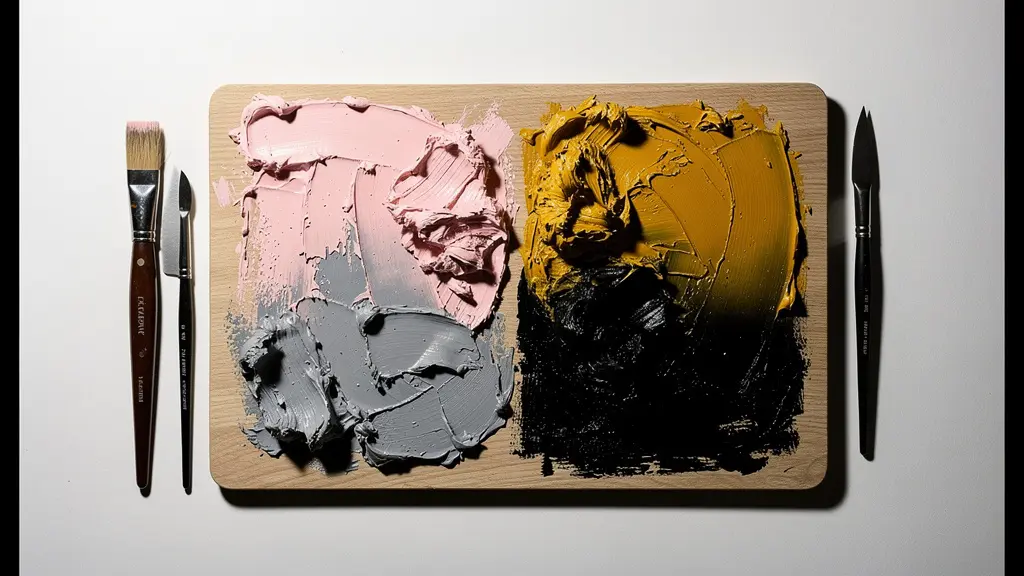
The following checklist provides a framework for starting this dialogue with color, moving you from thinking about emotion to feeling it through pigment.
Your action plan: Building a personal emotional color language
- Start by reflecting on your current emotional state before choosing any colors. Close your eyes and ask: where does this feeling live in my body? What is its temperature and weight?
- Experiment with counter-intuitive palettes. Deliberately choose a color you wouldn’t normally associate with the feeling and see what it reveals. Try pale pink for rage or deep black for joy.
- Consider the ‘weight’ and ‘temperature’ of colors beyond just their hue. Think about how a thick, heavy application of dark paint feels different from a thin, light wash of a bright color.
- Build complex emotional landscapes using multiple, sometimes conflicting, colors for a single emotion to reflect its true complexity.
- Document your unique color-emotion associations in a journal. Note which combinations felt most authentic, creating a personal reference for your future work.
Brushes or Hands: Which application method releases more physical tension?
The tool you use to apply paint is not just a mediator; it is an active participant in your emotional dialogue. The choice between a fine-tipped brush and your own hands is a choice between control and surrender, between precision and kinesthetic release. Different tools engage your body in profoundly different ways, offering distinct pathways to express and relieve physical and emotional tension. The question is not which is better, but which tool best serves the specific energy of the emotion you are processing.
Using your hands and fingers is the most direct method. It bypasses the intellectual distance a brush creates, providing immediate sensory feedback. The feeling of smearing thick, cool paint across a surface connects you to a primal, pre-verbal state of creation. This method is exceptionally effective for releasing stored physical tension, as it engages the large muscles of your arms and shoulders, turning the act of painting into a form of physical exertion.
Conversely, brushes offer a more nuanced and controlled form of expression, acting as an extension of your arm. A palette knife, with its sharp edges and firm surface, is perfect for aggressive, decisive movements that can channel feelings of anger or frustration. It allows you to scrape, slash, and build up textures that have a visceral, almost violent quality. A soft sponge can be used for gentle, dabbing motions, ideal for processing softer emotions like grief or sadness, where absorption and release are more fitting than aggressive application.
This table, based on an analysis of different abstract techniques, breaks down how each tool facilitates a different kind of emotional work.
| Tool Type | Physical Connection | Emotional Release | Best For |
|---|---|---|---|
| Hands/Fingers | Direct sensory feedback, activates more nerve endings | Primitive, visceral connection | Releasing stored physical tension |
| Brushes | Extension of arm, fine motor control | Controlled expression | Detailed emotional exploration |
| Palette Knife | Sharp, decisive movements | Aggressive release | Anger, frustration |
| Sponges | Soft, absorbing texture | Gentle processing | Grief, sadness |
The mindset trap that forces you to fix “mistakes” instead of feeling them
During the creative process, an unexpected drip, a “muddy” color mix, or a line that goes astray can trigger an immediate impulse: “I have to fix this.” This reaction pulls you out of the emotional flow and back into the critical mindset of problem-solving. This is the mindset trap. When you see these moments as “mistakes,” you are judging the painting against an imaginary standard of perfection. But in expressive art, there are no mistakes—only artifacts of the emotional dialogue.
That accidental smear of brown isn’t an error; it’s a record of a moment of hesitation or a surge of chaotic energy. That drip running down the canvas isn’t a flaw; it’s gravity participating in your conversation. To “fix” it is to erase a part of the story, to censor the raw transcript of your feelings. The goal is to feel the emotion, not to manage its appearance. When you stop to correct, you halt the emotional process to perform aesthetic maintenance.
A more liberating approach is to embrace these moments, inspired by the Japanese philosophy of Kintsugi—the art of repairing broken pottery with gold, highlighting the cracks instead of hiding them. When an “accident” happens on your canvas, pause. Instead of reaching for a rag to wipe it away, consider how you can honor it. Can you outline it? Can you make it the focal point? Can you surround it with a contrasting color to celebrate its uniqueness?
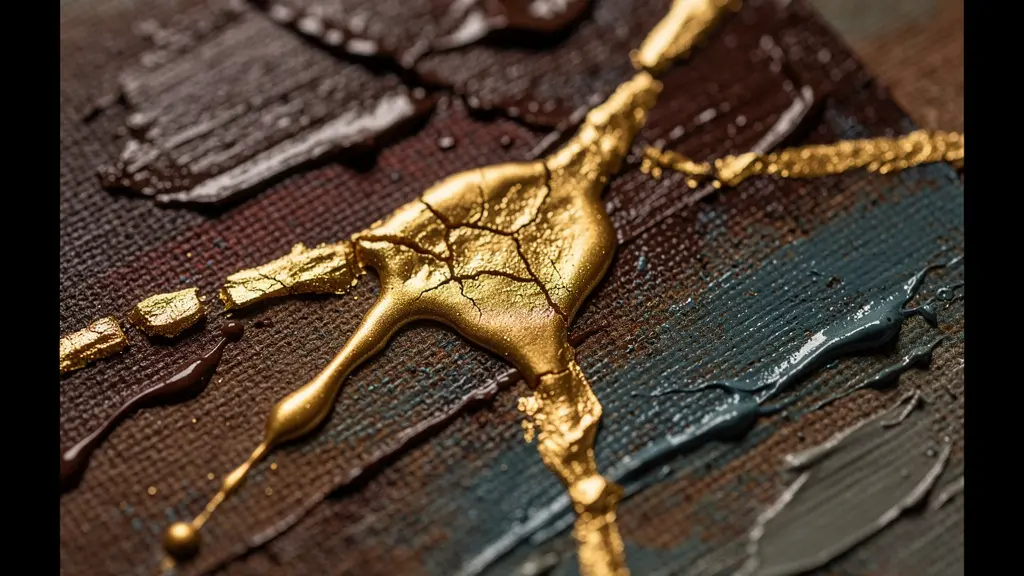
This shift in perspective is transformative. It turns moments of frustration into opportunities for deeper discovery. The “mistake” often becomes the most interesting and honest part of the piece, a testament to the unpredictable nature of emotion itself. By allowing these imperfections to exist, you are giving yourself permission to be fully human on the canvas, messy and uncontrolled.
When to stop adding layers: Knowing when an emotional piece is finished
In traditional painting, a piece is finished when it is aesthetically resolved. In expressive abstract art, the finish line is emotional, not visual. Knowing when to stop has nothing to do with whether the painting looks “good” and everything to do with whether the emotional conversation has reached a natural conclusion. Pushing past this point is like forcing a conversation after everything has been said; it often leads to overworking the piece and muddling the original, raw expression.
The signals for completion are somatic and intuitive. They are felt in the body, not seen with the eyes. It might be a sudden feeling of lightness, a deep exhale, or a sense of quiet calm settling in. It could also be a feeling of complete exhaustion, as if the emotional energy you were channeling has been fully spent. Trust these internal cues. As artist Claire Desjardins explains, the end is a feeling of closure:
The piece is finished when you feel a sense of catharsis, release, quiet, or even exhaustion. The ‘conversation’ with the emotion has come to a close for now.
– Claire Desjardins, Painting from the Heart Guide
If you’re unsure, step away. One powerful technique is the 24-hour inversion test: turn the painting to face the wall and don’t look at it for a full day. When you turn it back around, your first gut reaction is the most honest one. Do you feel a sense of resonance and completion, or do you feel a nagging urge to add something? If it’s the latter, the conversation may not be over. If you feel a sense of peace, it’s done.
It’s also helpful to reframe the idea of “finished.” Instead of seeing each piece as a final, monumental statement, consider it an entry in a visual diary. It is complete *for today*. It has captured the feeling of this specific moment. Tomorrow, a new page awaits. This releases the pressure for each piece to be a masterpiece and allows it to be what it truly is: a single, honest breath.
Why do dark oil colors turn dull and matte as they dry?
As you work, you might notice a frustrating technical issue: your rich, dark, and vibrant oil colors look luscious when wet but become dull, chalky, and matte as they dry. This phenomenon, known as “sinking in,” happens when the oil binder from the paint is absorbed by the underlying layer or gesso, leaving the pigment on the surface looking under-bound and lifeless. While this can be seen as a technical flaw to be corrected, in the context of emotional expression, it can also be embraced as a powerful metaphorical tool.
Just as emotions can feel vibrant and overwhelming in the moment, only to recede into a dull ache later, the changing nature of oil paint can mirror this process. Instead of fighting it, you can work *with* it. The contrast between a glossy, wet area and a sunken, matte section can create profound visual and emotional depth. A glossy finish can represent an active, present emotion, while a matte finish might symbolize a memory, exhaustion, or a feeling that has subsided.
You can use this technical property intentionally as part of your emotional vocabulary. For example:
- Symbolize emotional exhaustion: Allow an area representing intense feeling to dry to a dull, matte state to show the aftermath and energy drain of that emotion.
- Create emotional depth: Contrast a richly varnished, glossy black (representing a sharp, present grief) with a sunken, matte grey (representing a lingering, older sadness).
- Control the narrative: Use glazing techniques—applying thin, transparent layers of color mixed with a medium—over dry, sunken areas to “re-awaken” them, symbolizing a return to or reprocessing of a past feeling.
This approach transforms a technical problem into an expressive opportunity. By understanding why darks sink in, you gain the power to either prevent it (by using a less absorbent ground or “oiling out” the surface) or, more interestingly, to command it as part of your somatic dialogue. The material is not an obstacle; it’s another voice in the conversation.
Why is silica dust invisible to the naked eye yet deadly after 10 years?
In a practice centered on vulnerability and release, creating a safe physical space is the first and most crucial step toward creating a safe psychological one. Many art materials, particularly those used in sculpture, ceramics, and even some pigments, contain crystalline silica. When sanded, scraped, or disturbed, it creates a fine, invisible dust. These particles are so small they bypass the body’s natural defenses, lodging deep in the lungs and causing irreversible scarring (silicosis) over years of exposure. It’s a silent, hidden danger that underscores a critical principle: your creative sanctuary must first be a physically safe one.
This might seem purely technical, a chore unrelated to the lofty goal of emotional expression. But the act of maintaining a safe studio—wearing a respirator, using proper ventilation, cleaning with a wet mop instead of a dry broom—is a form of mindfulness. It is a ritual of self-care. It sends a powerful message to your subconscious: “I am worthy of protection. This space is safe.” You cannot be truly vulnerable and open to emotional release in an environment that is, on a fundamental level, harming you.
The connection between physical safety and mental well-being in the studio is not just anecdotal. In fact, studies on artist wellbeing indicate that practitioners with safe and mindful studio habits report significantly better mental health outcomes. By consciously managing invisible risks like silica dust, you are practicing a form of grounding. You are tending to your physical self, which allows your emotional self the freedom and security to emerge.
Think of studio safety not as a set of restrictive rules, but as the foundation upon which your expressive freedom is built. Just as a therapist’s office must be a confidential and safe space for a client to open up, your studio must be a physically non-threatening space for your emotions to surface without inhibition. Protecting your lungs from invisible dust is a profound act of honoring the body that houses the very emotions you seek to express.
Key takeaways
- Abandon perfectionism; the goal of expressive art is emotional release, not a flawless product.
- Develop a personal color language based on the physical ‘energy’ of your emotions, not on universal symbols.
- Use your tools, especially your hands, as a means of kinesthetic release to translate emotional tension into physical action.
How to Protect Your Artistic Expression from Shadowbanning on Instagram?
After engaging in a deeply personal and vulnerable process of emotional expression, the modern artist faces a new challenge: sharing that work with the world. Social media platforms like Instagram are powerful tools for connection, but their algorithms can be unforgiving. Content that is flagged as too dark, sensitive, or that uses certain trigger words in captions can be “shadowbanned,” drastically reducing its visibility without notifying the creator. This can feel like a devastating invalidation of an honest expression.
The desire to create something perfect can lead to feelings of inadequacy, frustration, and self-doubt, especially when the artist’s vision doesn’t align with the final product.
– Payal Kudesia, The Intersection of Creativity and Mental Health
This fear of being censored can push artists back into the perfectionism trap, forcing them to sanitize their work and its story for public consumption. However, it is possible to share your authentic art while navigating these digital minefields. The key is to shift the narrative from the potentially “dark” theme to the cathartic and creative process itself. Instead of captioning a piece “My battle with depression,” you can focus on the journey of its creation.
Here are some creative strategies to protect your expression online:
- Use metaphorical language: Write poetic or allusive captions that hint at the emotion without using clinical or flagged keywords. Talk about “navigating a storm” or “finding light in a deep forest.”
- Show the process, not just the result: Create carousel posts or Reels that show the energetic, physical act of painting. Focus on the movement, the color mixing, and the layering. This frames the work around artistic action rather than a static, potentially triggering image.
- Build a narrative around catharsis: Share what the process of creating the piece did for you. Talk about the feeling of release, the discoveries you made, or the sense of peace it brought you. This focuses the story on healing and creativity.
- Use abstract and technical hashtags: Instead of #sadness or #anxiety, use hashtags that describe the medium, technique, or style, such as #AbstractExpressionism, #ImpastoPainting, #SomaticArt, or #ColorTherapy.
By framing your work in this way, you are not being dishonest; you are simply choosing which part of the story to tell. You are inviting your audience into the artist’s journey, focusing on the transformative power of creation rather than the raw pain that may have fueled it. This protects your work and your voice, allowing your emotional dialogue to continue reaching others.
By embracing this intuitive, physical, and honest approach, your canvas becomes more than just a painting; it becomes a sanctuary for the feelings that have no words. Start your own somatic dialogue today and discover the profound release that comes from speaking this silent language.