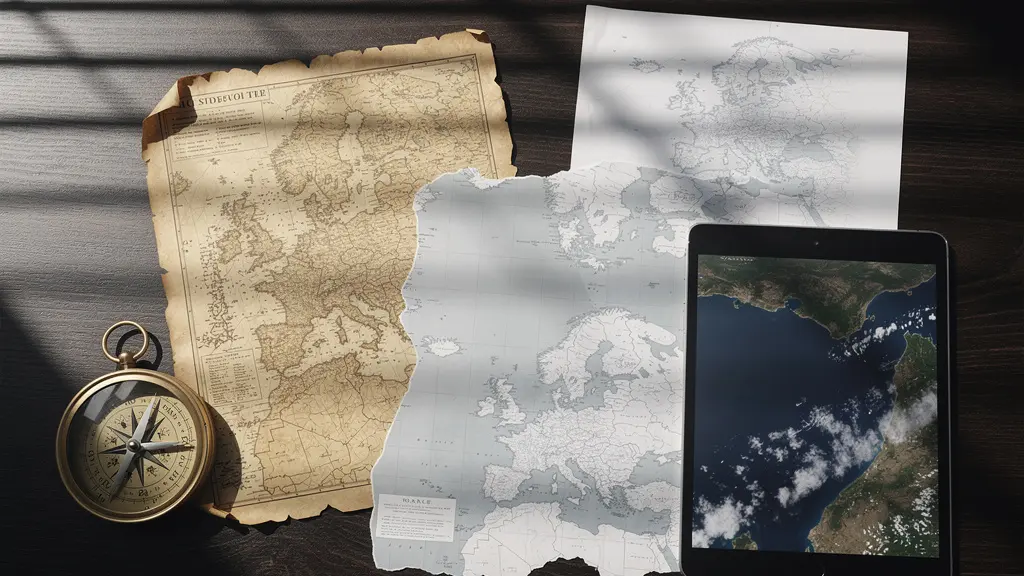
The key to understanding modern geopolitical conflicts is not memorizing historical facts, but mastering the critical tools to see how the past is used—and misused—to frame the present.
- Debunk the myth that “history repeats itself” and instead learn to identify the more subtle and complex patterns, or “rhymes,” of history.
- Develop the skills to rapidly verify viral historical explanations and recognize common biases like “presentism” that distort our judgment.
Recommendation: Begin applying this analytical toolkit to your daily news consumption to see beyond simplistic headlines and understand the deep-rooted causes of global tensions.
In an age of constant information, understanding the world’s complex geopolitical landscape can feel overwhelming. Every new crisis, from border disputes to trade wars, is immediately flooded with explanations, hot takes, and historical justifications. News consumers and students are often caught in a crossfire of competing narratives, each claiming to hold the definitive answer to “why” an event is happening. The common advice is to “look at the history,” but this is often where the confusion deepens, not resolves.
Many fall back on familiar platitudes: that “history repeats itself,” or that simply looking at old colonial maps will unlock all secrets. While there is a kernel of truth in these approaches, they are dangerously incomplete. They often lead to simplistic, deterministic conclusions that ignore the agency of current actors and the unique technological and social contexts of our time. These shortcuts fail to equip us with the most crucial skill: the ability to critically analyze the *use* of history itself as a political tool.
This guide breaks from that simplistic mold. Instead of providing a list of historical events to memorize, it offers a historian’s analytical toolkit. The central argument is that true understanding comes not from knowing *what* happened, but from mastering the method of *how* to think about the past in relation to the present. It’s about learning to deconstruct historical claims, identify manipulative narratives, and appreciate the profound difference between a past that is dead and a past that is not even past.
This article will equip you with a set of practical frameworks and mental models. We will explore how to stress-test historical analogies, verify sources in minutes, understand the biases that cloud our judgment, and recognize how data and maps can be designed to lie. By the end, you will have the tools to move beyond being a passive consumer of historical narratives and become a discerning analyst of the world around you.
Summary: A Guide to Interpreting Geopolitics with Historical Context
- Why is the phrase “history repeats itself” a dangerous oversimplification of current events?
- How to verify the historical accuracy of a viral news explanation in 5 minutes?
- Colonial maps or ethnic divisions: Which factor explains current regional instability better?
- The “Presentism” bias that makes us misjudge the motivations of historical figures
- How to trace the 3 key decisions from 50 years ago that caused today’s crisis?
- Why legal ownership is not the same as moral ownership in the eyes of the public?
- The “P-hacking” trap that leads companies to make bad decisions based on a faulty studies
- How to Design Data Visualizations That Tell the Truth Without Distorting Facts?
Why is the phrase “history repeats itself” a dangerous oversimplification of current events?
The most common and most misleading cliché in historical analysis is that “history repeats itself.” This idea suggests a cyclical, almost mechanical, view of the past, where events are doomed to recur in the same fashion. This is not only wrong; it is a dangerous oversimplification. It encourages lazy thinking, leading analysts and the public to draw false equivalences between vastly different situations. It flattens the complexities of context, technology, and ideology that make each historical moment unique. A far more useful and accurate concept comes from Mark Twain.
Twain’s observation was that “History never repeats itself, but it does often rhyme.” As one analysis of his work explains, he saw history not as a loop, but as a kaleidoscope. The same broken fragments of human nature—ambition, fear, greed, and altruism—are always present, but they combine into new, unprecedented patterns with every turn. The context of the 1874 work *The Gilded Age* clarifies this idea with vivid imagery, suggesting that the “pictured present often seem to be constructed out of the broken fragments of antique legends.” According to the research of a quote investigator, this metaphor perfectly captures the analytical challenge: we must learn to recognize the “rhyming” patterns without being fooled into thinking we are seeing an exact repetition.

Thinking in terms of “rhymes” instead of “repeats” forces a more rigorous analysis. It compels us to ask more precise questions: What are the genuine similarities in motivation or structure between a past event and a current one? More importantly, what are the fundamental differences in technology, international norms, and communication that make the present situation entirely new? For example, while the rhetoric of nationalism may “rhyme” across centuries, the existence of social media and nuclear weapons makes its modern expression a fundamentally different phenomenon. Escaping the “repetition” trap is the first step toward mature historical interpretation.
How to verify the historical accuracy of a viral news explanation in 5 minutes?
In the digital age, historical “facts” spread at the speed of a share. A single, compelling infographic or a viral thread can shape public understanding of a conflict’s origins, often based on simplified or outright false information. To avoid being misled, it’s crucial to have a rapid verification method. This process begins with understanding the different tiers of historical sources, as not all information is created equal. A claim’s reliability depends entirely on whether it comes from a primary, secondary, or tertiary source.
This hierarchy of evidence is the bedrock of historical practice. The table below breaks down these categories, highlighting their distinct characteristics and reliability levels. Internalizing this framework is the first step in sorting credible analysis from populist propaganda.
| Source Type | Characteristics | Reliability Level | Verification Speed |
|---|---|---|---|
| Primary Source | Original documents, eyewitness accounts, artifacts from the period | Highest (direct evidence) | Slow (requires context) |
| Secondary Source | Scholarly analysis, peer-reviewed interpretations, academic books | High (expert interpretation) | Medium (check credentials) |
| Tertiary Source | Media reports, social media posts, popularized summaries | Variable (often simplified) | Fast (but misleading) |
With this framework in mind, you can apply a quick, five-minute method to stress-test any viral historical claim. This isn’t about becoming an expert in an hour, but about quickly determining whether a narrative is built on a solid foundation or on sand. It’s a form of intellectual triage for the information age.
- Minute 1: Trace the Claim. Identify if the viral post is referencing a primary source (e.g., a treaty text), a secondary source (a historian’s book), or is itself a tertiary source (a media summary). This immediately tells you the level of interpretation you’re dealing with.
- Minute 2: Use Specific Search Operators. Go beyond a simple search. Use queries like “[claim] primary source” or “[historical figure] original letter” to hunt for the foundational evidence.
- Minute 3: Find the Counter-Narrative. Actively seek out opposing views. Search for “Why [theory] is wrong” or “Alternative explanation for [event].” The existence of a robust, scholarly counter-argument is a major red flag against a simplistic viral claim.
- Minute 4: Check Google Scholar Abstracts. You don’t need full access. Searching an “expert’s” name on Google Scholar and reading the abstracts of their papers reveals if they are a recognized figure in the academic debate or a fringe voice.
- Minute 5: Compare Evidence Quality. Based on the previous steps, assess which side of the argument relies more on primary and peer-reviewed secondary sources versus tertiary reports and unsourced assertions.
Colonial maps or ethnic divisions: Which factor explains current regional instability better?
When analyzing post-colonial conflict, particularly in Africa, a fierce debate often emerges: what is the primary driver of instability? One camp points to the arbitrary nature of colonial maps, lines drawn on a map in Berlin that ignored realities on the ground. The other camp argues that pre-existing ethnic rivalries are the true cause, and that colonialism merely put a temporary lid on them. The truth, as is often the case, is not a simple “either/or.” The instability is a product of the disastrous interaction between these two factors, often weaponized by a third: the pursuit of resources.
The “hardware” of the colonial state, with its rigid borders, was installed on top of the complex “software” of ethnic homelands and identities. This mismatch created immense friction. As research from the American Economic Review shows, partitioned ethnic homelands experience 57% more political violence incidents. These artificial boundaries split cohesive groups and forced historical rivals into single states, creating a permanent source of tension. The state structure itself, inherited from colonial powers, was often seen as illegitimate, an external imposition rather than an organic expression of the nation.

However, this structural problem was made far worse by deliberate colonial policies and the geography of resources. European powers often employed “divide and rule” tactics, actively instigating conflicts among local peoples to maintain control. Furthermore, a critical analysis reveals that many of these arbitrary borders were drawn with a keen eye for resource extraction. As one report highlights, “many borders intersect resource-rich areas such as oil in Sudan and South Sudan or minerals in the DRC, further fueling disputes.” The colonial map, therefore, was not just ignorant; it was a tool designed to facilitate control and extraction, embedding conflict over resources directly into the political DNA of the new states.
The “Presentism” bias that makes us misjudge the motivations of historical figures
One of the most subtle and pervasive errors in historical interpretation is “presentism”: the tendency to interpret past events and judge historical figures through the lens of modern-day values, knowledge, and perspectives. We see historical actors making choices that seem illogical or immoral to us, and we condemn them without first understanding the world in which they operated. This bias prevents us from grasping their true motivations and the constraints they faced, leading to a distorted, self-righteous, and ultimately unhelpful understanding of the past.
Overcoming presentism requires a conscious act of what historians call “historical empathy.” This is not about excusing or condoning past actions, but about making a disciplined effort to understand the past on its own terms. As a core principle, it is a vital tool for any serious analysis. This is why scholars emphasize its importance.
Presentism challenges historians because it risks oversimplifying history as a sequence of inevitable outcomes, potentially undermining individual agency and justifying past injustices. Scholars recognize that while complete objectivity may be unattainable, being aware of presentist biases is crucial for responsible historical analysis.
– EBSCO Research, Presentism and Cultural Bias – Research Starters
To combat this bias, it’s not enough to simply be aware of it. We need a practical tool to force our minds out of the present and into the past. The “Historical Empathy Canvas” is a structured exercise designed to do just that. By systematically mapping out a historical figure’s world, we can begin to see their choices as they likely saw them, constrained by the information and norms of their time.
Your Action Plan: The Historical Empathy Canvas
- Information Available: List what the historical figure knew based on their era’s prevailing science, social norms, available texts, and communication methods.
- Information Unavailable: List modern concepts they couldn’t possibly have known (e.g., germ theory, human rights frameworks, climate science, DNA).
- Decision Context: Map the immediate pressures, threats, and opportunities as they would have understood them in their time.
- Alternative Choices: Identify what realistic options existed for them given their knowledge constraints and the political realities of their day.
- Modern Misreading: Note how applying present-day values and knowledge creates a false or misleading interpretation of their actions.
How to trace the 3 key decisions from 50 years ago that caused today’s crisis?
Modern geopolitical crises rarely emerge from nowhere. They are often the culmination of decades-long processes, shaped by a few critical decisions made in the past. Understanding a current conflict, therefore, requires a form of “narrative forensics”: working backward from the present to identify the key turning points, or “bifurcation points,” where history could have gone in a different direction. This is the concept of path dependency, where early, sometimes arbitrary, “design choices” lock a system into a particular trajectory, making future changes difficult or impossible.
The “Scramble for Africa” provides a classic, large-scale example of this process. The decisions made at the Berlin Conference of 1884–1885 created borders with little regard for local realities. These initial, arbitrary decisions set in motion a path of political development for the entire continent from which it has been difficult to escape. As one analysis notes, these “colonial legacies remain a critical factor in Africa’s political tensions” over 140 years later. This demonstrates how initial choices create institutions and structures that constrain possibilities for generations.
Identifying these critical junctures in a more recent crisis requires a systematic approach. The “Bifurcation Point Analysis” method helps historians and analysts pinpoint the moments that mattered most. It moves beyond a simple chronological narrative to a more dynamic analysis of cause, effect, and contingency.
- Work Backwards: Start from the current crisis and trace the chain of events backward, identifying major turning points (e.g., a coup, a treaty, a major economic policy change).
- Ask “What If?”: For each turning point, ask “What credible alternative existed at this moment?” This helps distinguish inevitable trends from genuine moments of choice.
- Find the Point of No Return: Identify the specific moment when the current outcome became nearly inevitable. This is the key bifurcation point.
- Analyze Early ‘Design Choices’: Look at foundational decisions made early in a nation’s history, such as its legal system, constitutional framework, or major infrastructure projects, which locked in a certain trajectory.
- Apply ‘Negative Space’ Analysis: Crucially, identify the critical decisions that were *not* made—the treaties not signed, the reforms not passed, the warnings not heeded. Often, inaction is the most consequential decision of all.
Why legal ownership is not the same as moral ownership in the eyes of the public?
In many geopolitical disputes, particularly those concerning land and sovereignty, a fundamental conflict arises between two different concepts of ownership: legal and moral. Legal ownership is based on treaties, deeds, and internationally recognized laws. It is the world of official documents and court rulings. Moral ownership, however, is rooted in collective memory, cultural identity, shared narratives, and a sense of belonging that may long predate any legal framework. In the court of public opinion, and often in the hearts of the people involved, moral ownership frequently trumps legal paperwork.
This disconnect is a primary source of intractable conflicts. A state may hold a legally unassailable title to a territory, yet the population living there, or a neighboring group, may feel a profound and legitimate sense of moral ownership based on ancestral ties or historical grievances. Analysis using Murdock’s ethnolinguistic maps shows that 28% of all ethnic groups in Africa saw their ancestral homelands divided by colonial partitions. While the resulting new states are legally sovereign, this statistic represents a massive and ongoing crisis of moral legitimacy for those borders. The following table breaks down the core distinctions between these two powerful concepts.
| Aspect | Legal Ownership | Moral Ownership | Public Perception Impact |
|---|---|---|---|
| Foundation | Treaties, deeds, international law | Collective memory, identity, belonging | Emotional resonance trumps legal documents |
| Authority Source | Official history, state archives | Oral traditions, shared narratives | Stories matter more than statutes |
| Dispute Examples | Colonial-era borders legally recognized | Pre-colonial territories remembered | Legitimacy crisis for modern states |
| Resolution Method | Courts, arbitration, treaties | Truth commissions, acknowledgment | Legal wins without moral recognition fail |
Understanding this distinction is critical for any analyst. Simply insisting on the “legality” of a situation while ignoring the powerful claims of moral ownership is a recipe for failure. It explains why some conflicts fester for generations, as legal solutions are imposed without addressing the underlying sense of injustice. Effective diplomacy and conflict resolution often require engaging with both registers: upholding international law while simultaneously finding ways to acknowledge and honor the narratives of moral ownership through gestures, commissions, or other forms of recognition.
The “History-Hacking” trap that leads companies to make bad decisions based on faulty studies
In data science, “p-hacking” refers to the practice of manipulating data or statistical analyses until a desired, statistically significant result (a “p-value”) is found. This creates the illusion of a meaningful discovery from what is often just random noise. An equivalent and equally dangerous practice exists in historical analysis, which we can call “History-Hacking.” It is the selective and manipulative use of historical data to support a predetermined contemporary political or ideological narrative. It starts with a conclusion and works backward, cherry-picking facts, ignoring contradictory evidence, and framing events in a misleading way to “prove” a point.
This is not genuine historical inquiry; it is propaganda dressed in academic clothing. It is one of the most common forms of historical malpractice found in public discourse, and it can be incredibly persuasive to the untrained eye. For instance, critiques of works like the 1619 Project or the film *The Woman King* often center on accusations of this practice. According to some critics, these projects create a “zero-sum game of heroes and villains viewed through the prism of contemporary racial identity,” which demonstrates how selective historical framing can serve a present agenda. Regardless of one’s stance on these specific works, they serve as prominent examples of how historical interpretation has become a modern battleground.
Recognizing History-Hacking in action is a crucial skill for any news consumer. It requires a skeptical mindset and a checklist of questions to ask when confronted with a neat, compelling historical narrative that perfectly aligns with a current political cause.
- Is the time frame suspicious? Is the analysis cherry-picking a very narrow or specific period that just happens to support its claim, while ignoring the decades before or after?
- Are contradictory events minimized? Does the narrative conveniently ignore major events or facts from the same period that would complicate or undermine its conclusion?
- Are contexts being falsely compared? Is the argument comparing two historical situations (e.g., empires, revolutions) without acknowledging fundamental differences in technology, ideology, or power dynamics?
- Does it start with a conclusion? Does the analysis feel like an investigation searching for truth, or a prosecution building a case for a verdict it has already decided on?
- Are outliers presented as patterns? Is a single, dramatic event or quote being used to represent a widespread phenomenon when it was actually an exception to the rule?
Key Takeaways
- True historical analysis is not about knowing that “history repeats itself,” but understanding how it “rhymes”—recognizing patterns without assuming identical outcomes.
- Develop a critical toolkit: learn to distinguish primary from tertiary sources, detect “presentism” bias, and spot “History-Hacking” where facts are cherry-picked to fit a narrative.
- Geopolitical conflicts are rarely caused by a single factor; they result from a complex interaction of structural legacies (like colonial maps), identity politics, and competition for resources.
How to Design Data Visualizations That Tell the Truth Without Distorting Facts?
In our visual culture, maps and charts are not just illustrations; they are powerful arguments. A single data visualization can convey a sense of objectivity and authority that is far more persuasive than text alone. However, this power can be easily abused. The design choices behind every map and chart—from the projection and colors to the scale and what data is included or excluded—are inherently political. They can be engineered to tell a specific story, and sometimes, to lie, all while maintaining a veneer of scientific neutrality.
The most classic example is the choice of map projection. There is no way to represent the 3D surface of the globe on a 2D map without distortion. Every projection must choose what to preserve (e.g., shape, area, distance) and what to sacrifice. This choice is never neutral. The Mercator projection, long standard in Western classrooms and media, massively inflates the size of regions in the northern hemisphere (like Europe and North America) while shrinking areas near the equator (like Africa). This has the political effect of visually centering and enlarging the global north, reinforcing a colonial-era worldview. Understanding these implications is crucial for reading maps critically.
| Projection Type | Visual Effect | Political Message | Common Usage |
|---|---|---|---|
| Mercator | Inflates size of northern regions | Emphasizes global north importance | Navigation, Western media |
| Peters/Gall-Peters | Accurate area representation | Challenges Western centrism | Development organizations |
| Robinson | Balanced compromise | Attempts neutrality | Educational materials |
| Choropleth vs Cartogram | Area vs population emphasis | Land vs people importance | Election maps, demographics |
The challenge of honest data visualization in geopolitics extends beyond map projections. It demands an ethical framework to guide the presentation of complex and contested information. This is where the foundational principles of information design become paramount. The goal should be clarity and intellectual honesty, not simplistic persuasion.
Edward Tufte’s principle of maximizing ‘data-ink ratio’ and avoiding ‘chartjunk’ becomes crucial when visualizing historical conflicts – the goal is representing uncertainty and competing claims on a single map rather than presenting a deceptively simple ‘truth’.
– Edward Tufte, Visual Display of Quantitative Information principles applied to geopolitics
This principle urges us to create visualizations that are clean, dense with information, and respectful of the reader’s intelligence. For geopolitical conflicts, this means creating maps that show overlapping claims, disputed zones, and demographic complexities, rather than clean, hard lines that present a false sense of certainty. It means choosing neutrality and completeness over a simple, but misleading, narrative. As a consumer of information, your role is to question every visualization: What is this map or chart *not* showing me?
By internalizing these frameworks—from debunking myths and verifying sources to understanding bias and deconstructing visuals—you are no longer a passive observer. You are equipped with the historian’s analytical toolkit, ready to engage with the world’s complexities with newfound clarity and confidence. Start applying this critical lens to the news you consume today, and you will begin to see the deeper currents of history that shape our world.