Visual arts
Visual arts encompass a vast spectrum of creative practices where artists communicate ideas, emotions, and observations through tangible, primarily visual mediums. From the careful layering of oil paint on canvas to the spontaneous gestures of urban sketching, from traditional sculptural methods to AI-assisted digital workflows, the field continues to evolve while maintaining its connection to fundamental principles of composition, color, and form. Whether you’re drawn to representational work that captures the world around you or abstract expression that gives form to inner experiences, understanding the full landscape of visual arts empowers you to make informed creative and professional decisions.
This comprehensive exploration addresses the technical mastery, material knowledge, market dynamics, and contemporary challenges that define visual arts practice today. You’ll discover how traditional disciplines intersect with digital innovation, why material science matters for longevity, what drives value in the art market, and how to navigate the practical realities of a professional creative career. These interconnected topics form the foundation for both emerging artists building their practice and enthusiasts seeking deeper appreciation of the medium.
Foundational Disciplines: Painting, Drawing, and Sculpture
The traditional pillars of visual arts—painting, drawing, and sculpture—each demand specific technical knowledge and material understanding. Mastery in these areas builds from consistent practice combined with awareness of how materials behave, deteriorate, and can be preserved.
Oil Painting and Surface Treatment
Oil painting remains one of the most versatile yet technically demanding visual arts mediums. A critical aspect often overlooked by developing artists is the phenomenon of “sinking in,” where paint loses its initial vibrancy as the oil binder is absorbed by underlying layers or the ground. This occurs when previous layers are too absorbent or when insufficient medium is present in your paint mixture.
Proper varnishing addresses this issue while providing long-term protection. The timing of varnish application is crucial—applying it too early traps solvents and moisture within paint layers, potentially causing bloom (a cloudy, whitish haze) or future cracking. Most conservators recommend waiting six to twelve months for thin applications, longer for impasto work. The choice between damar, synthetic, and removable varnishes affects not only the final appearance but also future conservation options. Consider your work’s intended lifespan and display environment when selecting protective coatings.
Drawing and Sketching Practices
Urban sketching represents a dynamic approach to drawing that emphasizes spontaneity and direct observation. Working on location presents unique challenges: changing light conditions, moving subjects, weather variables, and public interaction. Successful location work requires a streamlined portable kit containing only essential materials—typically a compact sketchbook, limited color palette, water container, and versatile brushes or pens.
The skill lies not in rendering every detail but in capturing the essential character of a scene within a limited timeframe. Simplifying complex architectural perspective becomes intuitive with practice: focus on key vanishing points, use your pencil as a measuring tool held at arm’s length, and remember that suggested detail often reads more effectively than labored accuracy. Most public spaces permit sketching, though private property and certain government buildings may have restrictions worth understanding before you settle in.
Sculpture and Material Safety
Sculpture involves some of the most significant health considerations in visual arts practice. Silica dust from stone carving poses a microscopic danger that accumulates in lung tissue over time, potentially leading to silicosis—a serious, irreversible respiratory condition. Professional sculptors working with stone, concrete, or ceramic materials must implement comprehensive safety protocols.
Wet carving techniques dramatically reduce airborne particulates by keeping material damp during the working process. However, respiratory protection remains essential. Choose a properly fitted respirator rated for fine particulates (N95 minimum, P100 preferred for professional use), not simple dust masks. Studio ventilation systems should create negative pressure, drawing contaminated air away from your breathing zone and filtering it before exhaust. Regular pulmonary function testing allows early detection of capacity changes, enabling intervention before permanent damage occurs. These precautions aren’t optional for sustainable, long-term practice.
Expressive Approaches: Abstract Art and Emotional Communication
Abstract art offers a powerful language for expressing experiences that resist verbal articulation. The freedom from representational accuracy can feel liberating yet intimidating, particularly when transitioning from realistic work. Many artists struggle with what one might call the “fear of the ugly outcome”—the anxiety that without recognizable subject matter, the work will lack validity or meaning.
Breaking reliance on representational forms begins with shifting your focus from depicting objects to exploring relationships between visual elements. Color selection based on emotional resonance rather than optical accuracy opens new expressive possibilities. Consider how warm oranges and reds convey energy or agitation, while cool blues and greens suggest calm or melancholy. The physical act of mark-making matters as much as the tools you choose—a palette knife dragged across canvas creates entirely different emotional texture than a soft brush, and gestural movements involving your whole body generate different energy than controlled wrist motions.
The transition from initial chaos to intentional composition requires periodic assessment. Step back regularly, photograph your work-in-progress, or view it in a mirror to gain fresh perspective. Abstract work succeeds when visual elements achieve balance—not necessarily symmetrical balance, but a distribution of weight, contrast, and focal points that guides the viewer’s eye and creates coherent emotional impact.
The Digital Transformation of Visual Arts
Digital technologies have fundamentally altered creative workflows, market access, and even the definition of artistic authorship. Understanding these tools and their implications has become essential for contemporary practice.
AI Tools and Creative Workflows
Artificial intelligence has emerged as one of the most debated developments in recent visual arts history. The common myth that AI will entirely replace human creativity misunderstands both the technology’s current capabilities and the nature of artistic practice. AI tools excel at pattern recognition, style synthesis, and rapid iteration—capabilities that can enhance rather than eliminate human creative decision-making.
Many concept artists have integrated AI into their workflows as an ideation accelerator, using generated images as reference material or composition starting points that they then develop through traditional digital painting. This approach treats AI as another tool in the creative arsenal, similar to how photography transformed but didn’t eliminate observational painting. The critical questions involve copyright considerations when using generative art commercially, attribution practices, and maintaining the distinctive creative voice that distinguishes your work from algorithm-generated output.
Digital Platforms and Portfolio Development
The subscription economy has transformed access to professional digital art software. Major platforms now operate on recurring payment models, with costs varying significantly. Adobe Creative Cloud, Clip Studio Paint, Procreate (one-time purchase), and Corel Painter each offer different pricing structures and feature sets. For emerging artists, the cumulative annual cost of multiple subscriptions can represent a substantial investment—calculate total yearly expense rather than being swayed by seemingly small monthly fees.
Your digital portfolio serves as primary professional representation in current market conditions. Optimization requires understanding how different audiences access your work: recruiters typically spend under thirty seconds on initial portfolio review, gallery directors look for coherent artistic vision, and collectors seek evidence of technical competency and unique perspective. Structure your online presentation with your strongest, most representative work immediately visible, maintain consistent presentation quality, and regularly update to reflect your current capabilities rather than displaying comprehensive historical output.
Material Science and Conservation
The longevity of artwork depends heavily on understanding material compatibility and archival stability. Mixed media work presents particular challenges because combining materials with different chemical compositions, expansion rates, and aging characteristics can lead to deterioration over time.
The traditional fat-over-lean principle in oil painting—applying layers with progressively higher oil content—prevents cracking as paint cures. This same concept of compatible layering applies to mixed media: faster-drying materials should generally be applied over slower-drying bases, flexible materials over more rigid supports. Adhering heavy three-dimensional objects to canvas requires accounting for the substrate’s movement and flexibility. Rigid adhesives will eventually crack and fail; flexible archival adhesives or mechanical attachment methods prove more durable.
Acidic materials like newspaper, cardboard, or certain natural fibers will yellow and become brittle unless properly sealed from both atmospheric exposure and contact with other artwork layers. Archival barrier papers, deacidification sprays, or encapsulation techniques prevent acid migration. Before committing to any innovative material combination, create test samples and observe them over several months under various conditions. This simple practice prevents discovering incompatibility after investing significant time in a finished work.
Navigating the Visual Arts Market
The art market operates on complex dynamics that blend aesthetic judgment, social capital, historical context, and economic speculation. Whether you’re an artist building a career or a collector making acquisition decisions, understanding these mechanisms provides strategic advantage.
Understanding Artist Valuation
An artist’s market value derives from multiple intersecting factors: exhibition history, critical reception, institutional collection inclusion, secondary market performance, scarcity of available work, and cultural zeitgeist alignment. For emerging artists, early career valuation often reflects gallery positioning and initial collector enthusiasm rather than established market data.
Evaluating emerging artists before significant market recognition requires looking beyond current prices to underlying indicators: consistent artistic development showing clear vision evolution, growing institutional attention through group exhibitions or residencies, critical writing in respected publications, and studio practice sustainability. Many collectors who acquire work from emerging artists at accessible price points do so based on personal aesthetic connection rather than investment strategy, though both motivations can coexist.
Acquisition Strategies and Authentication
Choosing between gallery purchases and auction houses involves understanding their different value propositions. Galleries typically offer primary market access to living artists, authentication guarantee, sometimes advisory services, and relationship building with artists themselves. Auction houses provide secondary market access to sold-out editions or works by deceased artists, public price discovery, and competitive bidding that can benefit buyers when interest is limited or harm them when competition escalates.
Authentication and provenance represent critical due diligence for any significant acquisition. Provenance—documented ownership history—establishes legal right to sell and can dramatically affect value. Common pitfalls include accepting incomplete documentation, overlooking gaps in ownership timeline, and trusting verbal assurances without written verification. For works by established artists, consult catalogue raisonné databases, artist foundations, or recognized authentication committees before purchase. The cost of expert authentication is modest compared to the financial and legal consequences of acquiring misattributed or fraudulent work.
Professional Practice and Logistics
The practical business aspects of visual arts practice—shipping, insurance, documentation—receive less attention than creative technique but prove equally essential for sustainable careers. Large-scale paintings present particular logistical challenges when shipping to exhibitions, galleries, or collectors.
Professional shipping requires proper crating that protects both the structural support and paint surface. Custom crates for valuable work include floating mounts that suspend the piece away from crate walls, corner protection, and moisture barriers. Glazed work needs face protection; unglazed canvases benefit from glassine paper preventing surface abrasion. Courier service selection involves balancing cost against insurance limits, tracking capabilities, climate control during transit, and white-glove handling options.
Insurance should reflect full replacement value rather than creation cost—established artists’ work often sells for multiples of material and time investment. Specialized art insurance policies offer broader coverage than standard shipping insurance, including damage during installation, in-transit climate events, and mysterious disappearance. International shipping adds customs documentation requirements: detailed accurate descriptions, declared values, and sometimes certificates of origin or cultural property export permits. Errors or omissions in customs paperwork can result in shipment delays, unexpected fees, or seizure of work.
Understanding visual arts as both creative practice and professional discipline positions you to navigate its challenges while maintaining artistic integrity. The field rewards technical competency, material knowledge, market awareness, and consistent creative development. Whether your focus is personal expression, professional career building, or informed collecting, these interconnected aspects form the foundation for meaningful engagement with one of humanity’s oldest and most dynamic forms of communication.

How to Sketch Urban Landscapes Quickly Before the Light Changes?
The secret to fast urban sketching isn’t a faster hand; it’s a smarter eye trained in ‘visual triage’. Prioritize capturing the scene’s light, energy, and story over photorealistic accuracy. Use tactical shortcuts for perspective and choose your medium based on…
Read more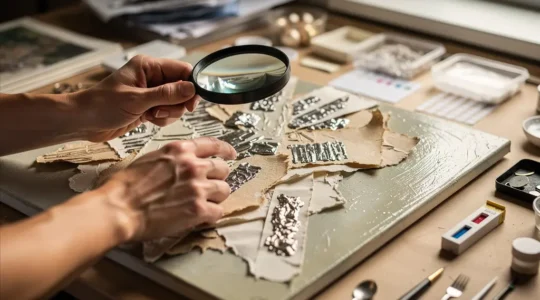
Preventing Chemical Reactions: The Material Science of Archival Mixed Media Art
The long-term survival of your mixed media art depends not on artistic intuition, but on understanding and preventing chemical warfare between your materials. Most failures, like cracking and delamination, result from predictable physical and chemical incompatibilities, such as different drying…
Read more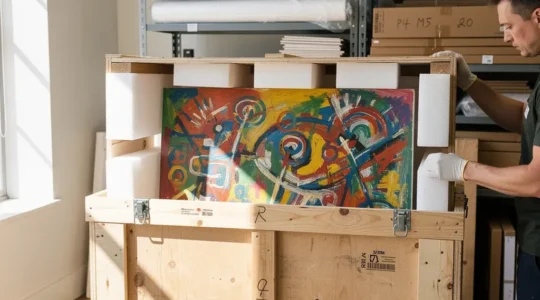
How to Ship a Large Acrylic Canvas Internationally: The Professional’s Guide to Avoiding Damage and Hidden Costs
In summary: Protect the canvas surface with a layer of acid-free glassine paper before any other wrapping to prevent permanent marks. Understand that a carrier’s “declared value” is not insurance; secure a separate, all-risk fine art insurance policy for real…
Read more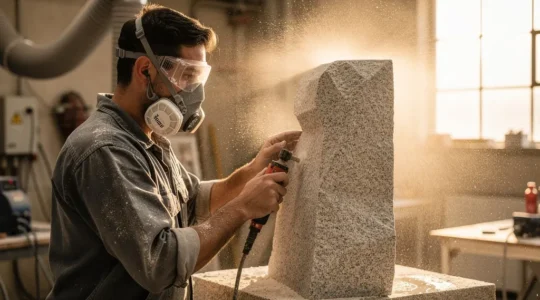
How to Protect Your Lungs from Silicosis When Carving Stone Daily
Chronic silicosis is an irreversible and fatal lung disease caused by invisible dust, but it is 100% preventable through rigorous, science-backed safety protocols. Wet carving methods and local exhaust ventilation are non-negotiable primary defenses that capture dust at its source….
Read more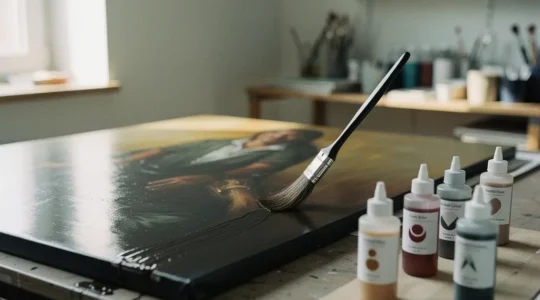
Why Varnish Clouds on Dark Oil Colors: A Conservator’s Chemical Breakdown
Cloudy varnish on dark paint is a predictable chemical failure, not bad luck, caused by microscopic surface and atmospheric imbalances. The “sinking in” of oil into dark, porous pigments creates an uneven surface that scatters light, appearing as matte, dull…
Read more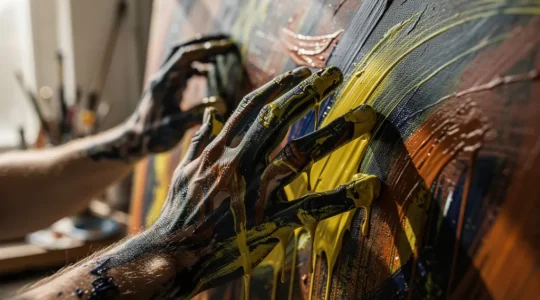
How to Use Abstract Painting to Express Emotions That Words Cannot Capture?
Expressing deep emotion through abstract art isn’t about finding the ‘right’ color for sadness; it’s about engaging in a physical dialogue that bypasses the critical mind entirely. Perfectionism is the primary block; the goal is cathartic release, not a flawless…
Read more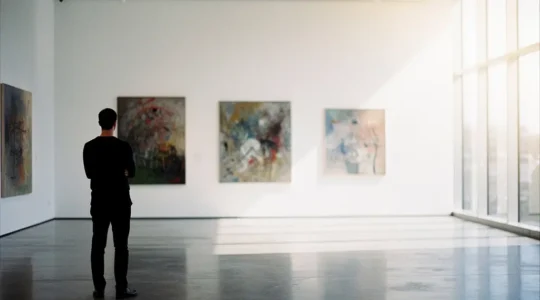
How to Start Collecting Contemporary Art with a Budget of $5,000?
In summary: Approach your first $5,000 art purchase with the mindset of a venture capitalist, focusing on rigorous due diligence rather than just personal taste. Identify high-potential artists at graduate shows by looking for material innovation and a cohesive body…
Read more
Will AI Art Tools Replace Traditional Illustrators in the Next 5 Years?
The debate isn’t about replacement, but about strategic partnership; AI’s greatest strengths in speed and iteration are also its most significant flaws in terms of originality and legal standing. Leverage AI for rapid concept exploration, not as a replacement for…
Read more